
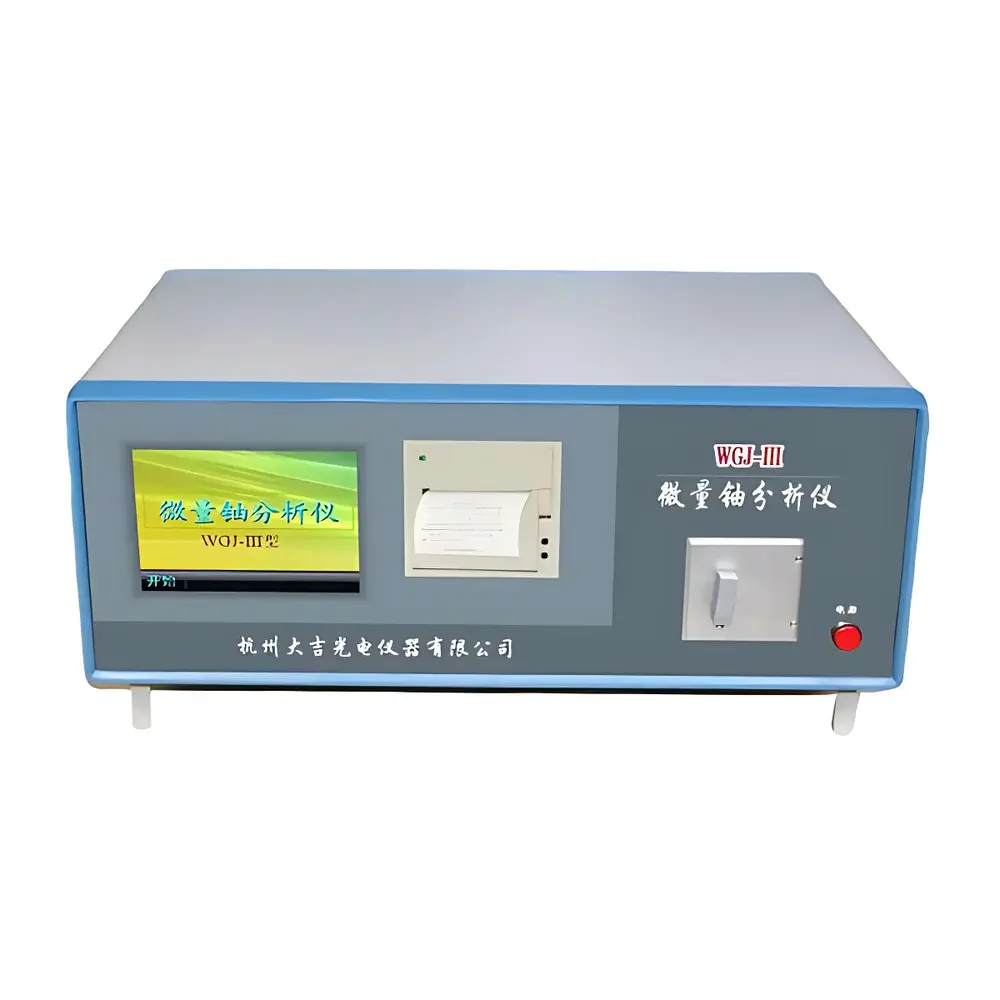
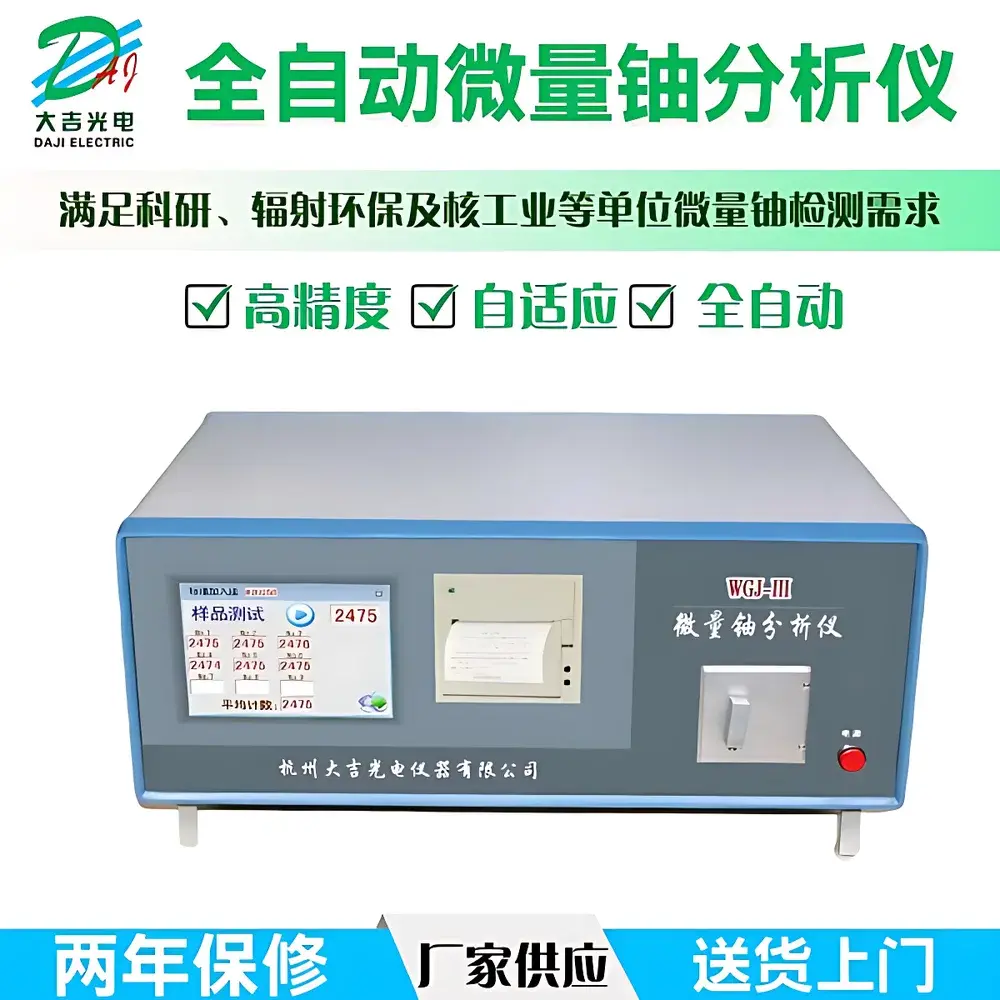
DAJ WGJ-III Laser-Induced Fluorescence Uranium Analyzer
| Brand | DAJ |
|---|---|
| Origin | Zhejiang, China |
| Manufacturer Type | Original Equipment Manufacturer (OEM) |
| Regional Classification | Domestic (PRC) |
| Model | WGJ-III |
| Pricing | Upon Request |
Overview
The DAJ WGJ-III Laser-Induced Fluorescence Uranium Analyzer is a dedicated benchtop instrument engineered for trace-level quantification of uranium in aqueous matrices. It operates on the principle of laser-induced fluorescence (LIF), wherein uranium(VI) ions—when complexed with specific fluorogenic reagents such as arsenazo III or thenoyltrifluoroacetone (TTA)—exhibit characteristic fluorescence emission upon excitation by ultraviolet light. The system employs a high-stability imported UV light source to excite the uranium–ligand complex, and a sensitive photodetector captures the resulting fluorescence intensity, which is linearly proportional to uranium concentration within the calibrated dynamic range. Designed for laboratories requiring regulatory-compliant uranium measurement without isotopic separation or radiochemical purification, the WGJ-III delivers rapid, reagent-efficient analysis directly in liquid samples—eliminating time-consuming pre-concentration or matrix removal steps typical of alpha spectrometry or ICP-MS workflows.
Key Features
- UV excitation source: Imported stable ultraviolet lamp with optimized spectral output centered near 365 nm for selective uranium(VI) complex excitation
- Integrated microprocessor control: Onboard single-chip microcontroller performs real-time signal processing, background correction, and automatic concentration calculation
- Human-centered interface: 7-inch full-color TFT LCD touchscreen with step-by-step guided operation protocol and multilingual menu support (English default)
- Dual data output: Embedded thermal printer for immediate hard-copy reporting + RS232/USB serial interface for bidirectional communication with Windows-based laboratory PCs
- Direct aqueous analysis: Capable of measuring uranium in clarified water, acid-digested environmental extracts, urine, or food leachates—solid samples require only dissolution and dilution, not extraction or enrichment
- Robust baseline stability: ≤±7% relative standard deviation (RSD) over 8-hour continuous operation at 2 ng/mL after 60-minute warm-up
- Non-volatile calibration memory: Linear calibration curves retained in EEPROM upon power-down, eliminating daily recalibration
Sample Compatibility & Compliance
The WGJ-III is validated for use with low-turbidity, low-ionic-strength aqueous solutions across diverse sample types including groundwater, soil leachates, nuclear fuel cycle effluents, biological fluids (urine, serum), and food extracts. Sample preparation follows standardized protocols outlined in GB 14883.7–2016 (Food Safety National Standard – Determination of Natural Thorium and Uranium in Foods), HJ 840–2017 (Analytical Method for Trace Uranium in Environmental Samples), and EJ/T 823–1994 (Technical Specification for Laser Fluorescence Micro-Uranium Analyzers). While not ISO/IEC 17025 accredited out-of-the-box, the instrument supports GLP-compliant documentation through timestamped printouts and exportable CSV datasets. Its measurement uncertainty profile meets QA/QC requirements for Class II environmental monitoring and routine nuclear material accountability per national regulatory frameworks.
Software & Data Management
Data acquisition and reporting are managed via embedded firmware—not external PC software—ensuring deterministic response timing and immunity to OS-level interruptions. All measurements are time-stamped, assigned unique batch IDs, and stored locally with metadata (operator ID, sample ID, dilution factor, calibration curve version). Exported datasets include raw fluorescence counts, corrected intensities, calculated concentrations, and statistical residuals. USB transfer enables integration into LIMS environments using generic serial-to-CSV conversion scripts. Audit trail functionality—while not 21 CFR Part 11 compliant by default—can be enhanced via external logging servers when deployed in regulated GMP or nuclear safety contexts.
Applications
- Environmental monitoring: Quantification of dissolved uranium in surface water, groundwater, and sediment pore water per EPA Method 908.1 analogs
- Nuclear safeguards: Rapid verification of uranium concentration in process streams during UF6 conversion or fuel fabrication
- Public health surveillance: Screening of drinking water and dietary samples for compliance with WHO provisional guideline values (30 µg/L)
- Occupational hygiene: Urinary uranium biomonitoring in uranium mining, milling, and enrichment facilities
- Geological prospecting: Field-deployable lab screening of rock leachates and borehole fluids during exploration campaigns
FAQ
What is the detection limit and how is it defined?
The method detection limit (MDL) is ≤0.02 ng/mL, determined as three times the standard deviation of ten replicate blank measurements.
Can the instrument measure uranium in solid samples directly?
No—solids must first be acid-digested (e.g., HNO3/HF microwave digestion) and diluted to fall within the 0–20 ng/mL linear range; no further separation or preconcentration is required.
Is the calibration curve retained after shutdown?
Yes—calibration parameters and polynomial coefficients are stored non-volatily and recalled automatically upon power-up.
What environmental conditions are required for optimal performance?
Ambient temperature: 10–40 °C; relative humidity: <85% at 30 °C; stable AC power supply (220 V ±10%, 50 Hz) with surge protection recommended.
Does the system comply with FDA 21 CFR Part 11?
The standalone instrument does not provide electronic signature, audit trail, or role-based access control natively; however, its data export architecture permits integration with Part 11–compliant LIMS platforms.





