
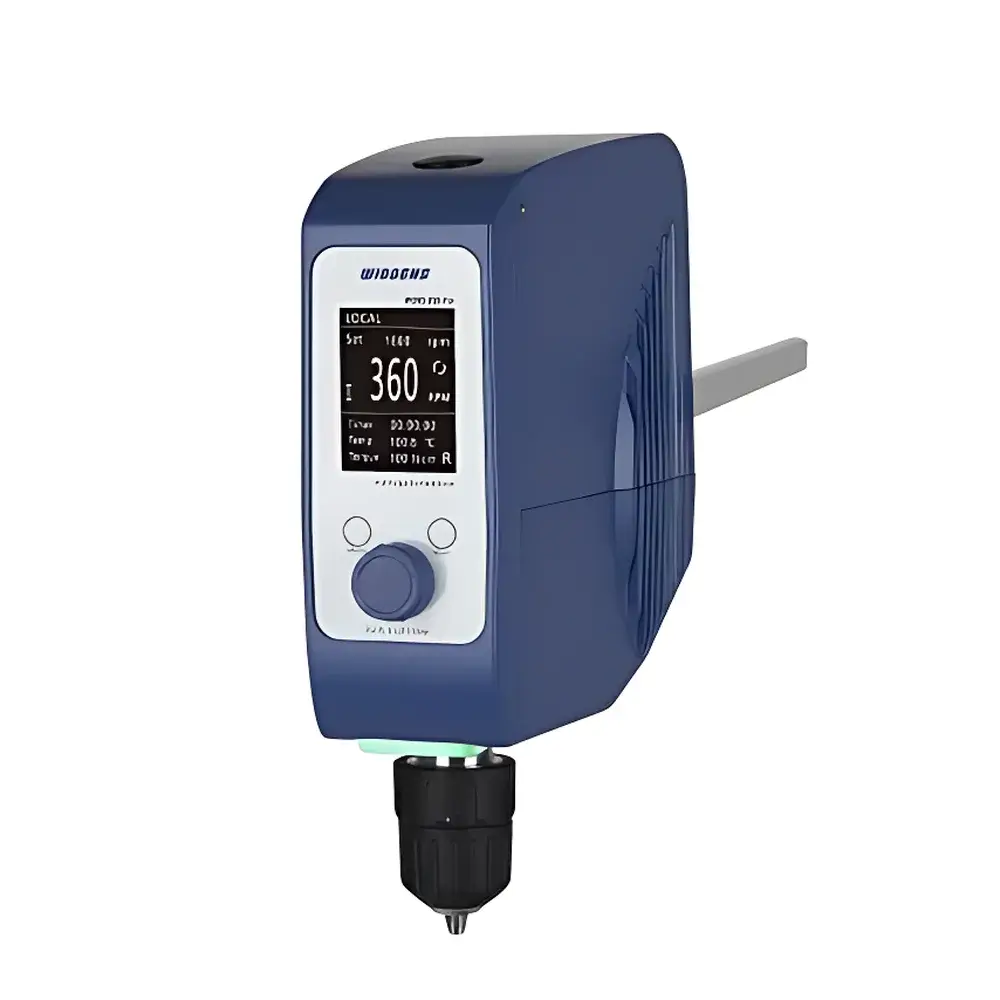
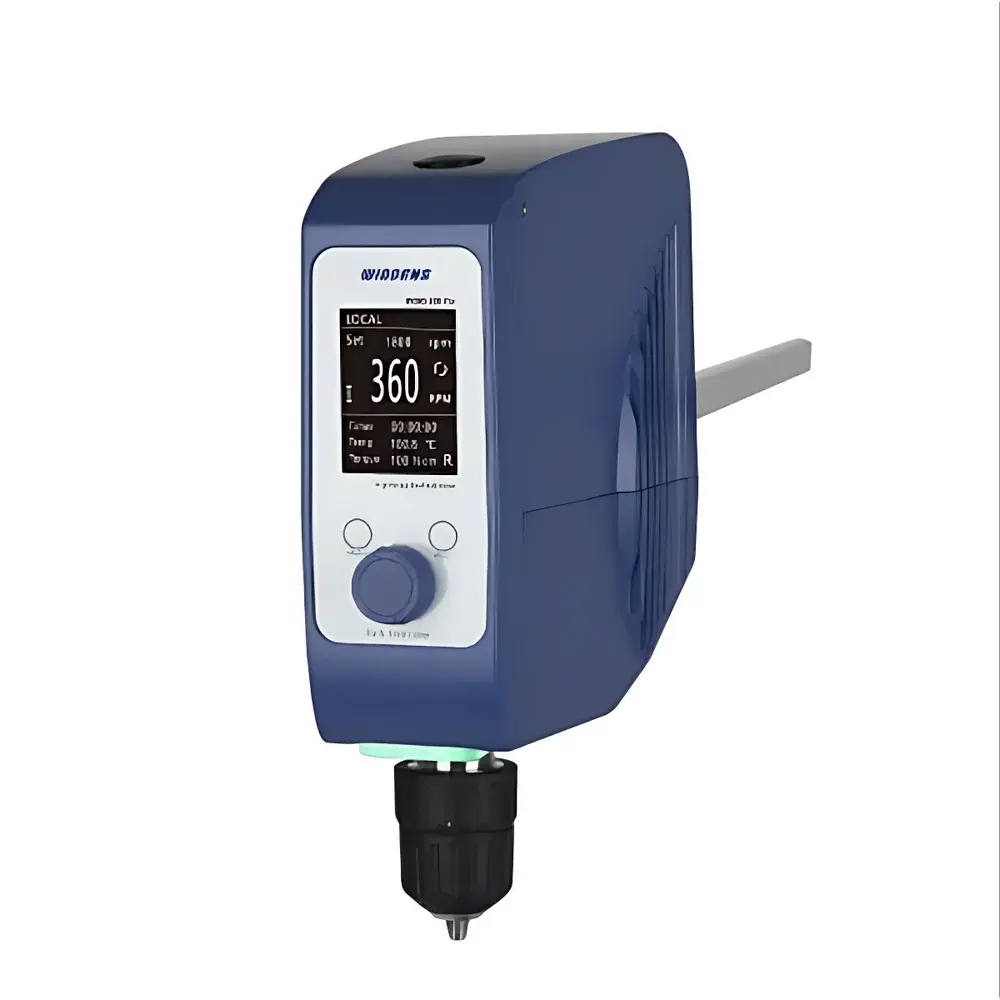
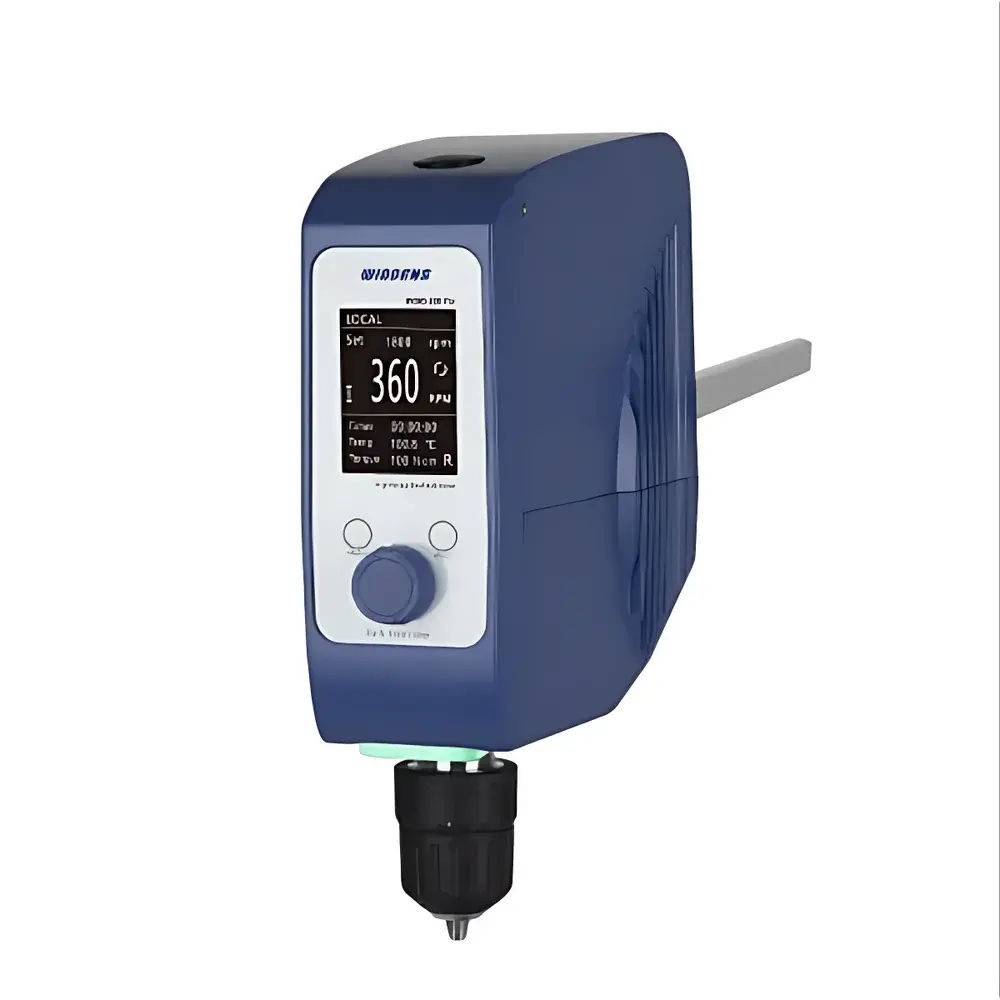
WIGGENS WOHS-200 Pro High-Speed High-Torque Laboratory Stirrer
| Brand | WIGGENS |
|---|---|
| Origin | Germany |
| Model | WOHS-200 Pro |
| Maximum Stirring Volume | 30 L (in water) |
| Speed Range | 100–20,000 rpm |
| Torque Output | up to 339 N·cm (Low-Speed Mode), 68 N·cm (High-Speed Mode) |
| Speed Control Accuracy | ±3% (at n > 300 rpm) |
| Step Resolution | ≥1 rpm |
| Motor Type | Brushless DC Motor |
| Power Input | 100–240 VAC, 50/60 Hz |
| Rated Power | 150 W |
| Chuck Type | Self-locking, tool-free collet |
| Shaft Inner Diameter | 10.2 mm (hollow shaft) |
| Clampable Shaft Diameter | 0.5–10 mm |
| Temperature Measurement Range | –10 to 350 °C |
| Temp. Resolution | 0.1 °C |
| Timer Range | 0–99 h 59 min 59 sec |
| Display | TFT touchscreen + rotary encoder interface |
| Operating Indicators | Standby (blue), Running (green), Alarm (red) |
| Max. Viscosity Handling | ≤100,000 cP |
Overview
The WIGGENS WOHS-200 Pro is a high-performance, microprocessor-controlled laboratory stirrer engineered for demanding mixing and dispersion tasks involving large-volume (up to 30 L in aqueous media) and highly viscous samples (up to 100,000 cP). Unlike conventional stirrers limited by thermal drift or mechanical wear, the WOHS-200 Pro employs a brushless DC motor architecture—eliminating carbon brushes, reducing maintenance, and enabling stable continuous operation under high-load conditions typical of polymer solutions, suspensions, emulsions, and ceramic slurries. Its dual-range speed control system (I: 30–600 rpm; II: 601–3,000 rpm) delivers torque amplification of over 5× in low-speed mode—critical for initiating motion in shear-thickening or yield-stress fluids without splashing or vortex formation. The unit operates on universal AC input (100–240 V, 50/60 Hz), making it suitable for global laboratory deployment without voltage adaptation.
Key Features
- Brushless DC motor with integrated thermal protection and dynamic load compensation—ensures consistent rotational output across extended duty cycles.
- Dual-speed range architecture: Low-speed mode (30–600 rpm) provides maximum torque (339 N·cm); high-speed mode (601–3,000 rpm) enables rapid homogenization while maintaining precision (±3% speed accuracy above 300 rpm).
- TFT graphical display with tactile rotary encoder and soft-touch keys—supports intuitive parameter entry, real-time torque trend visualization (derived from motor current feedback), and multi-stage timer programming (0–99 h 59 min 59 sec).
- Self-locking, tool-free collet chuck (0.5–10 mm clamping range) with hollow 10.2 mm internal shaft—facilitates rapid exchange of impellers, anchors, or custom agitators while accommodating temperature probes or pH electrodes.
- Integrated temperature sensing (–10 to 350 °C, 0.1 °C resolution) allows concurrent monitoring of sample thermal behavior during agitation—supporting reaction calorimetry, dissolution kinetics, or temperature-dependent viscosity profiling.
- Status LED indicators (blue = standby, green = active stirring, red = fault/alarm) provide immediate operational feedback compliant with ISO/IEC 17025 laboratory environmental monitoring expectations.
Sample Compatibility & Compliance
The WOHS-200 Pro is validated for use with glass, stainless steel, and PTFE-coated vessels ranging from 50 mL beakers to 50 L jacketed reactors. Its torque delivery and speed stability meet ASTM D1893 (Standard Test Method for Rheological Properties of Non-Newtonian Materials) requirements for controlled-shear mixing protocols. The device conforms to IEC 61000-6-3 (EMC emission standards) and IEC 61000-6-2 (immunity), and its electrical safety design complies with IEC 61010-1:2010 for laboratory equipment. While not intrinsically rated for hazardous locations, optional explosion-proof enclosures are available through WIGGENS certified partners for ATEX Zone 2 applications.
Software & Data Management
The WOHS-200 Pro supports optional RS-232/USB data logging via WIGGENS LabControl Suite v4.x—a GLP-compliant software platform that records timestamped speed, torque, temperature, and runtime parameters with audit-trail functionality. All exported datasets include metadata (operator ID, method name, instrument serial number) and comply with FDA 21 CFR Part 11 requirements when paired with user authentication and electronic signature modules. Raw data exports are provided in CSV and Excel-compatible formats for integration into LIMS or statistical process control (SPC) workflows.
Applications
- Preparation of high-concentration colloidal dispersions (e.g., TiO₂, SiO₂, nanocellulose) requiring controlled shear history to prevent aggregation.
- Accelerated aging studies of battery electrolytes and electrode slurries under elevated temperature and mechanical stress.
- Homogenization of biopolymer gels (alginate, carrageenan, xanthan) where precise torque ramping prevents chain scission.
- Scale-down validation of industrial mixing processes in pharmaceutical wet granulation or topical emulsion development.
- In situ monitoring of sol-gel transitions via real-time torque tracking during catalyst-induced crosslinking.
FAQ
Is the WOHS-200 Pro compatible with third-party impellers and drive shafts?
Yes—the self-locking collet accepts standard DIN 28121–compliant shafts (0.5–10 mm diameter), including those from IKA, Janke & Kunkel, and custom-machined stainless steel or Hastelloy components.
Does the unit support external triggering or PLC integration?
Via optional RS-232 or analog 0–10 V I/O module, the stirrer accepts start/stop commands and reports status flags (running, fault, timer complete) for synchronized operation within automated reactor systems.
How is torque quantified and displayed?
Torque is inferred from real-time motor current draw using factory-calibrated coefficients; the display shows relative torque trend (% of max) rather than absolute N·cm values in real time—absolute calibration requires traceable torque sensor verification per ISO 376.
Can the WOHS-200 Pro be used in fume hoods or controlled-environment chambers?
Yes—the unit’s IP20-rated enclosure and convection-cooled motor permit operation in ambient environments between –10 °C and 40 °C and relative humidity ≤80% non-condensing, meeting typical fume hood and glovebox interface specifications.
What maintenance is required over its service life?
No scheduled maintenance is required for the brushless motor; periodic inspection of chuck integrity and cleaning of ventilation grilles every 6 months is recommended per WIGGENS Technical Bulletin TB-WOHS-01.



