
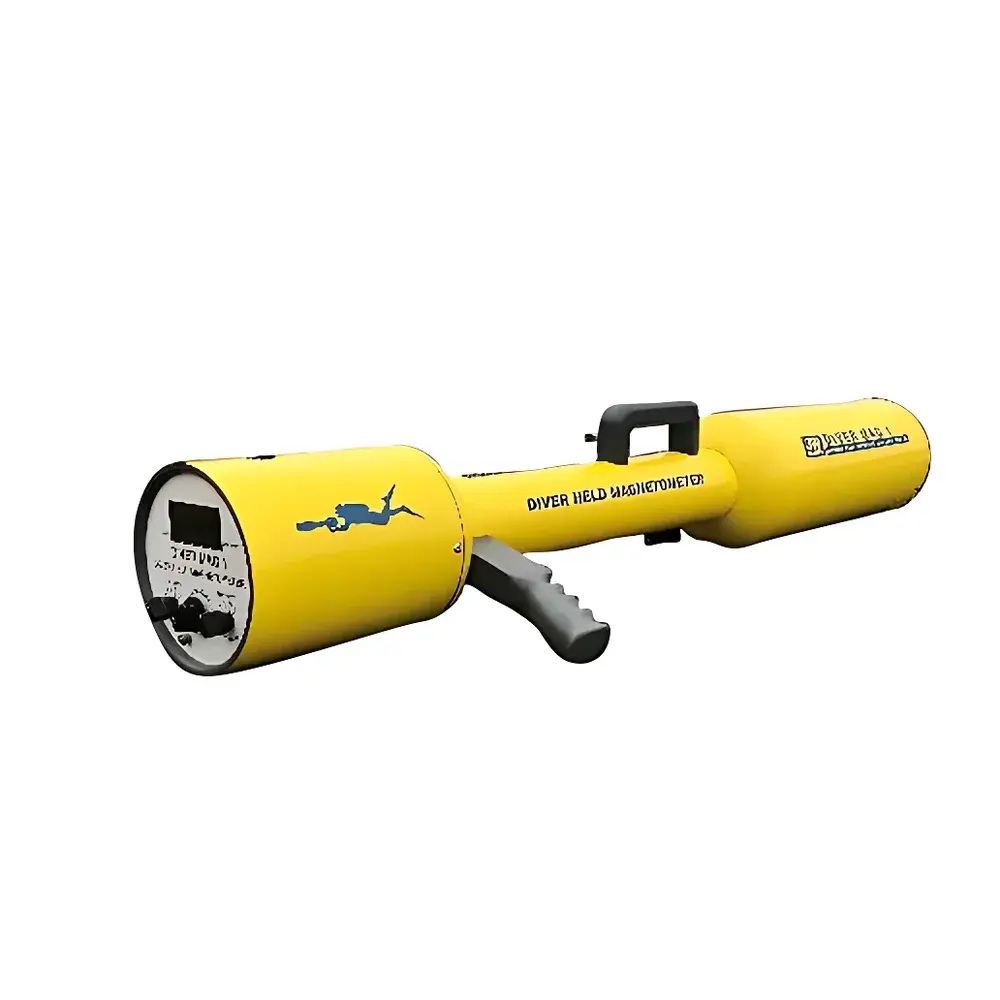
JW Fishers DiverMag-1 Handheld Marine Magnetometer
| Brand | JW Fishers |
|---|---|
| Origin | USA |
| Manufacturer Type | Authorized Distributor |
| Product Origin | Imported |
| Model | DiverMag-1 |
| Pricing | Available Upon Request |
Overview
The JW Fishers DiverMag-1 Handheld Marine Magnetometer is a high-sensitivity, microprocessor-controlled fluxgate magnetometer engineered for precise detection and localization of ferrous (iron/steel) objects in both terrestrial and submerged environments. Operating on the principle of measuring local perturbations in the Earth’s geomagnetic field—typically on the order of nanotesla (nT)—the DiverMag-1 delivers calibrated sensitivity down to 1 gamma (1 nT), enabling reliable identification of magnetic anomalies induced by buried or submerged ferromagnetic materials. Unlike conventional single-axis sensors, its integrated triaxial noise-rejecting coil assembly eliminates orientation-dependent dead zones and ensures stable, repeatable readings regardless of probe attitude—critical for diver-operated surveys, ROV-mounted reconnaissance, or shallow-water UXO clearance. Designed for rugged marine deployment, the system meets operational requirements for commercial salvage, pipeline inspection, underwater archaeology, harbor security, and post-dredging verification. Its modular architecture, corrosion-resistant polyurethane/PVC housing, and IP68-rated sensor head (rated to 60 m depth) reflect compliance with ISO 9001–certified manufacturing standards and long-term field reliability under harsh saline conditions.
Key Features
- Triaxial fluxgate sensor with intrinsic electromagnetic interference (EMI) rejection—enables stable operation near ignition systems, VHF radios, and urban electromagnetic noise sources
- User-adjustable sensitivity control (1 gamma baseline, with stepwise attenuation for fine target pinpointing)
- Selectable sampling intervals: 2 s (optimized for small targets), 5 s (standard survey mode), or 10 s (extended battery life)
- Backlit 5-digit LED display with luminance sufficient for low-light and turbid-water visibility
- Dual-output feedback: real-time numeric readout + audio tone modulation (frequency shift proportional to anomaly magnitude)
- Operator-controllable buoyancy via adjustable flotation collar—facilitates neutral buoyancy for diver-held operation
- Integrated rechargeable 12 V sealed lead-acid battery (2 h runtime at 5 s cycle); optional belt-mounted external battery pack available for extended missions
- Modular design allows field replacement of sensor head, electronics housing, or control panel without depot-level service
Sample Compatibility & Compliance
The DiverMag-1 detects magnetic susceptibility contrasts arising from ferromagnetic materials—including steel pipelines, shipwrecks, ordnance, anchors, cast-iron infrastructure, and unexploded ordnance (UXO). It does not respond to non-ferrous metals (e.g., aluminum, copper, stainless steel 316) or paramagnetic/diamagnetic substances. Detection range scales with target volume, magnetic moment, and orientation relative to Earth’s field—validated per ASTM E2574-22 (Standard Practice for Magnetic Particle Testing Using Yoke Magnetization) for qualitative anomaly mapping. The instrument complies with IEC 61000-6-2 (immunity to industrial electromagnetic disturbances) and is CE-marked for marine electronic equipment. While not FDA-regulated, its data output structure supports GLP-compliant logging when paired with third-party timestamped recording software.
Software & Data Management
The DiverMag-1 operates as a standalone analog-digital hybrid instrument with no embedded firmware-based data logging. All measurements are displayed in real time and may be manually recorded or captured externally via audio tone decoding or LED readout photography. For digital integration, users commonly interface the audio output signal with portable oscilloscopes or sound-card-based acquisition systems (e.g., Audacity with calibration lookup tables) to generate time-stamped anomaly profiles. Optional accessories—including underwater headphones (150 m rated), 220 VAC European charger, and waterproof external battery pack—extend operational flexibility across international deployments. No proprietary drivers or cloud platforms are required; raw gamma values remain fully traceable to NIST-traceable calibration certificates provided with each unit.
Applications
- Underwater pipeline and cable route verification prior to dredging or construction
- Marine salvage operations targeting sunken vessels, cargo containers, or structural steel debris
- UXO and ordnance detection in former naval training areas or conflict zones
- Archaeological site prospection for iron-age artifacts, cannon, or ballast iron
- Port and harbor security sweeps for submerged contraband or improvised devices
- Geotechnical pre-construction surveys to map buried ferrous infrastructure (e.g., rebar, culverts, abandoned wells)
- Environmental remediation support—locating buried drums, tanks, or scrap metal in sediment
FAQ
What is the maximum operational depth of the DiverMag-1?
The sensor head is rated to 60 meters seawater (200 ft), verified per ISO 6425 diving equipment pressure testing protocols.
Does the DiverMag-1 require periodic recalibration?
Factory calibration is stable for ≥24 months under normal use; field zeroing is supported via built-in declination adjustment for regional geomagnetic variation.
Can it distinguish between different types of ferrous objects?
No—it measures total field anomaly magnitude only; object identification requires correlation with sonar, visual inspection, or magnetic gradient analysis using multiple passes.
Is the unit compatible with AUVs or ROVs?
Yes—its compact form factor (112 × 15 cm), low power draw (<3 W avg.), and analog audio/LED outputs enable integration with most unmanned platforms via mechanical mounting and simple power tapping.
What safety certifications does it hold?
CE marking per EMC Directive 2014/30/EU and Low Voltage Directive 2014/35/EU; RoHS 2011/65/EU compliant; no intrinsic safety (ATEX) rating due to non-explosive environment design scope.



