
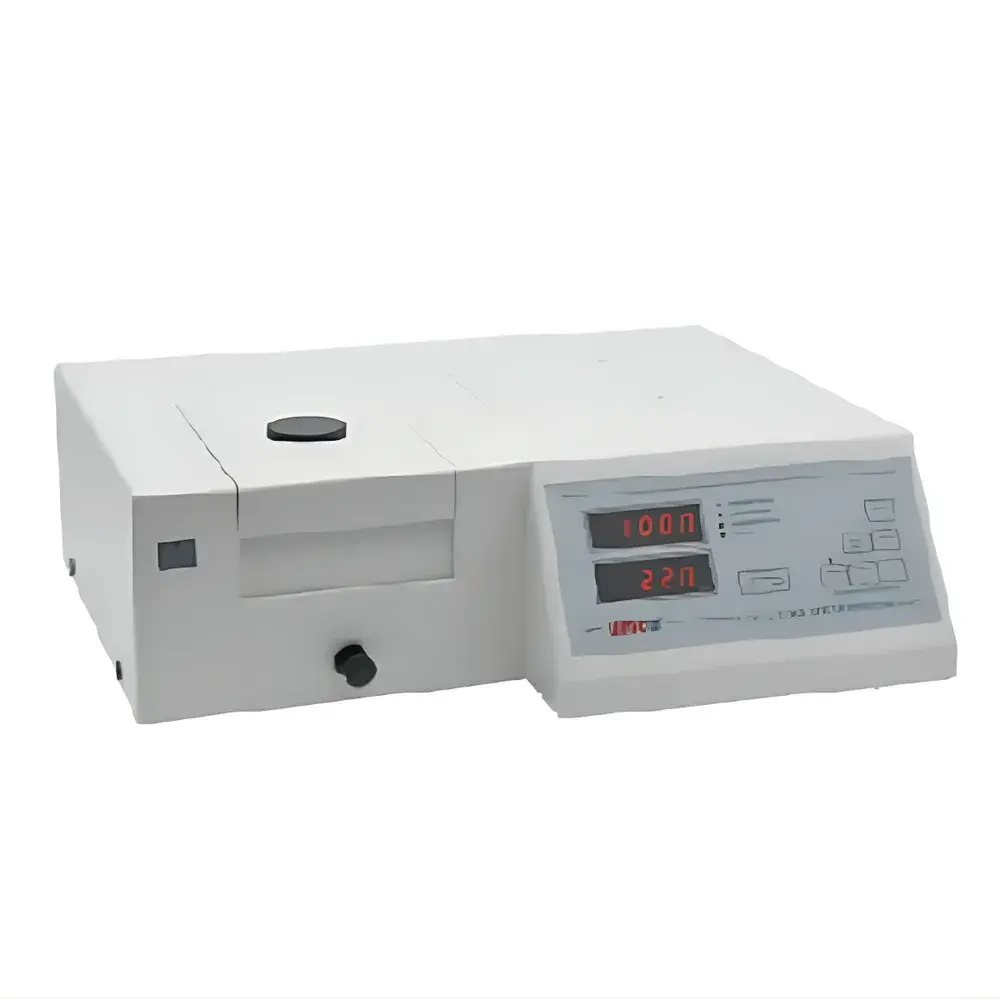
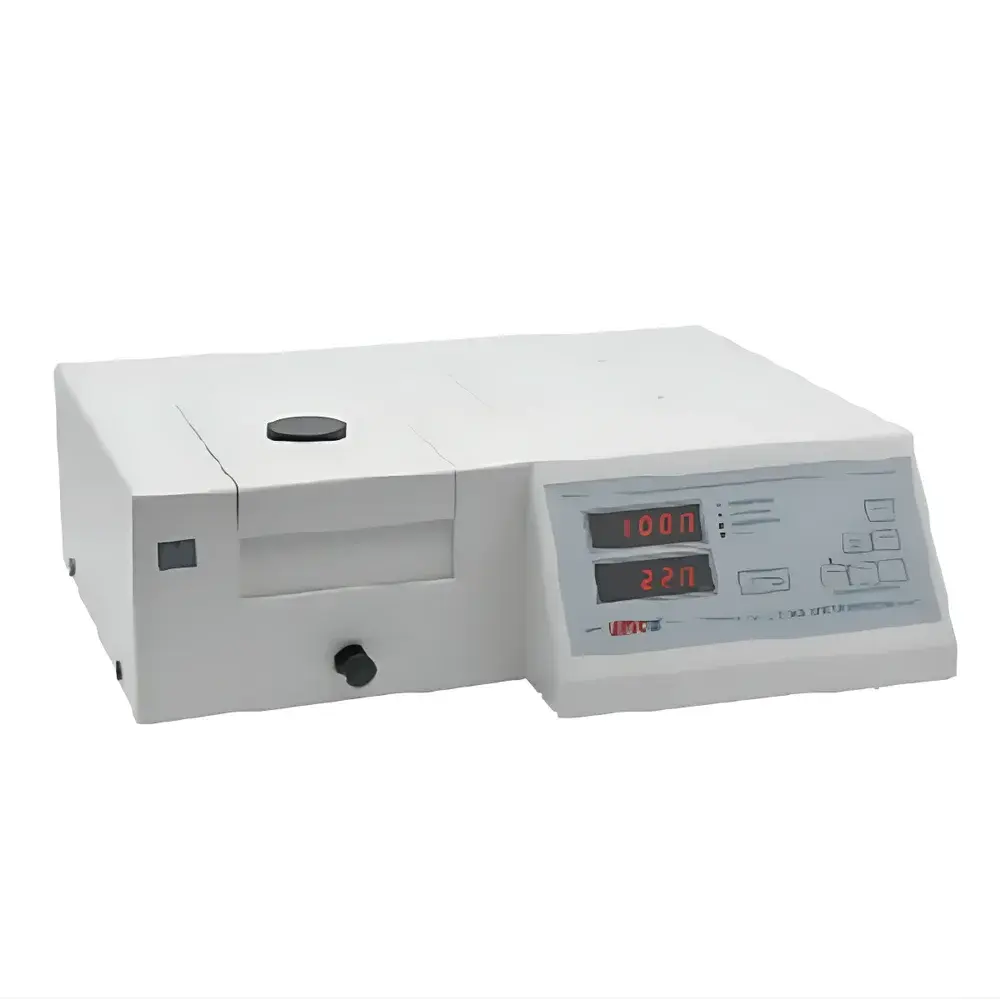
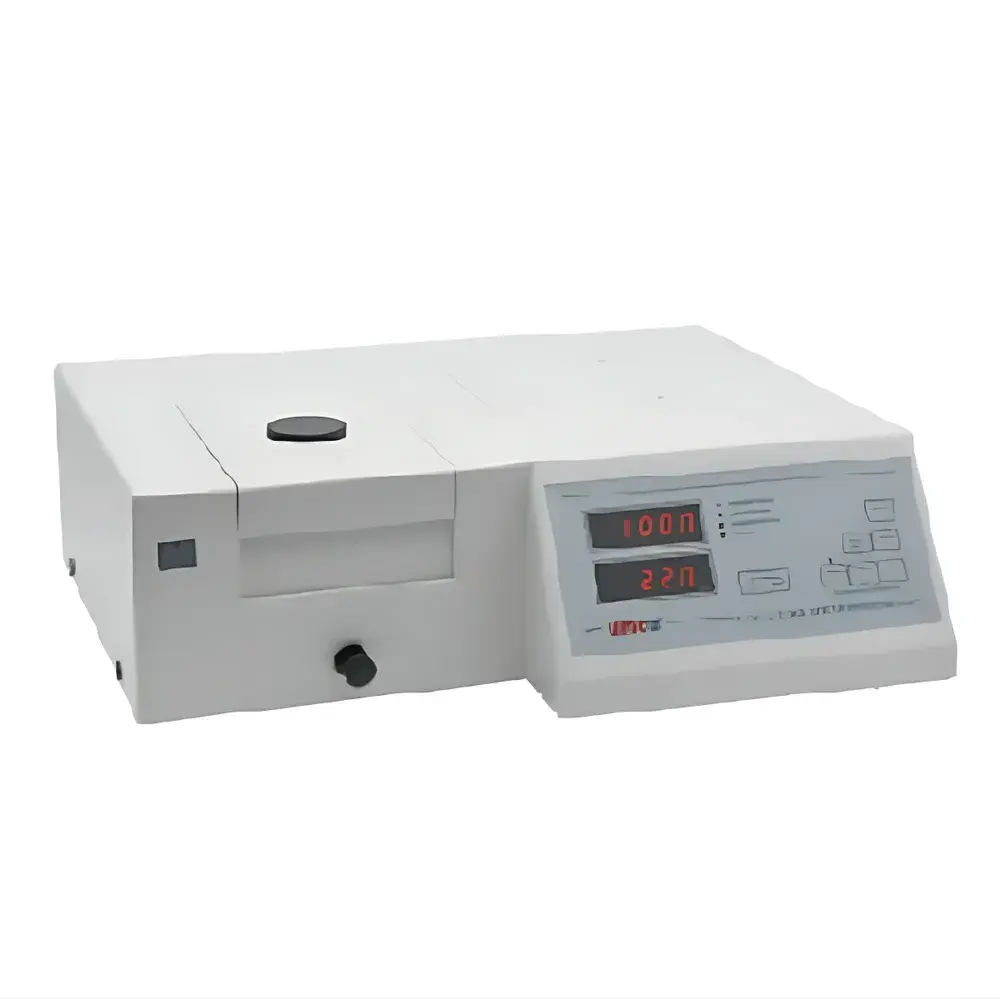
UniCo UV-2100 Single-Beam Ultraviolet-Visible Spectrophotometer
| Brand | UniCo |
|---|---|
| Origin | Shanghai, China |
| Model | UV-2100 |
| Optical System | Single-beam with 1200 lines/mm diffraction grating |
| Wavelength Range | 200–1000 nm |
| Spectral Bandwidth | 5 nm |
| Wavelength Accuracy | ±2.0 nm |
| Wavelength Repeatability | ±1.0 nm |
| Stray Light | ≤0.3% T (at 220 nm and 340 nm) |
| Photometric Accuracy | ±0.5% T |
| Photometric Repeatability | 0.1% T |
| Baseline Stability | ±0.002 A/h (at 500 nm) |
| Display | 4-digit LED, resolution 1 nm |
| Photometric Range | 0–125% T, –0.097–1.999 A, 0–9999 C (0–1999 F) |
| Data Interface | RS-232C |
| Dimensions (W×D×H) | 470×400×140 mm |
| Weight | 13.5 kg |
Overview
The UniCo UV-2100 is a single-beam ultraviolet-visible (UV-Vis) spectrophotometer engineered for routine quantitative and qualitative analysis in academic teaching laboratories, quality control environments, and industrial R&D settings. It operates on the principle of Beer-Lambert law-based absorbance measurement, utilizing a fixed 1200 lines/mm diffraction grating to disperse polychromatic light across a broad spectral range. The instrument delivers reliable photometric performance from 200 nm to 1000 nm—covering deep UV through near-infrared—with a nominal spectral bandwidth of 5 nm to balance resolution and signal-to-noise ratio. Its single-beam architecture simplifies optical alignment and reduces mechanical complexity, supporting high reproducibility under stable ambient conditions. Designed for ease of operation and long-term reliability, the UV-2100 features microprocessor-controlled wavelength scanning, automatic zeroing (0% T) and full-scale calibration (100% T), and real-time LED readout with 1-nm resolution.
Key Features
- Microprocessor-driven wavelength selection with automatic initialization and self-calibration routines
- High-stability tungsten-halogen and deuterium lamp source assembly for seamless UV and visible coverage
- Photocell-based detection system optimized for linearity and low drift over extended measurement sessions
- Integrated RS-232C serial interface for direct communication with external PCs or data loggers
- Four-digit LED display providing simultaneous readout of wavelength, transmittance (%T), absorbance (A), concentration (C), or factor (F)
- Robust mechanical design with aluminum alloy chassis and precision-machined optical housing for thermal and vibration stability
- Compliance-ready architecture supporting traceable calibration protocols and manual audit trail documentation
Sample Compatibility & Compliance
The UV-2100 accommodates standard 10-mm pathlength cuvettes—including quartz (for UV measurements below 350 nm) and optical-grade glass (for visible-range work)—via its fixed-position cuvette holder. The included accessory set comprises two quartz cells and four glass cells, enabling immediate deployment for common aqueous, organic, and buffered solutions. While the instrument does not incorporate automated compliance features such as electronic signatures or 21 CFR Part 11–compliant audit trails, its operational transparency, manual calibration logs, and deterministic photometric response support adherence to ISO/IEC 17025 requirements when integrated into documented laboratory procedures. Users may implement GLP-aligned workflows by recording wavelength verification checks (e.g., using holmium oxide or didymium filters) and photometric accuracy validation per ASTM E275 and ISO 6059 standards.
Software & Data Management
Control and data acquisition are enabled via optional UniCo proprietary software, which connects to the instrument through the RS-232C port. This application supports spectral scanning, kinetic assays, multi-wavelength quantitation, and standard curve generation with linear and polynomial regression. All acquired datasets—including time-stamped spectra, calibration records, and user annotations—are exportable in CSV and ASCII formats for downstream processing in Excel, MATLAB, or LIMS platforms. Though the base firmware lacks built-in method storage or user-level access control, the software layer permits saving instrument configurations and measurement templates, facilitating method transfer between operators and reducing setup variability in multi-shift environments.
Applications
- Quantitative determination of nucleic acid and protein concentrations (e.g., A260/A280 ratios)
- Colorimetric enzyme assays (e.g., ELISA, LDH, ALP) using chromogenic substrates
- Water quality testing (e.g., nitrate, phosphate, iron, and COD analysis via standardized colorimetric methods)
- Pharmaceutical excipient and active ingredient verification in non-GMP batch release screening
- Teaching fundamental spectroscopic concepts including absorption maxima, molar absorptivity, and spectral interference
- Stability-indicating assays for oxidation or hydrolysis products in formulation development
FAQ
What is the recommended wavelength verification standard for routine performance checks?
Holmium oxide solution in 10% perchloric acid is widely accepted for peak verification at 241.2, 279.4, 287.5, 333.7, 360.9, 418.5, 460.0, 485.8, 536.2, and 637.5 nm. Didymium glass filters may also be used for quick visual confirmation at ~529 nm and ~808 nm.
Can the UV-2100 measure samples with absorbance values above 2.0 A?
The instrument’s photometric range extends to 1.999 A; measurements exceeding this value require sample dilution or use of reduced-pathlength cuvettes to maintain linearity within the detector’s dynamic range.
Is the RS-232C interface compatible with modern Windows operating systems?
Yes—when paired with a USB-to-RS-232 adapter and appropriate driver installation, the interface functions reliably with Windows 10 and 11; terminal emulation software (e.g., Tera Term) or UniCo’s native application can establish stable communication.
How frequently should the deuterium and tungsten-halogen lamps be replaced?
Lamp lifetime is typically 1,000–2,000 hours under normal usage; replacement is indicated by diminished intensity below specification, increased noise in baseline scans, or failure to achieve 100% T during auto-zeroing.
Related Products




