
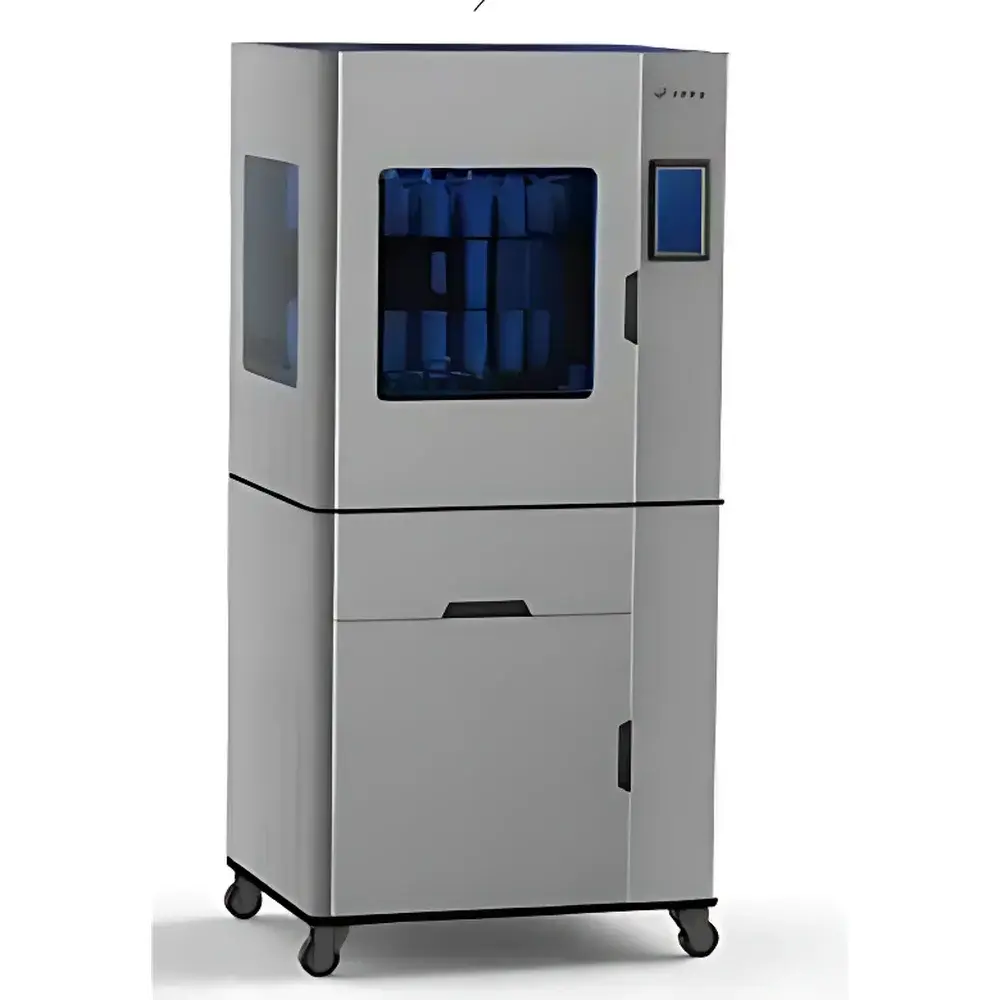
Anjie AJ5700 Automated Chemical Oxygen Demand (COD) Analyzer
| Brand | Anjie |
|---|---|
| Origin | Shanghai, China |
| Model | AJ5700 |
| Instrument Type | Laboratory Benchtop Analyzer |
| Measurement Principle | Rapid Digestion with Potassium Dichromate (Cr(VI)) Oxidation |
| Measurement Range | 0–700 mg/L COD<sub>cr</sub> |
| Accuracy | ≤5% (vs. certified reference materials) |
| Repeatability | RSD ≤2.0% |
| Cycle Time | <15 min per sample |
| Sample Capacity | ≥30 positions |
| Digestion Stations | ≥30 |
| Titration Stations | ≥2 |
| Reagent Dispensing Precision | ±0.2% |
| Safety Design | Negative-pressure enclosed chamber with fume containment |
| Waste Handling | Integrated废液 collection with overflow alarm |
| Connectivity | TCP/IP & Wi-Fi |
| Data Export Formats | PDF, Word, Excel, CSV, RTF, HTML |
Overview
The Anjie AJ5700 Automated Chemical Oxygen Demand (COD) Analyzer is a fully integrated benchtop system engineered for precise, reproducible, and compliant determination of CODcr in water and wastewater samples according to the Chinese national standard HJ 828–2017, “Determination of Chemical Oxygen Demand by the Dichromate Method.” The instrument implements a closed-loop, automated workflow based on the classical dichromate oxidation principle: under strongly acidic conditions (H2SO4) and reflux at elevated temperature (~150 °C), organic matter is quantitatively oxidized by potassium dichromate (K2Cr2O7), while excess dichromate is back-titrated with standardized ferrous ammonium sulfate (FAS). This gravimetrically traceable redox titration enables accurate quantification of oxygen demand expressed as mg O2/L. Unlike open-reflux or colorimetric alternatives, the AJ5700 preserves method fidelity through controlled thermal digestion, inert atmosphere management, and volumetric titration—ensuring metrological consistency required for regulatory reporting and inter-laboratory comparability.
Key Features
- Full automation of sample loading, reagent dispensing, digestion, cooling, titration, endpoint detection, and waste handling—eliminating manual intervention and operator bias.
- Negative-pressure sealed reaction chamber with active fume extraction, preventing Cr(VI) aerosol release and ensuring compliance with occupational health and safety regulations (e.g., OSHA PELs for hexavalent chromium).
- Eight independent syringe pumps with ±0.2% volumetric accuracy for sequential, contamination-free delivery of sulfuric acid, silver sulfate catalyst, mercury sulfate masking agent, and FAS titrant.
- Water-cooled reflux condensation system optimized for volatile organics (e.g., low-molecular-weight alcohols, aldehydes), minimizing analyte loss and improving recovery accuracy.
- Integrated dual titration stations with high-resolution potentiometric endpoint detection (±0.02 mL resolution), supporting both single- and dual-point calibration verification.
- Compact monolithic architecture (W × D × H: 650 × 580 × 520 mm) with casters and leveling feet—designed for ISO/IEC 17025-accredited labs with space constraints and modular ventilation integration.
Sample Compatibility & Compliance
The AJ5700 accommodates a broad matrix spectrum: surface water, domestic sewage, industrial effluents (including petrochemical, pharmaceutical, and food processing discharges), and treated wastewater. It handles turbid, colored, or chloride-containing samples (up to 2000 mg/L Cl−) via mercury sulfate suppression and digestion optimization. All operational parameters—including digestion time (120 min), acid-to-sample ratio (10:1 v/v), and titrant concentration—are programmable to align with method variants (e.g., ASTM D1252–06, ISO 6060). The system supports GLP-compliant audit trails: every sample run logs timestamp, operator ID, reagent lot numbers, environmental chamber temperature, digestion pressure, titration curve data, and raw sensor outputs. Full traceability satisfies requirements under CNAS-CL01:2018, EPA Method 410.4, and FDA 21 CFR Part 11 when paired with validated software configuration.
Software & Data Management
The AJ5700 runs Anjie’s AQUA-LAB v3.2 analytical workstation, accessible via embedded 7-inch capacitive touchscreen or remote PC client over TCP/IP or Wi-Fi. The software provides real-time visualization of digestion progress, titration curves, and QC flagging (e.g., outlier detection per ISO 5725-2). Data are stored in an encrypted SQLite database with immutable timestamps and role-based access control (RBAC). Reporting modules generate customizable certificates of analysis (CoA) in PDF, Excel, CSV, RTF, or HTML—each embedding digital signatures, instrument calibration status, and uncertainty estimates per GUM (JCGM 100:2008). Seamless integration with Laboratory Information Management Systems (LIMS) and Unified Monitoring Systems (UMS) is achieved via HL7, ASTM E1384, or custom RESTful API endpoints.
Applications
- Regulatory compliance monitoring for municipal wastewater treatment plants (WWTPs) reporting to local ecological environment bureaus.
- Process control in industrial pretreatment units—tracking influent COD load variations to optimize biological treatment efficiency.
- Environmental impact assessment (EIA) field laboratories performing rapid screening of riverine and groundwater quality.
- Research applications requiring high-throughput COD profiling across time-series or dose-response experiments (e.g., biodegradability studies under OECD 301 series).
- Accredited testing laboratories conducting proficiency testing (PT) schemes under CNAS PT002 or ILAC-P9.
FAQ
Does the AJ5700 comply with HJ 828–2017 without method deviation?
Yes—the entire hardware architecture, reagent protocol, digestion kinetics, and titration algorithm are validated against HJ 828–2017 Annex A verification procedures.
Can it analyze high-chloride samples without dilution?
It supports up to 2000 mg/L Cl− using HgSO4 masking; beyond this, dilution or alternative chloride removal (e.g., AgNO3 precipitation) is recommended per standard guidance.
Is remote diagnostics and firmware update supported?
Yes—via secure SSH tunneling and over-the-air (OTA) updates with version rollback capability and integrity checksum verification.
What maintenance intervals are required for long-term reliability?
Daily: waste tank emptying and tip rinse cycle. Quarterly: pump tubing replacement and electrode calibration. Annually: full optical alignment and pressure sensor validation per manufacturer’s PM checklist.
How is data integrity ensured during power failure?
The system features non-volatile memory buffering and automatic resume-from-interrupt—no sample data or method state is lost during unexpected shutdown.







