
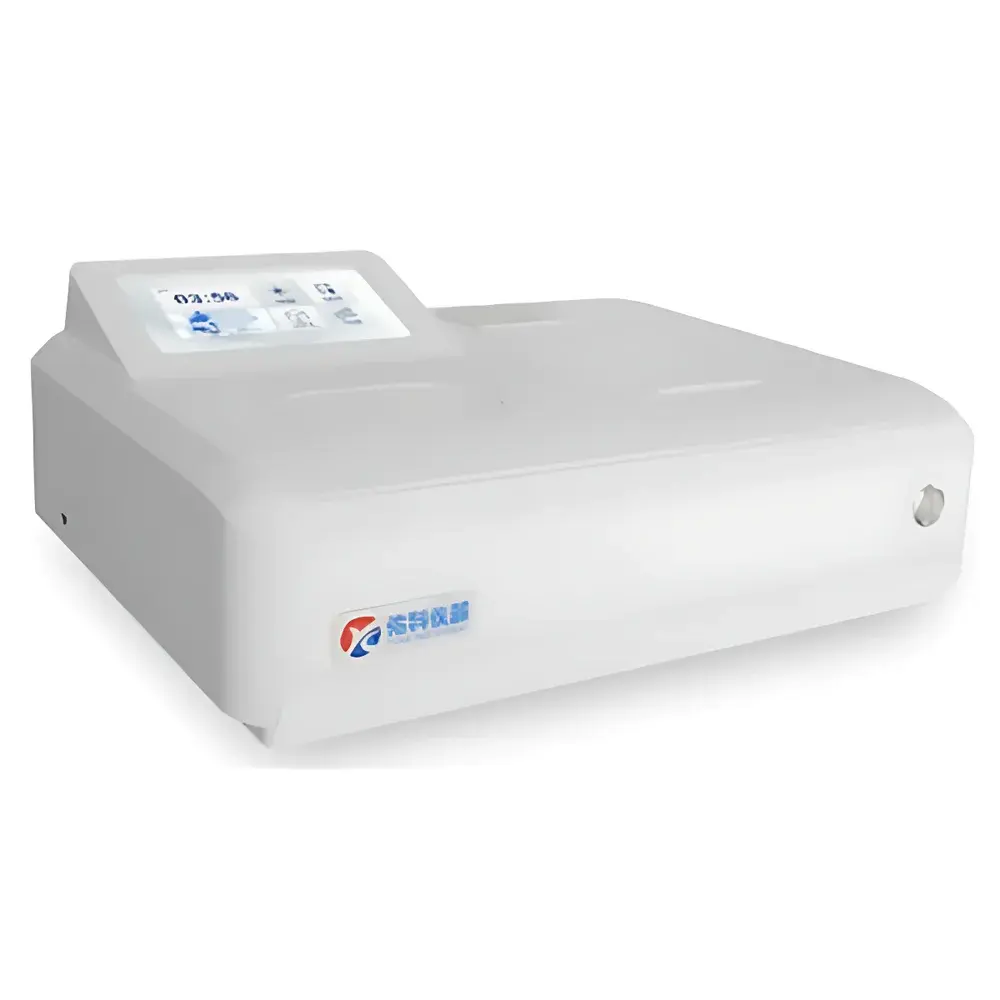
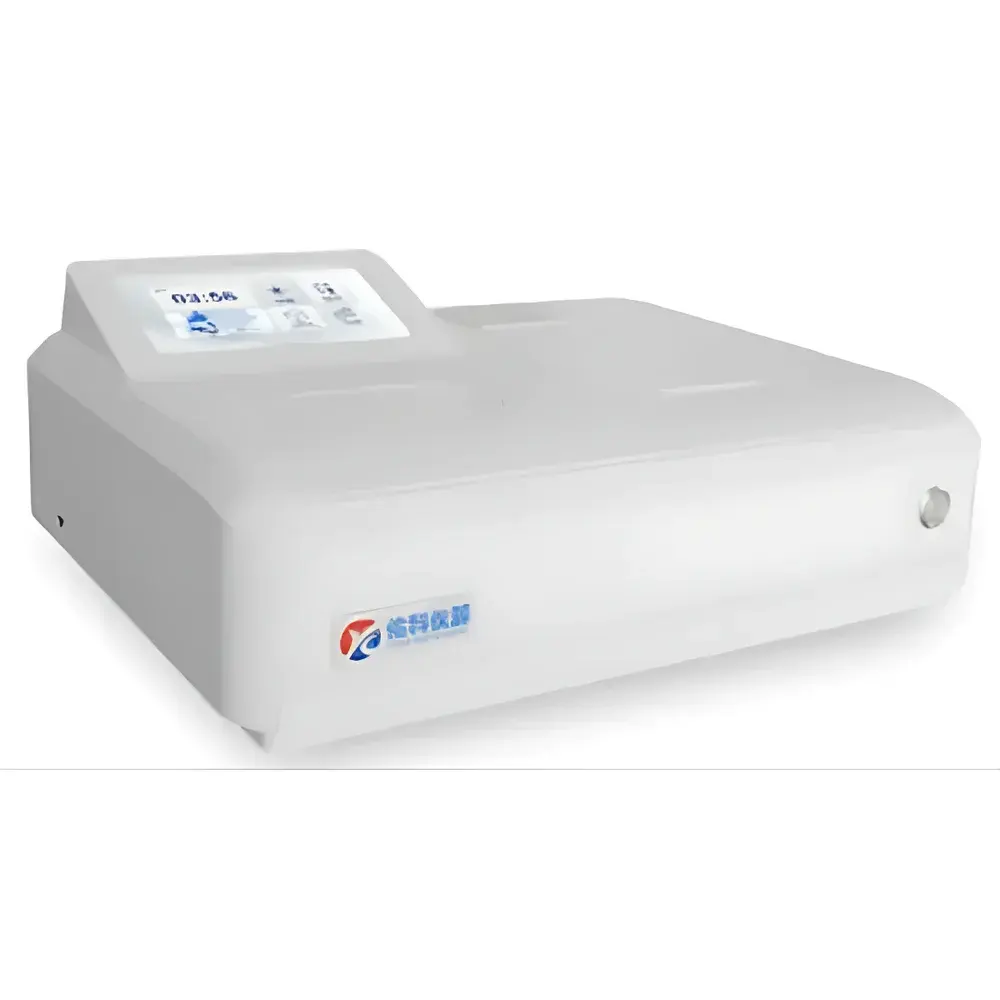
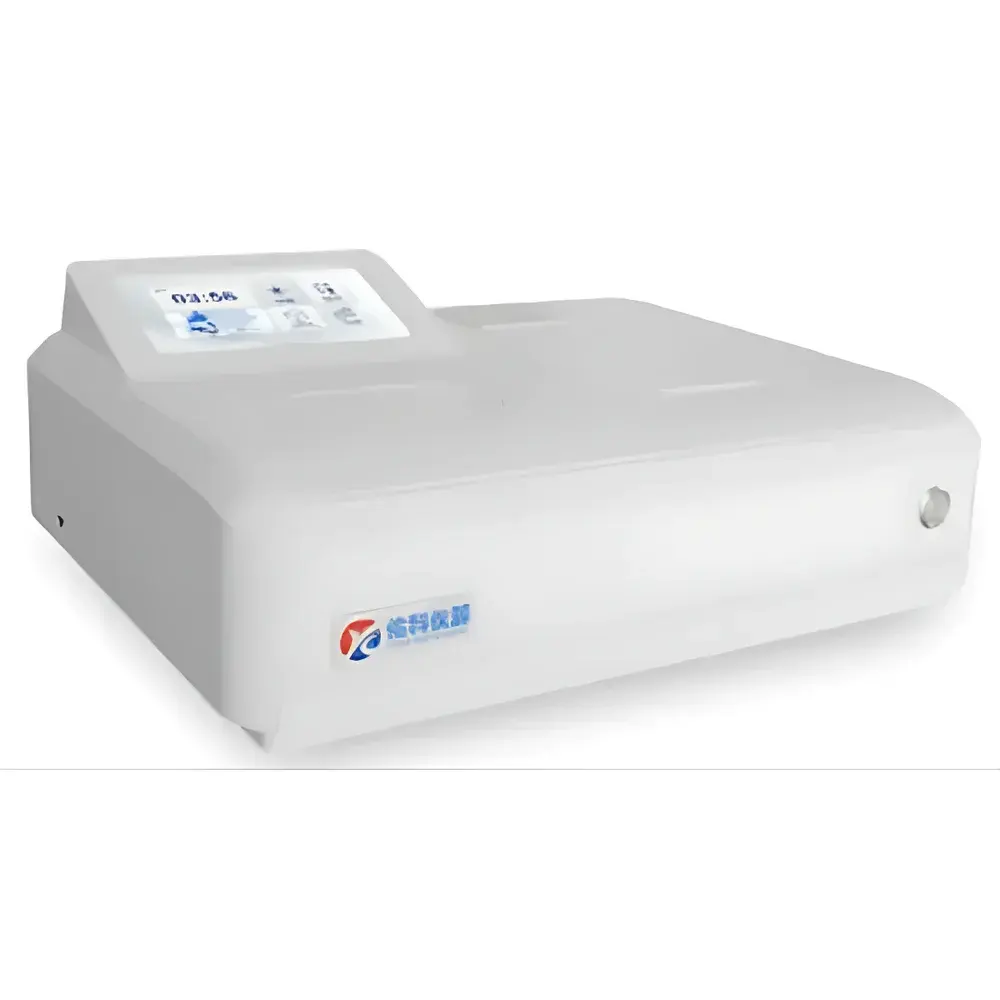
Yoke L3 IoT-Enabled Visible Spectrophotometer
| Brand | Yoke |
|---|---|
| Origin | Shanghai, China |
| Model | L3 |
| Optical Design | Single-Beam |
| Detector | Photodiode Array (PDA) |
| Wavelength Range | 320–1100 nm |
| Spectral Bandwidth | 4 nm (2 nm optional) |
| Wavelength Accuracy | ±1 nm |
| Wavelength Repeatability | ≤±0.5 nm |
| Stray Light | ≤0.1% T at 420 nm (NaNO₂) |
| Photometric Range | 0–200% T, –3 to +3 A |
| Photometric Accuracy | ±0.5% T / ±0.004 A (0–0.5 A), ±0.008 A (0.5–1 A) |
| Photometric Repeatability | ±0.5% T / ±0.004 A (0–0.5 A), ±0.008 A (0.5–1 A) |
| Baseline Stability | ±0.002 A (500 nm, 3 min) |
| Noise Level | ≤0.15% T |
| Grating | Holographic Blazed Grating, 1200 lines/mm |
| Display | 7-inch TFT-LCD Touchscreen (1024 × 768) |
| Connectivity | USB 2.0, Wi-Fi (standard), Bluetooth 4.2 (standard) |
| Data Storage | 2000 spectra + 96 calibration curves |
| Software | YokeLab PC software (optional), YOKE@Cloud IoT platform (standard) |
Overview
The Yoke L3 IoT-Enabled Visible Spectrophotometer is a single-beam, microprocessor-controlled analytical instrument engineered for precision absorbance and transmittance measurements across the visible and near-UV spectral region (320–1100 nm). It employs a Czerny-Turner monochromator architecture with a holographic blazed grating (1200 lines/mm) and a high-stability photodiode array detector—enabling consistent spectral resolution, low stray light (<0.1% T at 420 nm using NaNO₂ reference), and robust baseline stability (±0.002 A over 3 minutes at 500 nm). Designed for routine laboratory use in regulated and non-regulated environments, the L3 delivers traceable photometric performance aligned with ISO 6223, ASTM E275, and USP guidelines for spectrophotometric instrumentation. Its core optical design prioritizes reproducibility and long-term signal fidelity—critical for quantitative applications such as concentration determination, kinetic assays, and method validation.
Key Features
- 7-inch high-resolution capacitive touchscreen (1024 × 768) with intuitive, icon-driven UI optimized for glove-compatible operation and multi-user workflows.
- Integrated IoT connectivity: Standard Wi-Fi and Bluetooth 4.2 modules enable secure cloud synchronization via YOKE@Cloud—a web-accessible platform supporting QR-code-based instrument onboarding, remote firmware updates, and encrypted data backup.
- High-fidelity optical path: Blazed holographic grating coupled with 24-bit ADC conversion (Analog Devices) ensures minimal digitization error and enhanced dynamic range (–3 to +3 A).
- Automated wavelength selection and lamp switching (tungsten-halogen source, auto-switched at user-defined threshold, default 340 nm), eliminating manual alignment and reducing operator-induced variability.
- Flexible data export: Direct USB mass-storage mode; CSV/Excel-compatible output without proprietary plugins; supports wireless Bluetooth printing with certified thermal printers (e.g., Zebra ZQ520, Brother QL-820NWB).
- Scan speed up to 3000 nm/min with real-time preview, enabling rapid spectral acquisition for time-resolved studies and quality control screening.
Sample Compatibility & Compliance
The L3 accommodates standard 10-mm pathlength cuvettes (manual 1-cell holder included), with optional accessories including 5-cm and 10-cm manual holders, 8-position automated cuvette changers, and specialized fixtures for film, micro-volume, and test-tube samples. All optical components comply with RoHS Directive 2011/65/EU and IEC 61010-1:2010 safety standards. The instrument’s firmware and cloud interface support audit trail functionality per FDA 21 CFR Part 11 requirements when used with YokeLab software (configured with electronic signatures and role-based access). Calibration verification procedures follow NIST-traceable protocols, and photometric linearity is validated across the full absorbance range using neutral density filters and certified reference materials (e.g., potassium dichromate in 0.005 M H₂SO₄ per USP ).
Software & Data Management
The L3 operates natively via embedded firmware with local storage of up to 2000 spectra and 96 calibration curves. For advanced analysis, YokeLab PC software (Windows 10/11, 64-bit) provides full spectral processing capabilities—including derivative spectroscopy, peak integration, multi-wavelength overlays, kinetic modeling, and nucleic acid/protein quantification (A260/A280 ratio, ε calculations). All exported data files are plain-text CSV or XLSX—no vendor lock-in. YOKE@Cloud enables cross-instrument data aggregation, version-controlled method sharing, and GLP-compliant electronic lab notebook (ELN) integration via API. Audit logs record timestamped events: wavelength scans, calibration updates, user logins, and data exports—retained for ≥18 months unless manually purged.
Applications
- Chemical Analysis: Quantitative determination of transition metal ions (e.g., Fe²⁺/Fe³⁺, Cu²⁺), organic chromophores (e.g., azo dyes, phenolic compounds), and redox indicators via Beer-Lambert law compliance testing.
- Life Sciences: Nucleic acid (dsDNA, ssDNA, RNA) and protein (BSA, IgG) quantification; enzyme kinetics (e.g., NADH/NADPH oxidation at 340 nm); cell culture monitoring (OD₆₀₀).
- Environmental Testing: EPA-compliant analysis of nitrate, nitrite, phosphate, ammonia, and dissolved organic carbon (DOC) in surface water and wastewater per Methods 353.2, 354.1, and 4500-P E.
- Pharmaceutical QC: Assay of active pharmaceutical ingredients (APIs), excipient compatibility screening, dissolution profile tracking, and stability-indicating methods per ICH Q2(R2) guidance.
FAQ
Does the L3 meet regulatory requirements for GMP/GLP laboratories?
Yes—when configured with YokeLab software and YOKE@Cloud audit trails, it satisfies key elements of FDA 21 CFR Part 11, EU Annex 11, and ISO/IEC 17025 for instrument qualification, data integrity, and electronic records.
Can the L3 perform spectral scanning below 320 nm?
No—the L3 is optimized for the visible and near-UV range (320–1100 nm) and does not include a deuterium lamp; UV extension requires a dedicated UV-Vis model.
Is the 2 nm spectral bandwidth option factory-installed or field-upgradable?
The 2 nm slit width is a hardware-level configuration selected at time of order; it cannot be retrofitted post-delivery due to mechanical aperture constraints.
How is photometric accuracy verified during installation qualification (IQ)?
Certified reference standards—including NIST-traceable neutral density filters (OD 0.5, 1.0, 2.0) and potassium dichromate solution—are supplied with IQ documentation templates and acceptance criteria per USP .
What security protocols govern data transmission to YOKE@Cloud?
All communications use TLS 1.2+ encryption; device authentication employs certificate-based mutual TLS; no raw spectral data is stored on public cloud infrastructure—only encrypted metadata and user-configured summaries reside in YOKE@Cloud’s ISO 27001-certified hosting environment.





