
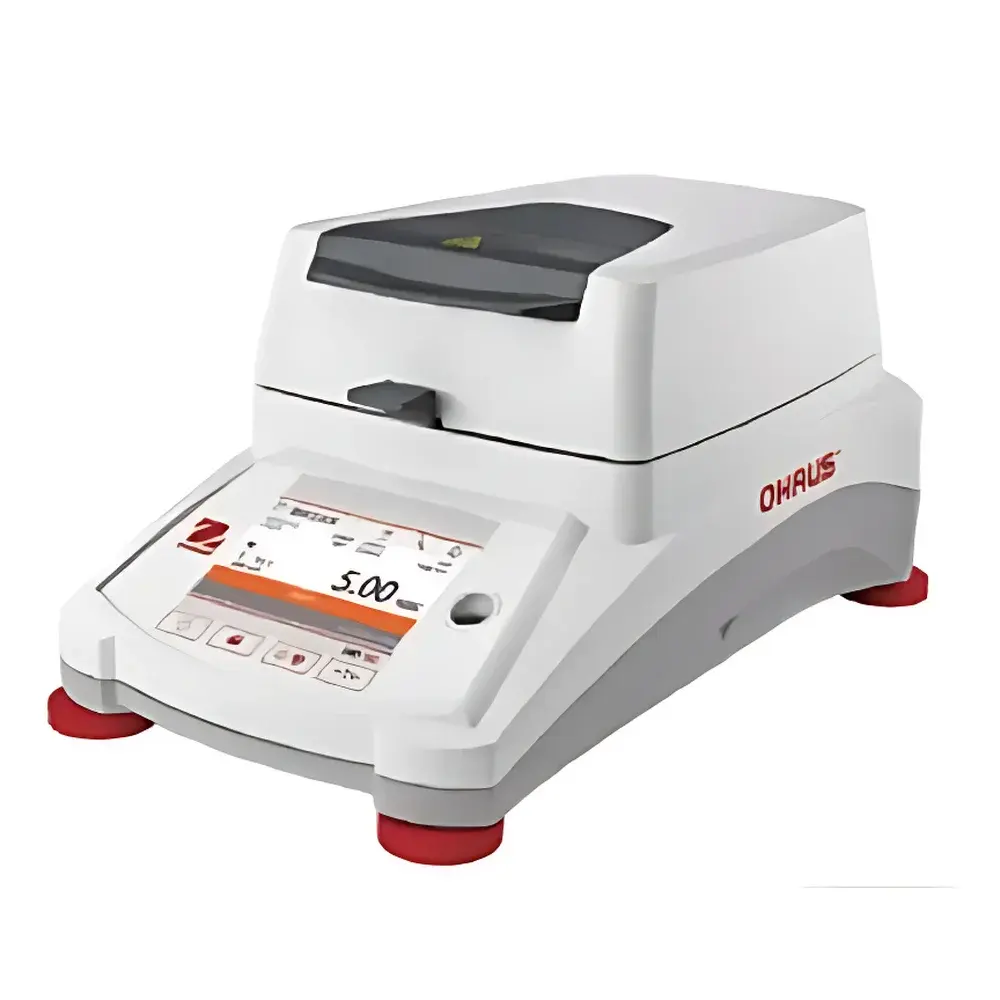
OHAUS MB90 Moisture Analyzer
| Brand | OHAUS |
|---|---|
| Origin | Shanghai, China |
| Manufacturer Type | Authorized Distributor |
| Country of Origin | China |
| Model | MB90 |
| Price | USD 2,950 (approx.) |
| Maximum Capacity | 90 g |
| Readability | 1 mg / 0.01% |
| Temperature Range | 40–200 °C |
| Heating Source | Halogen |
| Display | 4.3" Color Touchscreen |
| Method Storage | 100 methods |
| Result Storage | 1000 records |
| User Management | 3-Level Access Control |
| Interface | RS232, USB |
| Shut-off Modes | Manual, Timed, Auto (A30/A60/A90), Custom |
| Heating Modes | Standard, Rapid |
| Chamber Cleaning | Tool-free disassembly |
| Construction | Die-cast aluminum base |
Overview
The OHAUS MB90 Moisture Analyzer is a precision halogen-based thermogravimetric instrument engineered for reliable, repeatable moisture content determination in solid and semi-solid samples across laboratory, QC, and production environments. It operates on the principle of loss-on-drying (LOD): a pre-weighed sample is heated under controlled conditions, and the mass loss—attributed to volatiles including water—is measured in real time by a high-resolution analytical balance integrated into the instrument’s architecture. The MB90 employs a calibrated halogen lamp heating system that delivers rapid thermal response and uniform energy distribution across the sample surface, minimizing thermal gradients and improving inter-sample reproducibility. With a maximum capacity of 90 g and readability of 1 mg (0.01% moisture resolution), the MB90 meets routine analytical requirements for food, pharmaceuticals, chemicals, plastics, and agricultural products—particularly where regulatory compliance (e.g., USP <921>, AOAC 952.08, ASTM D4017) mandates traceable, auditable moisture data.
Key Features
- Halogen heating system with precise temperature control (40–200 °C range) ensures rapid heat-up times and consistent thermal profiles—critical for minimizing decomposition artifacts during LOD analysis.
- 4.3-inch full-color touchscreen interface with intuitive graphical navigation and four dedicated physical keys provides tactile feedback and supports high-frequency operation without degradation.
- Tool-free chamber access: glass cover, sample pan, and heating plate are designed for quick removal and cleaning—reducing downtime and supporting GLP-compliant maintenance logs.
- Three-tier user management system (Administrator, Supervisor, Operator) enforces role-based access to method editing, calibration, data export, and instrument configuration—aligning with FDA 21 CFR Part 11 expectations for electronic record integrity.
- Dual shutdown logic: manual, timed, auto (A30/A60/A90), and two customizable termination criteria allow optimization for diverse sample matrices—from hygroscopic powders to dense granules.
- Durable mechanical architecture: die-cast aluminum base minimizes vibration-induced weighing drift and enhances long-term stability under continuous use.
Sample Compatibility & Compliance
The MB90 accommodates a broad spectrum of non-volatile or low-volatility materials, including but not limited to flour, starch, polymer pellets, tablet granulations, dried herbs, and mineral powders. Its 90 g capacity and shallow-depth heating cavity support both small-batch R&D testing and mid-volume QC throughput. While not intended for volatile solvents or thermally labile compounds requiring vacuum or Karl Fischer titration, the MB90 complies with standard gravimetric validation protocols outlined in ISO 12099:2017 (Animal feeding stuffs — Guidance on the application of near-infrared spectroscopy and reference methods) and supports method transfer to ISO 5528:2013 (Cereals and cereal products — Determination of moisture content — Reference method). All stored methods and results include timestamp, operator ID, ambient temperature/humidity metadata, and can be exported via RS232 or USB for integration into LIMS or ERP systems.
Software & Data Management
No external software installation is required—the MB90’s embedded firmware handles all method development, execution, and reporting functions locally. Up to 100 user-defined test methods—including target temperature, heating profile, termination logic, and display preferences—can be saved with alphanumeric naming and version tagging. Each method supports dual-unit output (mass % and % moisture), automatic tare compensation, and real-time drying curve visualization. The instrument stores up to 1000 complete result records, each containing initial mass, final mass, moisture %, drying rate, and elapsed time. Data export formats include CSV and TXT; USB ports support direct transfer to flash drives or network-attached storage. Audit trail functionality logs all parameter changes, user logins, and calibration events—providing essential documentation for GMP/GLP audits.
Applications
- Quality control of raw materials in food manufacturing (e.g., flour, sugar, dairy powder)
- Stability testing of pharmaceutical excipients and finished dosage forms per ICH Q1A(R2)
- Moisture verification in polymer resins prior to extrusion or injection molding
- In-process monitoring of spray-dried or fluid-bed processed intermediates
- Regulatory submission support for AOAC Official Methods of Analysis (e.g., 952.08 for pet food)
- Educational use in university chemistry and food science laboratories
FAQ
What is the difference between the MB90 and MB120 models?
The MB120 offers extended capacity (120 g), higher maximum temperature (230 °C), additional heating modes (Slow, Step), and enhanced data storage (1000 methods, 10,000 results). The MB90 is optimized for cost-sensitive, high-throughput applications within its 90 g/200 °C operational envelope.
Does the MB90 support GLP-compliant data integrity?
Yes—it includes timestamped records, user-level authentication, tamper-resistant result storage, and full audit trail logging for all critical actions, satisfying core elements of ALCOA+ principles.
Can I validate the MB90 according to pharmacopeial standards?
Absolutely. The instrument supports IQ/OQ documentation templates, allows calibration with certified weights and NIST-traceable moisture standards, and permits generation of drying curves required for USP <921> verification.
Is halogen heating suitable for heat-sensitive samples?
Halogen lamps provide faster, more controllable heating than infrared or convection ovens—but optimal temperature selection remains sample-dependent. The MB90’s temperature-assisted method setup (via MB120 reference) helps identify safe upper limits for sensitive matrices.
How often does the MB90 require recalibration?
Daily zero calibration is recommended before first use; span calibration with certified reference standards should be performed at least weekly—or after any physical impact, ambient temperature shift >5 °C, or observed drift exceeding ±0.02% moisture.






