
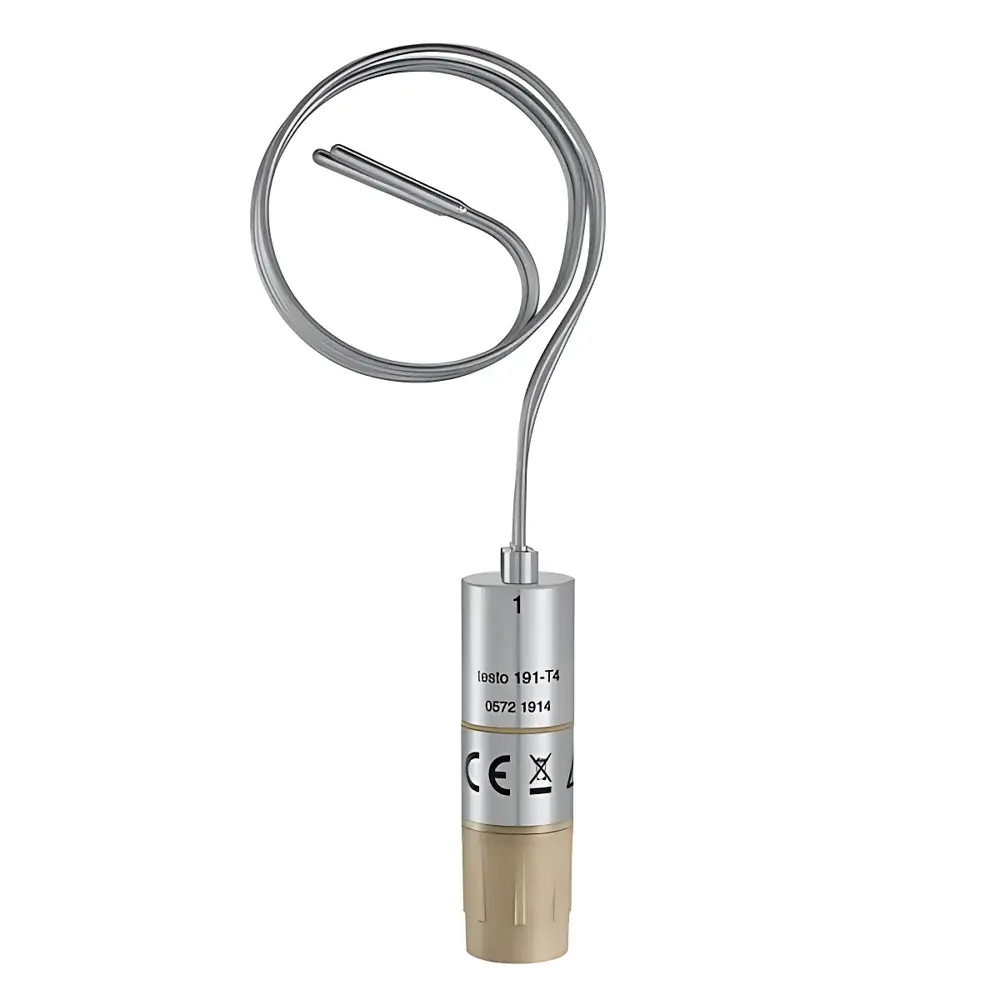
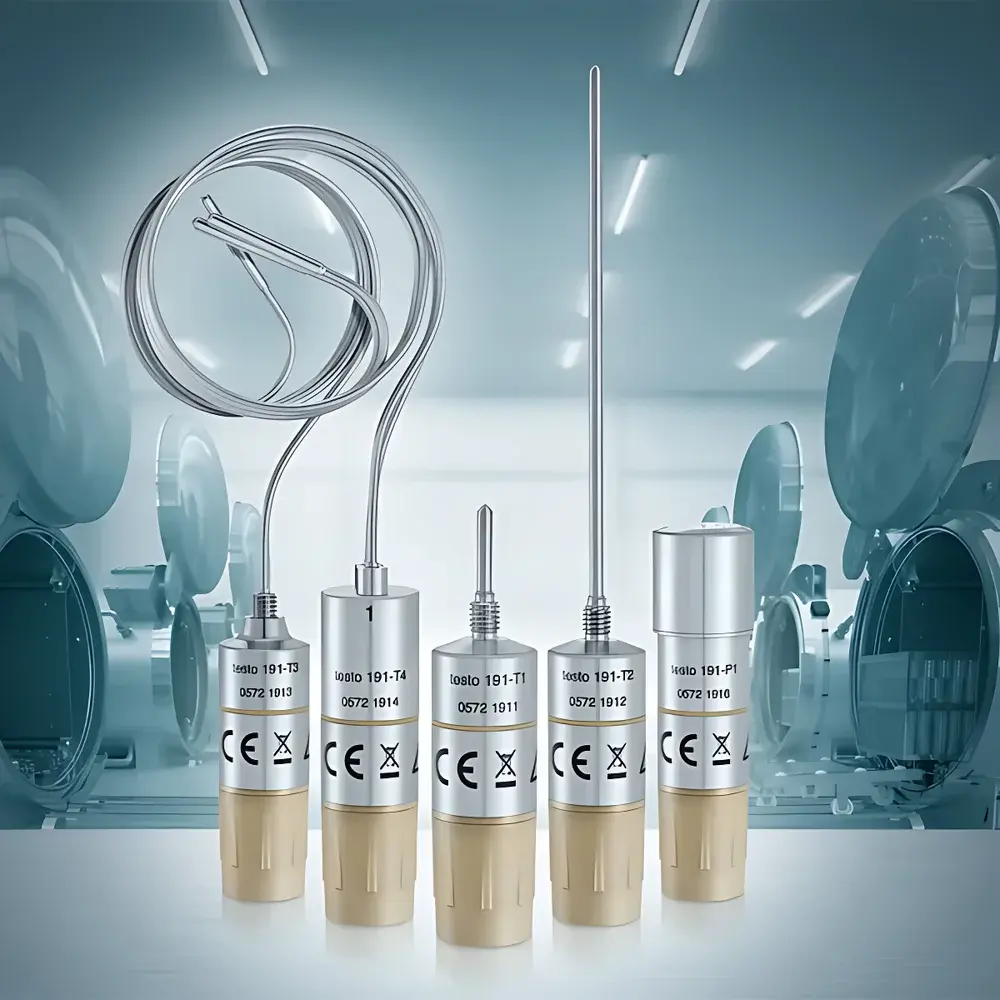
testo 191-T4 HACCP Temperature Data Logger with Dual Flexible Pt1000 Probes
| Brand | testo |
|---|---|
| Origin | Germany |
| Model | 0572 1914 |
| Measurement Principle | Pt1000 Resistance Thermometry |
| Temperature Range | –50 to +140 °C |
| Accuracy | ±0.2 °C (–50 to –40 °C), ±0.1 °C (–40 to +140 °C) |
| Resolution | 0.01 °C |
| Response Time t₉₀ | 6 s |
| Probe Length | 775 mm |
| Probe Diameter | 1.5 mm |
| Housing Diameter × Height | 20 × 72 mm |
| IP Rating | IP68 |
| Battery | 1/2 AA lithium |
| Operating Life | 2,500 h (10 s measurement interval at +121 °C) |
| Memory Capacity | 30,000 readings per channel |
| Enclosure Material | Stainless steel housing with PEEK-coated battery cap |
| Compliance | CE-marked, designed for HACCP-critical thermal validation |
Overview
The testo 191-T4 HACCP Temperature Data Logger (Order No. 0572 1914) is a rigorously engineered, intrinsically robust instrument purpose-built for thermal process validation in food manufacturing environments governed by Hazard Analysis and Critical Control Point (HACCP) requirements. It operates on the principle of high-stability Pt1000 resistance thermometry—ensuring traceable, NIST-compatible temperature measurement across extreme thermal gradients. Its dual-channel architecture supports simultaneous monitoring of two independent thermal zones, making it especially suited for validating critical unit operations including pasteurization, steam sterilization (e.g., autoclave cycles), and freeze-drying (lyophilization) where spatial thermal uniformity and penetration depth must be verified. The device meets the physical and operational demands of ISO 22000, FDA 21 CFR Part 11 (when used with testo 191 Professional software and audit-trail-enabled workflows), and EU Regulation (EC) No 852/2004 on food hygiene. Its stainless steel body and PEEK-coated sealing interface ensure full integrity under repeated thermal cycling, high-pressure steam exposure, and immersion conditions—critical for validation protocols requiring repeatable, unbroken chain-of-custody data.
Key Features
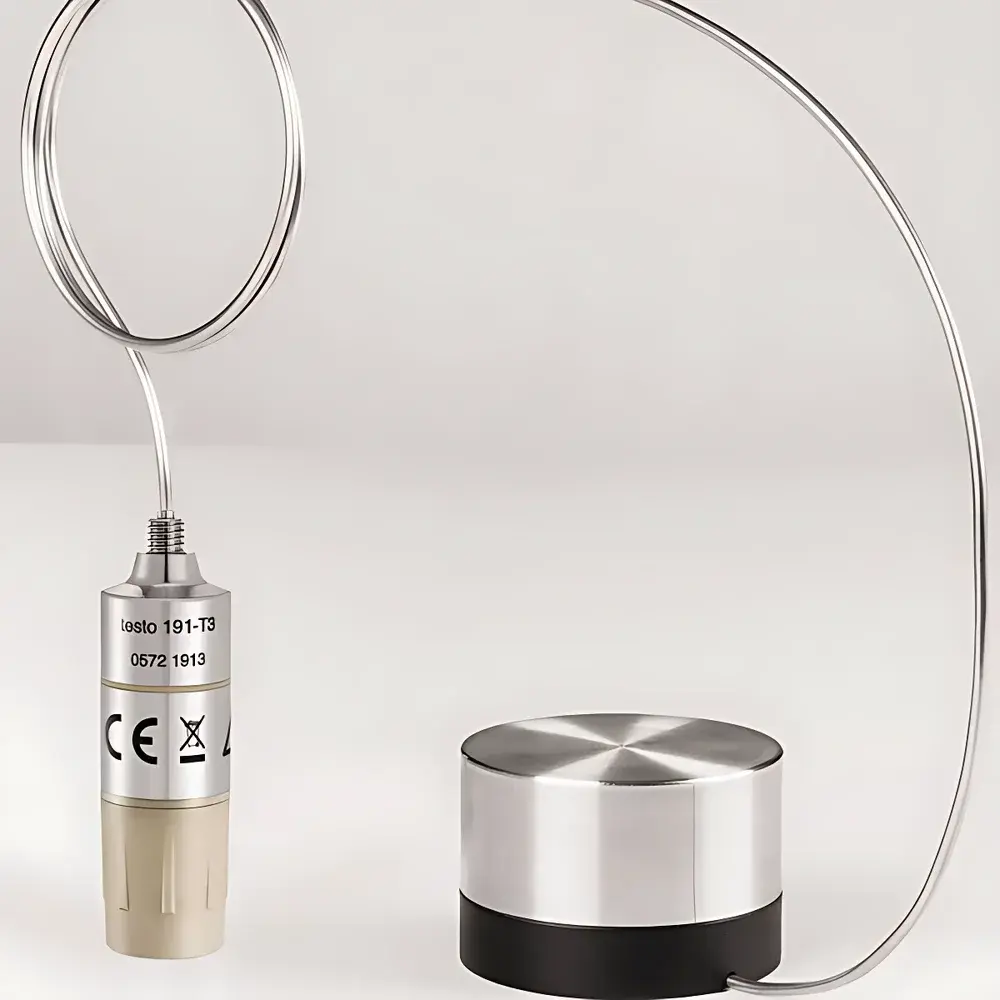
- Dual flexible Pt1000 probes (775 mm length, 1.5 mm diameter, 3 mm tip) enabling precise surface contact and liquid immersion measurements—even in geometrically constrained areas such as chamber corners, tray gaps, or freeze-dryer shelves.
- IP68-rated stainless steel housing with hermetic PEEK-sealed battery compartment—maintains full ingress protection after battery replacement without tools or recalibration.
- Tool-free, rotational-thread battery access allowing sub-5-second battery swaps—minimizing downtime during multi-cycle validation runs.
- Compact cylindrical form factor (Ø20 × 72 mm) optimized for insertion into narrow ducts, sterilization trays, and lyophilizer manifolds without compromising probe positioning fidelity.
- High-density memory: 30,000 timestamped readings per channel (60,000 total), supporting extended validation runs at configurable intervals from 1 second to 24 hours.
- Extended operational range: –50 °C to +140 °C, with certified accuracy of ±0.1 °C between –40 °C and +140 °C—validated per DIN EN 60751 and calibrated against accredited reference standards.
Sample Compatibility & Compliance
The testo 191-T4 is validated for direct contact with food-grade surfaces, stainless-steel process equipment, silicone gaskets, and pharmaceutical-grade elastomers. Its probes are compatible with standard freeze-dryer probe mounts (sold separately) and withstand repeated autoclaving at 121 °C for 30 minutes per cycle. The device conforms to CE marking requirements under the EU Electromagnetic Compatibility Directive 2014/30/EU and the Low Voltage Directive 2014/35/EU. For regulated environments, its use aligns with FDA guidance on electronic records (21 CFR Part 11) when paired with testo 191 Professional software configured for user authentication, electronic signatures, and immutable audit trails. It supports GLP/GMP-aligned workflows through documented calibration certificates (provided at shipment) and firmware version traceability.
Software & Data Management
Data configuration, retrieval, and analysis are executed via testo 191 Professional software (sold separately), a Windows-based application compliant with ICH E6(R3) and Annex 11 principles. The software enables batch programming of up to eight testo 191-T4 loggers simultaneously using the optional multi-unit docking station—eliminating individual USB connections and reducing setup time by >70%. All measurement files are stored in encrypted .tdf format with embedded metadata (device ID, probe assignment, timestamp, operator ID). Export options include CSV, PDF reports with annotated limit violations, and Excel-compatible trend charts. Critical alarms (e.g., out-of-spec excursions) trigger visual alerts and automatic annotation within the timeline—facilitating root-cause analysis during regulatory audits.
Applications
- Pasteurization tunnel validation: mapping thermal profiles across conveyor belts and product carriers.
- Sterilization cycle verification: monitoring load temperature distribution inside autoclaves and SIP systems.
- Freeze-drying shelf mapping: capturing spatial temperature gradients during primary and secondary drying phases.
- Cold chain monitoring: continuous logging during frozen storage, transport, and blast freezing.
- HACCP plan verification: documenting critical control points (CCPs) for thermal processing steps per Codex Alimentarius guidelines.
FAQ
Does the testo 191-T4 support real-time data streaming?
No—it is a standalone logger designed for autonomous, high-integrity recording. Real-time telemetry is not supported; data is retrieved post-cycle via USB docking.
Can the probes be calibrated independently?
Yes—each Pt1000 probe is individually calibrated and certified; calibration certificates list channel-specific deviation values at multiple reference points (–40 °C, 0 °C, +100 °C).
Is the device suitable for steam sterilization validation (e.g., EN 285)?
Yes—its IP68 rating, stainless steel construction, and PEEK-sealed battery cap meet the mechanical and environmental requirements for Class B and Class S sterilizers per EN 285:2015 Annex C.
What is the maximum allowable measurement interval for long-term stability?
At 10-second intervals, battery life is rated for 2,500 hours at +121 °C; at 60-second intervals, runtime extends beyond 15,000 hours under equivalent thermal stress.
Does the testo 191-T4 comply with FDA 21 CFR Part 11?
The hardware itself is Part 11–capable; full compliance requires use of testo 191 Professional software with enabled audit trail, role-based access control, and electronic signature functionality.




