
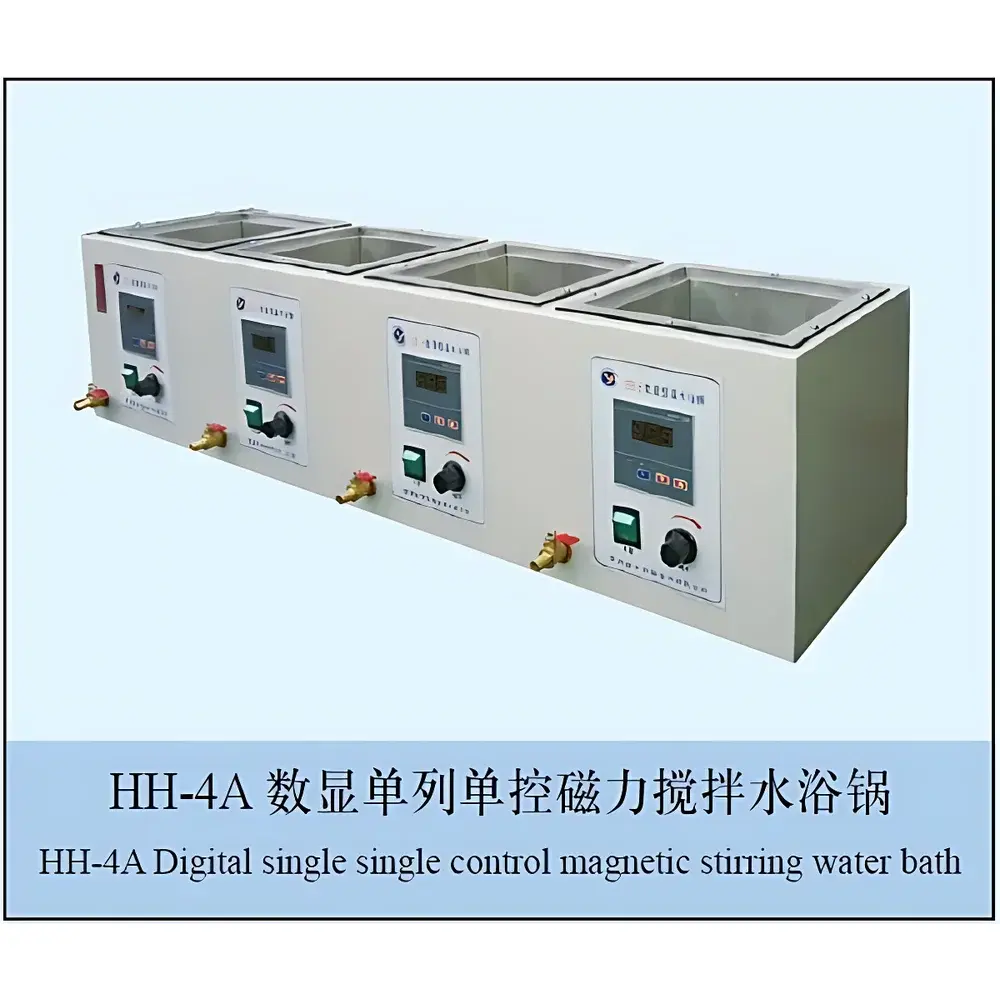
CZGY HH-4B Four-Position Four-Zone Magnetic Stirring Water Bath
| Brand | CZGY |
|---|---|
| Origin | Jiangsu, China |
| Manufacturer Type | Direct Manufacturer |
| Equipment Type | Water/Oil Bath Constant Temperature Unit |
| Circulation Mode | Internal Circulation |
| Power Supply | 220 V AC, 50 Hz |
| Tank Dimensions (per chamber) | 150 × 150 × 90 mm |
| Total Chambers | 4 independent stainless steel baths |
| Heating Power | 400 W × 4 |
| Temperature Range | Ambient to 100 °C |
| Temperature Control Accuracy | ±0.5 °C |
| Stirring Speed Range | 0–1600 rpm (adjustable per channel, knob-controlled) |
| Display | Digital LED temperature readout with individual SET key per zone |
Overview
The CZGY HH-4B Four-Position Four-Zone Magnetic Stirring Water Bath is an engineered solution for laboratories requiring simultaneous, independent thermal and mechanical control across multiple samples. Designed around the principle of conductive heat transfer via liquid-phase medium (water or oil), the unit maintains precise, stable temperatures in four physically isolated stainless steel chambers—each equipped with a dedicated resistive heating element, PID-based digital temperature controller, and embedded magnetic stirrer. Unlike single-zone water baths, the HH-4B eliminates cross-contamination risk and thermal interference between samples while enabling comparative studies under divergent thermal protocols (e.g., enzyme kinetics at 37 °C vs. denaturation at 95 °C). Its architecture supports both direct bath stirring (for uniform thermal equilibration of the medium itself) and vessel-based stirring (for homogeneous mixing of reaction solutions in beakers or flasks placed within each well). The system operates without external coolant or pump integration, relying solely on internal convection and forced magnetic agitation to achieve rapid thermal response and high reproducibility—critical for applications governed by ISO/IEC 17025-compliant calibration workflows.
Key Features
- Four independent temperature-controlled zones with individual digital displays and SET-key interface for real-time setpoint adjustment
- Stainless steel inner tank construction (304 grade) ensures corrosion resistance, ease of cleaning, and long-term dimensional stability under repeated thermal cycling
- Dual-mode stirring capability: configurable for either bath-medium agitation (enhancing thermal homogeneity) or sample-vessel agitation (enabling kinetic control in open containers)
- Knob-based analog speed control per channel (0–1600 rpm), providing tactile feedback and eliminating software dependency for routine operation
- Integrated safety architecture: ground-fault protected power input, automatic over-temperature cutoff, and low-water-level detection circuitry to prevent dry-heating damage
- Cold-rolled steel exterior with epoxy powder coating delivers mechanical robustness and resistance to laboratory solvents and humidity
Sample Compatibility & Compliance
The HH-4B accommodates standard laboratory glassware including 50–500 mL beakers, Erlenmeyer flasks, and cylindrical digestion vessels up to 12 cm diameter—compatible with common borosilicate and Pyrex materials. Each chamber accepts magnetic stir bars ranging from 20 to 40 mm length, supporting viscosity ranges typical of aqueous buffers, organic solvents, and low-concentration polymer solutions (up to ~500 mPa·s). From a regulatory standpoint, the device meets IEC 61010-1:2010 requirements for electrical safety in laboratory equipment. While not intrinsically compliant with FDA 21 CFR Part 11 due to its analog control interface, it supports GLP/GMP-aligned documentation when paired with external data loggers (e.g., calibrated thermocouple arrays + timestamped CSV export). It is routinely deployed in environments adhering to ASTM D1557 (soil compaction), USP (compounding sterile preparations), and ISO 5667-3 (water sampling preservation).
Software & Data Management
The HH-4B operates as a standalone instrument with no embedded firmware, cloud connectivity, or proprietary software dependencies. Temperature setpoints and stirring speeds are adjusted manually via front-panel controls, ensuring operational continuity during IT infrastructure outages or cybersecurity restrictions. For traceable data acquisition, users may integrate third-party USB or RS-485 temperature loggers (e.g., Omega OM-DAQPRO-5300 series) connected to the unit’s auxiliary PT100 output terminals (available on optional configuration). All controllers retain last-set parameters after power interruption, minimizing protocol restart overhead. Audit trails—when required—are maintained externally through lab notebook entries or LIMS-integrated electronic records referencing batch IDs, operator initials, and start/end timestamps.
Applications
- Simultaneous multi-temperature enzymatic assays (e.g., comparative Michaelis-Menten analysis across pH/temperature gradients)
- Controlled solvent evaporation and concentration of HPLC fractions under inert atmosphere (with optional lid modification)
- Pre-incubation of cell culture reagents, antibody dilutions, and PCR master mixes prior to downstream processing
- Standardization of viscometric reference fluids per ASTM D2196 before rotational rheometer calibration
- Accelerated stability testing of pharmaceutical suspensions per ICH Q1A(R2) guidelines
- Extraction efficiency optimization in Soxhlet and reflux setups using parallel solvent boiling points
FAQ
Can the HH-4B operate with oil as the heating medium?
Yes—the unit is rated for use with silicone oil, mineral oil, or glycerol up to 100 °C; however, maximum safe operating temperature must be validated against the specific oil’s flash point and thermal degradation threshold.
Is external cooling capability available?
No—the HH-4B provides only heating and stirring functions; active cooling requires integration with a separate recirculating chiller via external manifold adaptation.
What maintenance is required for long-term accuracy?
Annual verification of temperature uniformity (±0.3 °C across each chamber at 37 °C and 70 °C) using NIST-traceable RTD probes is recommended; stir bar magnetism should be checked quarterly for demagnetization effects.
Does the unit support remote monitoring or Ethernet connectivity?
Not natively—this is a benchtop analog-digital hybrid instrument designed for local operation; digital telemetry requires external data acquisition hardware.
How is calibration performed?
Calibration follows ISO/IEC 17025 Section 6.5: users verify setpoint accuracy at three points (e.g., 25 °C, 50 °C, 85 °C) using a certified reference thermometer, adjusting offset values if deviation exceeds ±0.5 °C.



