
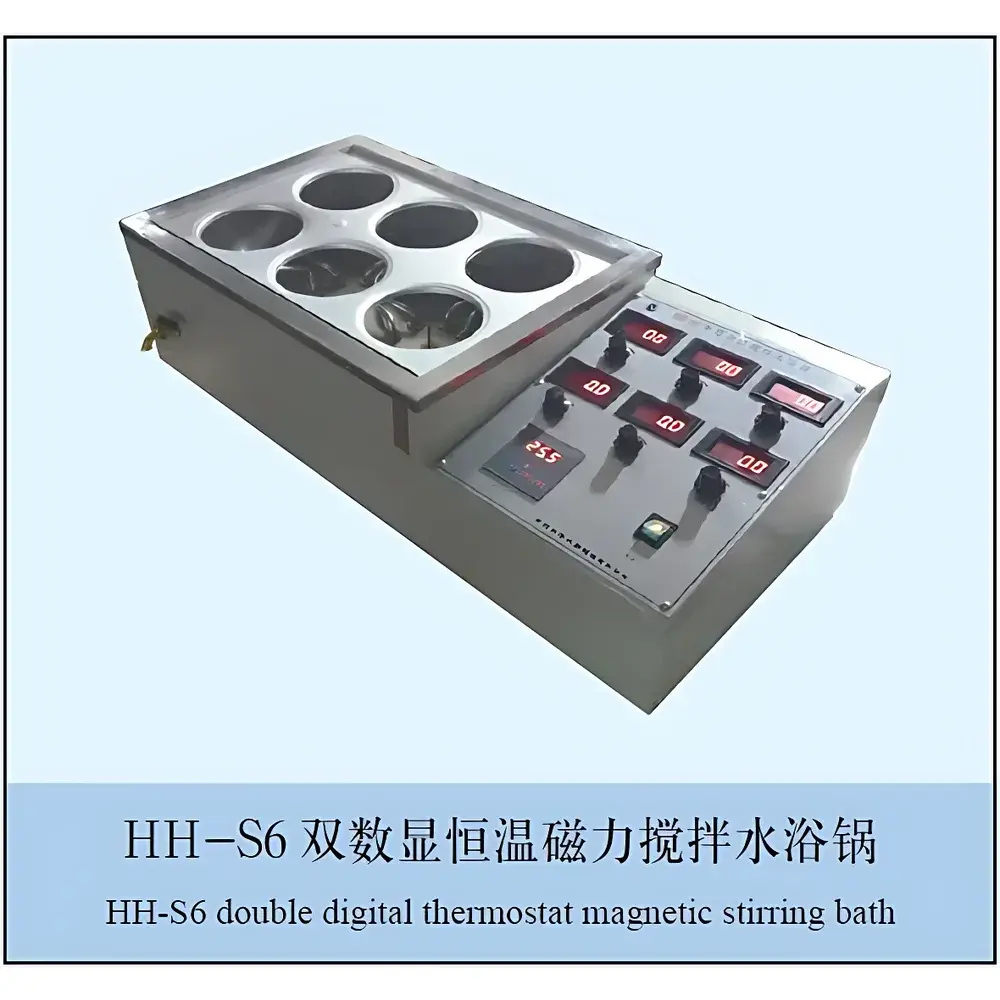
CZGY HH-S6 Plus Dual-Digital Display Magnetic Stirring Water Bath
| Brand | CZGY |
|---|---|
| Origin | Jiangsu, China |
| Manufacturer Type | Direct Manufacturer |
| Product Category | Domestic |
| Model | HH-S6 Plus |
| Instrument Type | Water Bath / Oil Bath |
| Circulation Function | Non-Circulating |
| Power Supply | 220 V AC, 50 Hz |
| Tank Dimensions | 400 × 300 × 120 mm (L×W×H) |
| Heating Power | 1500 W |
| Temperature Range | Ambient to 100 °C |
| Temperature Control Accuracy | ±0.5 °C |
| Stirring Speed Range | 0–2000 rpm |
| Independent Speed Control Channels | 6 |
| Digital Speed Display | Yes (per channel) |
| Construction | Stainless Steel Inner Bath, Cold-Rolled Steel Outer Casing with Epoxy Powder Coating |
| Safety Features | Grounded 3-Pin Plug, Over-Temperature Protection (Implied), Dry-Run Prevention Advisory |
Overview
The CZGY HH-S6 Plus Dual-Digital Display Magnetic Stirring Water Bath is an engineered laboratory thermal platform designed for precise temperature maintenance and homogeneous mixing of multiple samples simultaneously. It operates on the principle of resistive immersion heating combined with permanent-magnet-driven magnetic stirring—enabling independent control of thermal and mechanical energy inputs across six discrete positions. Unlike circulating baths, this unit relies on natural convection within the water or oil medium, supplemented by localized agitation to minimize thermal gradients and ensure uniform heat transfer to vessels placed directly above the heating elements. Its dual-digital interface provides real-time, independent readouts for both setpoint temperature and actual stirring speed per channel—critical for method reproducibility in applications requiring strict adherence to standardized protocols such as ASTM D129, ISO 6298, or USP compounding workflows where thermal stability and mixing consistency directly impact reaction kinetics and solute homogeneity.
Key Features
- Dual digital display system: separate LED readouts for temperature setpoint/actual and individual stirring speed (0–2000 rpm) across all six stations
- Six independent magnetic stirrer circuits with dedicated speed controls—enabling heterogeneous experimental conditions within a single bath
- Stainless steel inner tank (400 × 300 × 120 mm) fabricated from corrosion-resistant 304-grade material, welded for leak integrity and long-term chemical compatibility
- Robust outer housing constructed from cold-rolled steel with electrostatic epoxy powder coating for enhanced durability and resistance to lab-grade solvents and humidity
- PID-based temperature controller with adjustable parameters (P, T, E) supporting fine-tuned thermal response and reduced overshoot during ramp-up phases
- 1500 W high-efficiency heating element optimized for rapid warm-up and stable hold performance across the full 0–100 °C range
- Integrated safety architecture: grounded 3-pin power input, dry-run advisory logic (user-guided minimum water level of 3 cm above heater), and thermal cut-off protection
Sample Compatibility & Compliance
The HH-S6 Plus accommodates standard laboratory glassware including 50–500 mL beakers and Erlenmeyer flasks up to 12 cm diameter, compatible with both aqueous and low-viscosity oil media (e.g., silicone oil, mineral oil). Its non-circulating design meets requirements for static immersion applications defined in ISO 17025-accredited laboratories where fluid cross-contamination must be avoided. While not certified to IEC 61010-1 or UL 61010B out-of-the-box, its construction aligns with general electrical safety expectations for Class I laboratory equipment operating under GLP/GMP-aligned environments. Users performing regulated work should validate thermal uniformity per SOP using calibrated PT100 probes and document stirring consistency via rotational speed verification traceable to NIST standards.
Software & Data Management
This instrument operates as a standalone analog-digital hybrid system with no embedded firmware or network connectivity. All parameter adjustments—including temperature setpoint, PID tuning constants (P, T, E), and individual stir speeds—are performed manually via front-panel push buttons and rotary dials. No data logging, remote control, or audit trail functionality is provided; therefore, it complies with FDA 21 CFR Part 11 only when used in conjunction with external validated recording systems (e.g., chart recorders or LIMS-integrated thermocouple arrays). For quality-critical processes, users are advised to implement manual logbook entries or integrate third-party USB data acquisition modules compliant with ISO/IEC 17025 documentation requirements.
Applications
- Controlled-temperature enzymatic reactions and protein denaturation studies requiring simultaneous multi-vessel incubation
- Extraction protocols (e.g., Soxhlet pre-extraction, herbal active compound isolation) where consistent thermal input and agitation prevent sedimentation
- Standardization of viscosity reference measurements using capillary or rotational methods at fixed bath temperatures
- Preparation of calibration standards for spectrophotometry, titration, and chromatography—particularly in environmental and pharmaceutical QC labs
- Drying and concentration of heat-labile biological samples under gentle convective-oil conditions (when operated as oil bath)
- Teaching laboratories conducting kinetic experiments across parallel reaction conditions without cross-talk between stations
FAQ
What is the maximum recommended oil volume for safe operation as an oil bath?
The tank’s internal volume is approximately 14.4 L. When used with oil, maintain fill level ≥3 cm above the heating element and ≤2 cm below the top rim to prevent overflow during thermal expansion.
Can this unit be used for sterilization procedures?
No. It lacks steam generation, pressure containment, or validated microbial kill cycles; it is not suitable for autoclaving or depyrogenation.
Is the stainless steel bath resistant to nitric acid or hydrochloric acid solutions?
304 stainless steel offers limited resistance to halide-containing acids. Prolonged exposure to HCl or HNO₃ may cause pitting. Use only with neutral or mildly alkaline aqueous media unless protected by borosilicate glass inserts.
Does the unit include a calibration certificate?
No factory-issued calibration certificate is supplied. Users must perform initial and periodic verification using traceable reference thermometers and tachometers per internal QA procedures.
How often should the water be changed to maintain optimal thermal performance?
Distilled or deionized water should be replaced after each use if contamination risk exists; otherwise, weekly replacement is recommended to inhibit scale formation and microbial growth in non-sterile settings.



