
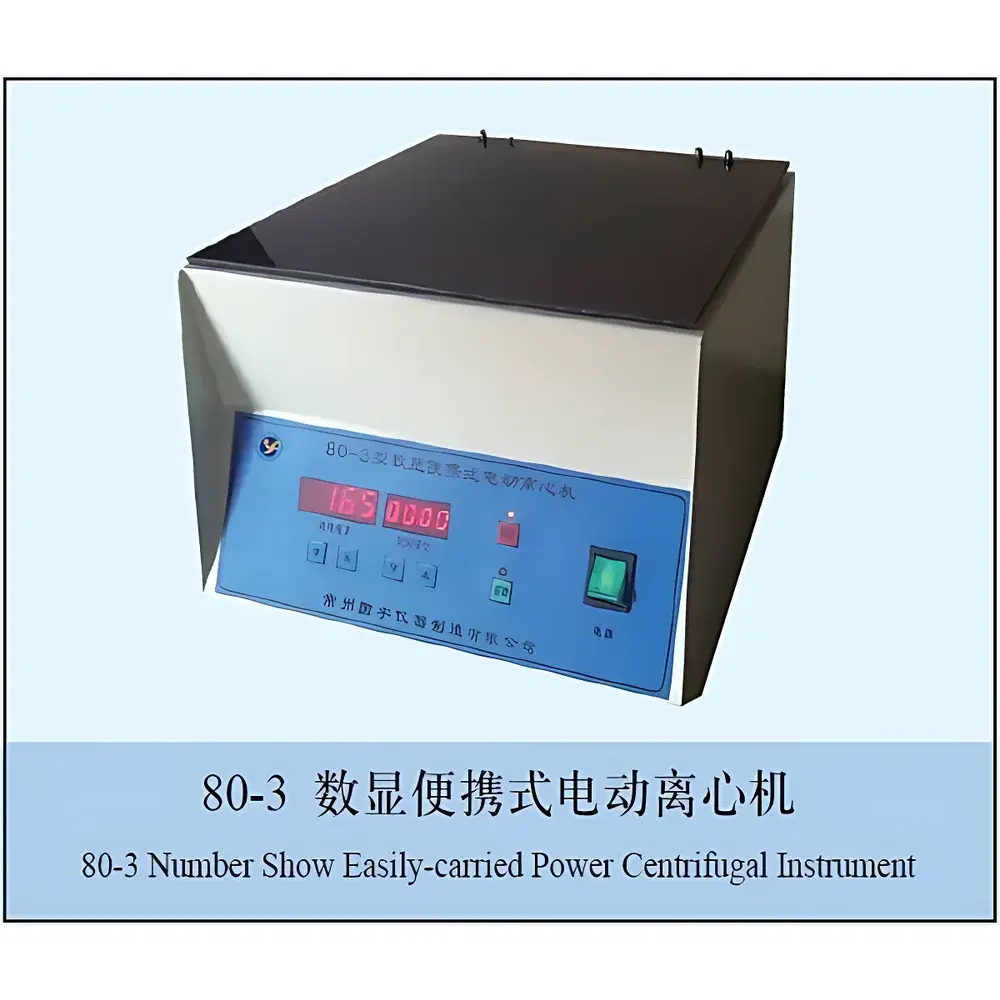
CZGY 80-3 Digital Display Portable Centrifuge
| Brand | CZGY |
|---|---|
| Origin | Jiangsu, China |
| Manufacturer Type | Direct Manufacturer |
| Country of Origin | China |
| Model | 80-3 |
| Max Capacity | 12 × 20 mL |
| Max Speed | 0–4000 rpm |
| Dimensions | 29 × 33 × 26 cm |
| Power Supply | 220 V, 50 Hz |
| Rated Power | 80 W |
| RCF (Relative Centrifugal Force) | 1960 × g (at 4000 rpm) |
| Timer Range | 0–99 min |
| Safety | Grounded operation required |
| Compliance | Designed for GLP-aligned laboratory workflows |
Overview
The CZGY 80-3 Digital Display Portable Centrifuge is a compact, benchtop centrifugation system engineered for routine separation tasks in clinical diagnostics, biomedical research, and quality control laboratories. It operates on the principle of sedimentation under controlled rotational acceleration—generating relative centrifugal force (RCF) to separate components based on density differentials in liquid samples. With a maximum speed of 4000 rpm and an RCF of up to 1960 × g, this unit delivers sufficient force for plasma/serum separation, cellular pellet formation, precipitate recovery, and preliminary purification of biological macromolecules. Its portable footprint (29 × 33 × 26 cm) and lightweight construction make it suitable for space-constrained environments including field clinics, mobile labs, and teaching laboratories where plug-and-play reliability is essential.
Key Features
- Digital LED display for real-time monitoring of rotational speed (rpm) and remaining timer duration—enabling precise protocol adherence without manual estimation.
- Stepless speed control from 0 to 4000 rpm with smooth acceleration/deceleration profiles to minimize sample disturbance and rotor stress.
- Integrated mechanical timer with 1-minute resolution across a 0–99 minute range; auto-stop function ensures reproducible run termination.
- Robust aluminum alloy housing with reinforced polymer lid assembly; transparent polycarbonate lid provides full visual access while maintaining acoustic dampening and airflow containment.
- Fixed-angle rotor configuration accommodating twelve 20 mL conical or cylindrical tubes (e.g., standard polypropylene centrifuge tubes), optimized for balanced loading and thermal stability during operation.
- Ground-fault protected power input (220 V, 50 Hz) and low-noise brush motor design compliant with IEC 61000-3-2 harmonic emission standards.
Sample Compatibility & Compliance
The 80-3 supports common laboratory tube formats including glass, polypropylene, and polycarbonate vessels rated for ≥2000 × g. Tube mass imbalance must not exceed ±3 g per position to ensure mechanical integrity and bearing longevity. While not certified for biosafety level (BSL)-2 or higher containment, the unit meets basic electrical safety requirements per GB 4793.1–2007 (equivalent to IEC 61010-1) and is routinely deployed in settings adhering to Good Laboratory Practice (GLP) frameworks. It does not incorporate features required for FDA 21 CFR Part 11 compliance (e.g., electronic audit trails or user authentication), but its digital timer and speed readout support traceable manual recordkeeping per ISO/IEC 17025 documentation practices.
Software & Data Management
This centrifuge operates as a standalone electromechanical instrument with no embedded firmware, network interface, or proprietary software. All operational parameters—including set speed, elapsed time, and final RCF—are displayed locally via dual seven-segment LED indicators. Users are expected to log run conditions manually into laboratory notebooks or LIMS-compatible spreadsheets. For institutions requiring digital integration, external USB data loggers (e.g., HOBO UX120 series) may be mounted adjacent to the unit to capture ambient temperature and vibration signatures during operation—supporting preventive maintenance scheduling and environmental correlation studies.
Applications
- Routine serum/plasma separation from whole blood specimens in hospital clinical chemistry and hematology labs.
- Preparative isolation of cellular fractions (e.g., erythrocytes, leukocytes) in immunology and vaccine development workflows.
- Concentration of suspended particles in urine sediment analysis and microbiological culture supernatants.
- Removal of insoluble aggregates from protein solutions prior to electrophoresis or HPLC injection.
- Teaching applications in undergraduate biochemistry and molecular biology courses—demonstrating sedimentation kinetics and rotor dynamics principles.
- Field-deployable processing of environmental water samples for subsequent filtration or nucleic acid extraction protocols.
FAQ
What is the maximum relative centrifugal force (RCF) achievable with this model?
At 4000 rpm and a rotor radius of approximately 10.5 cm (typical for fixed-angle 12-position rotors), the calculated RCF is 1960 × g.
Can this centrifuge accommodate microcentrifuge tubes (1.5–2.0 mL)?
No—the rotor is dimensionally configured for 20 mL tubes only; adapters for smaller formats are not supplied or validated by the manufacturer.
Is the motor brushless or brushed?
It utilizes a maintenance-interval-rated brushed DC motor, optimized for cost-effective long-term operation at moderate speeds.
Does the unit include automatic rotor identification or imbalance detection?
No—imbalance protection relies solely on user verification of symmetrical tube loading and adherence to the ±3 g mass tolerance guideline.
What maintenance procedures are recommended?
Wipe exterior surfaces with 70% ethanol after each use; inspect rotor threads and lid latch mechanism monthly; lubricate pivot points annually using silicone-based grease approved for laboratory equipment.



