
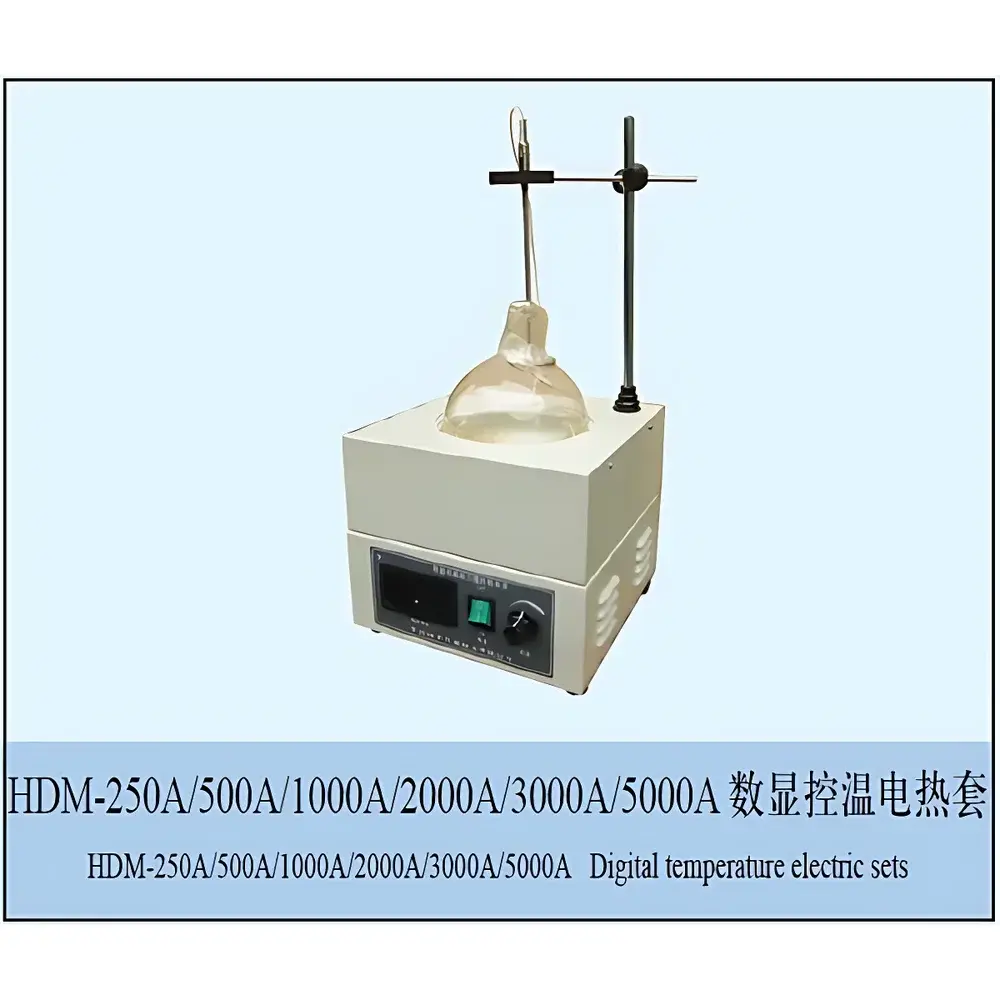
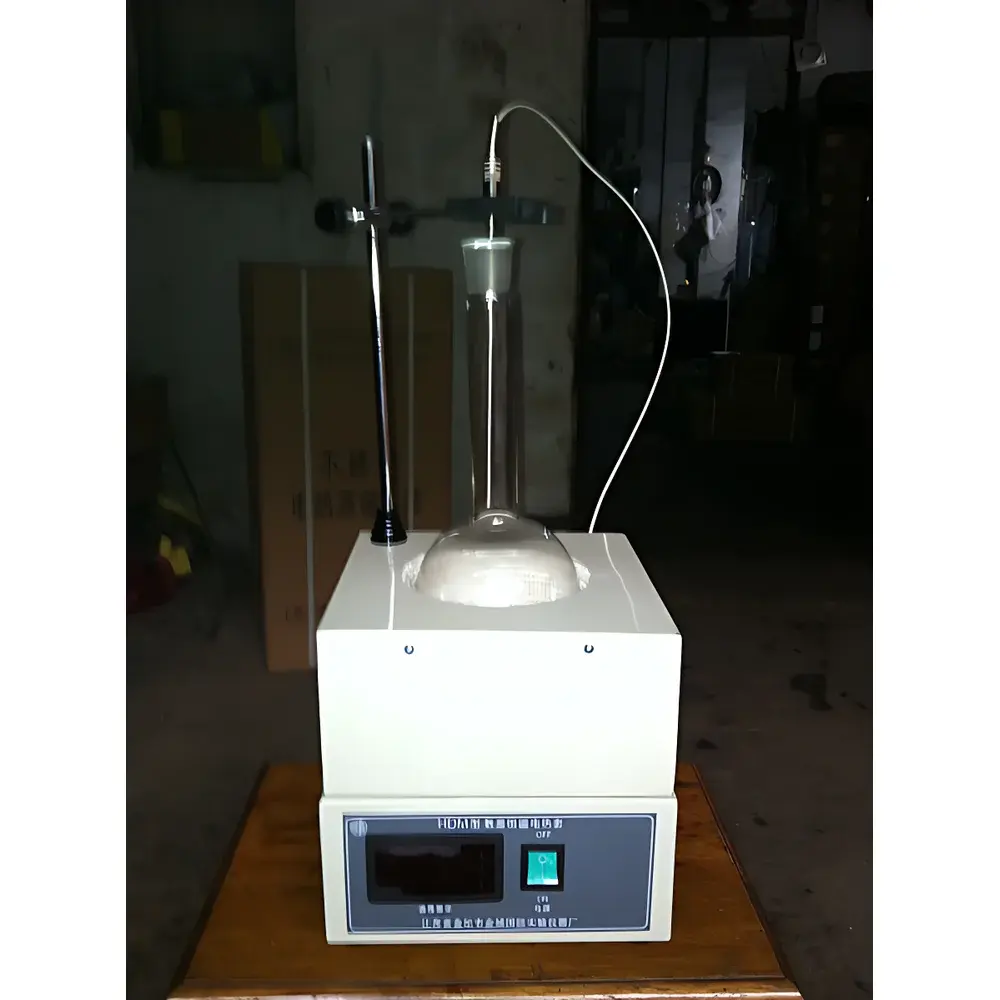
CZGY HDM Series Digital Temperature-Controlled Electric Heating Mantle
| Brand | CZGY |
|---|---|
| Origin | Jiangsu, China |
| Manufacturer Type | Direct Manufacturer |
| Model | HDM-250A / HDM-500A / HDM-1000A / HDM-2000A / HDM-3000A / HDM-5000A |
| Rated Voltage | 220 V ±10% |
| Frequency | 50 Hz ±2 Hz |
| Temperature Range | Ambient +30 °C to 300 °C (digital display) |
| Control Accuracy | ±1 °C |
| Heating Power | 300–1500 W |
| Capacity | 250–5000 mL |
| Insulation Material | High-Temperature Alkali-Free Glass Fiber |
| Heating Element | Sealed Nichrome Wire |
Overview
The CZGY HDM Series Digital Temperature-Controlled Electric Heating Mantle is an engineered solution for precise, flameless, and uniform heating of laboratory glassware in academic, pharmaceutical, petrochemical, environmental, and fine chemical laboratories. Based on resistive heating principles, the mantle integrates a sealed nichrome wire heating element embedded within alkali-free glass fiber insulation—providing thermal stability, electrical safety, and mechanical resilience. Unlike open-coil heaters or hot plates, the semi-spherical mantle design ensures maximal surface contact with round-bottom flasks and reaction vessels, minimizing thermal gradients and reducing the risk of localized overheating or glass fracture. Its digital PID temperature controller enables stable setpoint maintenance across the full operating range (ambient +30 °C to 300 °C), making it suitable for reflux, distillation, solvent evaporation, and controlled synthesis protocols where reproducible thermal input is critical.
Key Features
- Digitally Controlled PID Regulation: Equipped with a microprocessor-based controller supporting adjustable proportional (P), integral (I), and derivative (D) parameters—enabling fine-tuned response to thermal load variations and minimizing overshoot during ramp-up.
- Wide Capacity Range: Six standardized models (HDM-250A to HDM-5000A) accommodate vessels from 250 mL to 5000 mL, ensuring compatibility with common laboratory flask sizes including 100/250/500/1000/2000/3000/5000 mL round-bottom flasks.
- High-Efficiency Thermal Architecture: The woven semi-spherical mantle geometry maximizes heat transfer area while maintaining low thermal mass—resulting in rapid warm-up times and improved energy efficiency compared to flat-surface heaters.
- Electrical & Operational Safety: Grounded construction, Class H insulation rating (180 °C continuous), and automatic over-temperature alarm (AL parameter) mitigate risks associated with prolonged operation or sensor drift. Initial conditioning protocol (low-power smoke-out cycle) ensures long-term dielectric integrity of the glass fiber matrix.
- User-Configurable Parameters: Advanced settings—including measurement offset (Sc), output hysteresis (HY), and parameter lock level (Lck)—support calibration traceability and lab-specific SOP compliance without requiring firmware access.
Sample Compatibility & Compliance
The HDM series is designed exclusively for use with standard borosilicate glass apparatus (e.g., Pyrex®, Kimax®). It is not intended for direct contact with metallic reactors, plastic vessels, or pressurized systems. While not certified to IEC 61010-1 or UL 61010B as a standalone appliance, its construction adheres to general laboratory equipment safety expectations under ISO/IEC 17025-accredited environments when operated per manufacturer instructions. The absence of magnetic stirring eliminates electromagnetic interference concerns in sensitive analytical setups. For GLP/GMP-regulated workflows, users may document calibration events using the Sc (sensor offset) and AL (alarm threshold) parameters to support audit readiness. Note: As a Class II non-medical device, it falls outside FDA 21 CFR Part 11 scope but supports manual recordkeeping compatible with Annex 11-aligned data integrity practices.
Software & Data Management
This analog-digital hybrid instrument does not feature USB, Ethernet, or Bluetooth connectivity. Temperature setpoints and real-time readings are displayed via dual 4-digit LED indicators (set value / actual value). All configuration changes—including P/I/D tuning, Sc correction, and Lck status—are stored in non-volatile memory and persist through power cycles. While no proprietary software is provided, the parameter structure aligns with widely adopted industrial PID conventions, enabling integration into custom LabVIEW™ or Python-based monitoring scripts via optional RS-485 interface modules (sold separately). Raw temperature logs must be manually recorded; however, the ±1 °C control accuracy and <0.5 °C short-term repeatability support robust manual trending for QC/QA documentation.
Applications
- Controlled heating of reaction mixtures in organic synthesis and catalysis studies
- Reflux and fractional distillation in teaching and research labs
- Solvent removal and concentration steps in sample preparation workflows
- Pre-heating of reagents prior to injection into GC or HPLC systems
- Thermal conditioning of viscosity standards before rheometer calibration
- Stabilization of enzymatic assay temperatures in biochemistry labs (within 30–80 °C range)
FAQ
Is the HDM mantle compatible with all standard round-bottom flasks?
Yes—each model corresponds to nominal flask capacities (e.g., HDM-1000A fits 1000 mL flasks), and the flexible fiberglass body conforms to typical taper angles (24/40, 29/32, 45/50).
Does it require external calibration equipment?
No routine recalibration is needed. However, if field verification is required, a calibrated PT100 probe inserted into the flask neck (not contacting the mantle surface) can validate displayed temperature against actual liquid-phase temperature.
Can it be used in fume hoods without performance loss?
Yes—the mantle operates independently of ambient airflow and maintains setpoint accuracy even under moderate draft conditions typical of Class I or II hoods.
What is the recommended conditioning procedure before first use?
Power on at 50 °C for 15 minutes, then increase by 20 °C increments every 10 minutes until reaching 150 °C. Repeat until no visible smoke occurs. This drives off residual binder volatiles from the glass fiber insulation.
Is grounding mandatory?
Yes—grounding is essential for operator safety and noise suppression in adjacent electronic instrumentation. Operation without proper earth connection violates basic electrical safety requirements per IEC 60364-4-41.



