
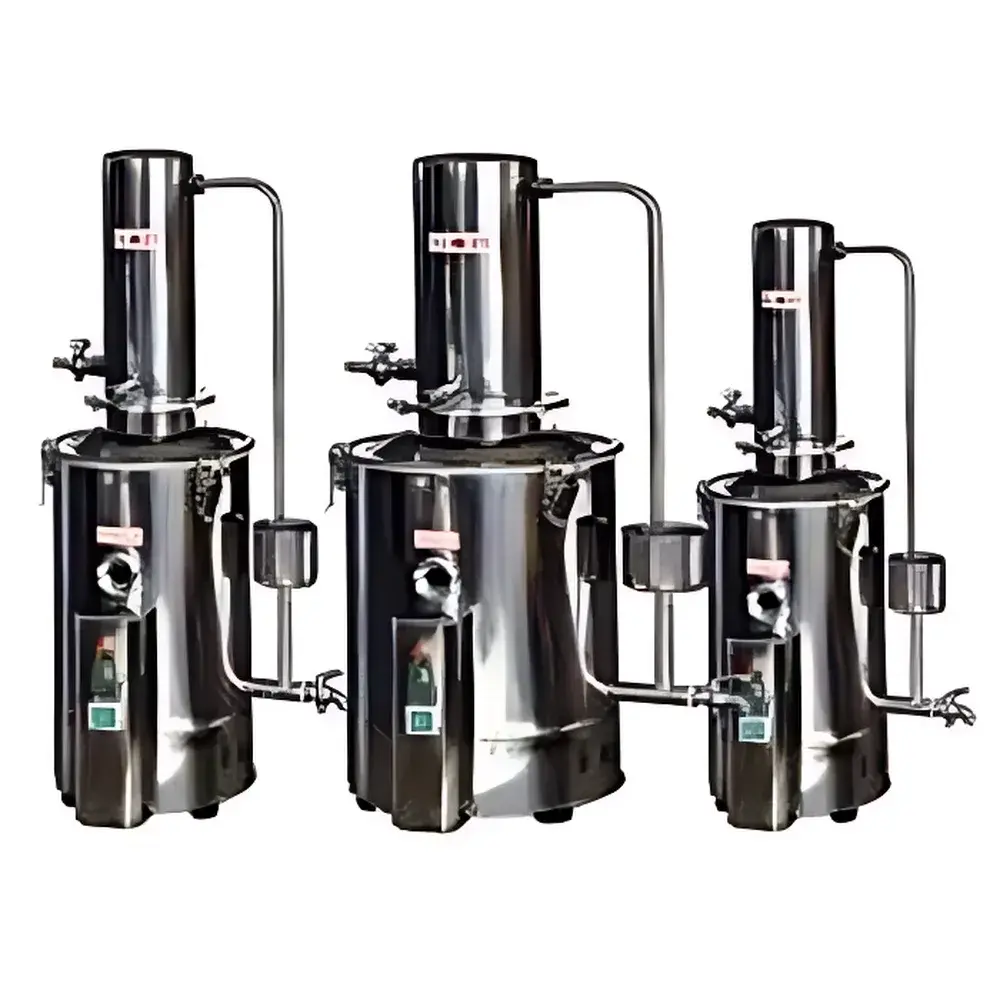
CZGY HS.Z11 Series Stainless Steel Sub-boiling Distillation Apparatus
| Brand | CZGY |
|---|---|
| Origin | Jiangsu, China |
| Manufacturer Type | Direct Manufacturer |
| Equipment Type | Sub-boiling Distiller |
| Model | HS.Z11.5 / HS.Z11.10 / HS.Z11.20 |
| Output Rate | 5 L/h / 10 L/h / 20 L/h |
| Power Consumption | 4.5 kW / 7.5 kW / 15 kW |
| Input Voltage | 220 V (HS.Z11.5) / 380 V (HS.Z11.10 & HS.Z11.20) |
| Compliance | Meets Chinese Pharmacopoeia requirements for distilled water when feed water conforms to GB 5749–2022 (formerly TJ20-76) |
Overview
The CZGY HS.Z11 Series Stainless Steel Sub-boiling Distillation Apparatus is a laboratory-grade water purification system engineered for continuous, high-reliability production of Type II purified water via thermal distillation. Operating on the principle of sub-boiling evaporation—where feed water is heated below its atmospheric boiling point to minimize volatile impurity carryover—the unit delivers distilled water with low ionic residue, negligible organic extractables, and consistent compliance with pharmacopeial specifications (Chinese Pharmacopoeia, ChP). Designed for sustained operation in regulated environments—including pharmaceutical QC labs, clinical diagnostics centers, electroplating facilities, and university research laboratories—the apparatus integrates robust thermal management, fail-safe water-level control, and corrosion-resistant construction to ensure long-term stability and reproducible output quality.
Key Features
- Electropolished 304 stainless steel evaporator chamber fabricated by precision roll-forming and TIG welding—resistant to pitting, scaling, and chloride-induced stress corrosion.
- Integrated sub-boiling heating system using immersion-type tubular heaters with oxygen-free copper sheaths (TX-grade), providing uniform thermal distribution and extended service life under continuous load.
- Counter-current stainless steel shell-and-tube condenser with optimized surface-area-to-volume ratio, achieving >92% thermal exchange efficiency and maintaining distillate temperature at ≤40 °C to reduce post-condensation recontamination.
- Automatic water-level regulation via float-controlled solenoid valve; maintains optimal liquid level in evaporator even during variable inlet pressure or prolonged operation.
- Dual-safety design: overheat cut-off switch (resettable bimetallic thermostat) and dry-run protection circuit prevent heater damage if coolant flow is interrupted.
- Front-accessible drain valve and removable inspection port facilitate routine descaling using mild acidic (e.g., 2–5% citric acid) or alkaline cleaning solutions—fully compatible with GLP-mandated maintenance logs.
Sample Compatibility & Compliance
The HS.Z11 series accepts municipal tap water meeting GB 5749–2022 (China’s National Standard for Drinking Water Quality) as feedstock. Under these conditions, the resulting distillate satisfies ChP General Chapter 0261 “Purified Water” for conductivity (≤1.3 μS/cm at 25 °C), non-volatile residue (<1 mg/100 mL), and absence of heavy metals and microbial contaminants. While not certified to ISO 3696:1987 or ASTM D1193 Type II without third-party validation, the unit’s design aligns with core engineering prerequisites for GMP Annex 1-compliant water systems—particularly in pre-treatment and point-of-use distillation roles. All wetted surfaces comply with FDA 21 CFR 178.3570 (indirect food additives: adjuvants and production aids).
Software & Data Management
This is a standalone analog-operated distillation system with no embedded microprocessor or digital interface. Operational parameters—including inlet water pressure, cooling water temperature (monitored via calibrated glass thermometer port), and distillate flow rate—are manually recorded per GLP/GMP documentation protocols. The unit supports integration into facility-wide monitoring networks via optional external PT100 sensors (not included) and analog 4–20 mA signal transmitters for centralized SCADA logging. Audit trails, electronic signatures, and 21 CFR Part 11 compliance require integration with validated LIMS or ELN platforms—no native software is provided.
Applications
- Preparation of solvent-grade water for HPLC mobile phase preparation and ICP-MS diluent blanks.
- Feed water for ultra-pure water systems (e.g., as pretreatment stage before EDI or UV oxidation).
- Production of injection-grade water precursors in non-sterile pharmaceutical manufacturing support areas.
- Calibration standard preparation in analytical chemistry laboratories requiring low-conductivity baselines.
- Continuous supply of low-residue water for electroplating bath replenishment and semiconductor rinse processes.
- Educational use in undergraduate physical chemistry labs demonstrating phase-change thermodynamics and separation efficiency principles.
FAQ
What feed water quality is required to meet pharmacopeial specifications?
Feed water must conform to GB 5749–2022 (or equivalent national drinking water standards), with total hardness < 250 mg/L CaCO₃ and free chlorine < 0.5 mg/L. Pre-filtration through 5 µm sediment and activated carbon cartridges is strongly recommended for municipal supplies with variable turbidity or chloramine residuals.
Can this unit operate unattended overnight?
Yes—provided inlet water pressure remains stable (0.15–0.4 MPa), ambient cooling water temperature stays below 30 °C, and the unit is installed on a level, vibration-isolated surface. A mechanical timer (not supplied) may be added for scheduled shutdown.
How often should descaling be performed?
Under typical municipal feed water conditions, descaling every 100–150 operating hours is advised. Frequency increases proportionally with feed water hardness; units operating on well water (>300 mg/L CaCO₃) require weekly maintenance.
Is validation documentation available?
Factory test reports (including material certificates, weld maps, and pressure test records) are supplied with each unit. IQ/OQ protocol templates compliant with ISO/IEC 17025 and WHO TRS 970 Annex 4 are available upon request for qualified customers.
What is the expected service life under proper maintenance?
With bi-weekly visual inspection, quarterly descaling, and annual heater resistance verification, the evaporator and condenser assemblies maintain functional integrity for ≥8 years; heating elements typically last 3–5 years depending on duty cycle and water quality.



