
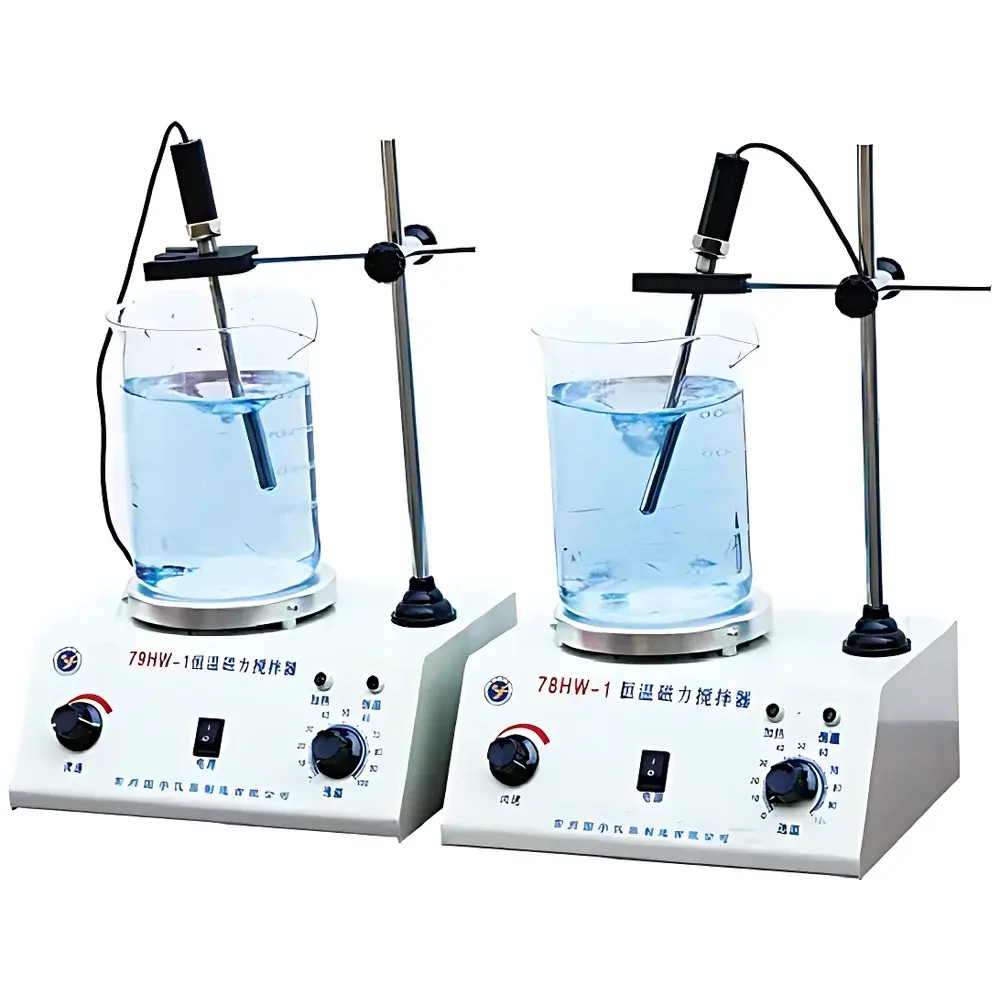
CZGY 78HW-1 Constant-Temperature Magnetic Stirrer
| Brand | CZGY |
|---|---|
| Origin | Jiangsu, China |
| Manufacturer Type | Direct Manufacturer |
| Instrument Type | Magnetic Stirrer |
| Model | 78HW-1 |
| Maximum Stirring Volume | 1000 mL |
| Speed Range | 0–1600 rpm |
| Temperature Control Range | Ambient to 100 °C |
| Heating Power | 150 W |
| Motor Power | 25 W |
| Platform Diameter | 12 cm |
| Temperature Accuracy | ±1 °C |
| Power Supply | 220 V, 50 Hz |
| Continuous Operation | 8 h at medium speed, 4 h at high speed |
Overview
The CZGY 78HW-1 Constant-Temperature Magnetic Stirrer is an entry-level yet robust benchtop instrument engineered for precise temperature-controlled mixing in academic, industrial, and quality control laboratories. It operates on the principle of magnetic coupling—where a rotating permanent magnet beneath the heated platform induces synchronous rotation of a PTFE- or glass-coated magnetic stir bar immersed in the sample vessel. Integrated resistive heating elements enable uniform thermal distribution across the ceramic-coated aluminum platform, while a solid-state PID controller maintains setpoint stability within ±1 °C over the full ambient-to-100 °C range. Designed for reliability under routine use, the unit features a brushless DC motor delivering smooth, vibration-free operation up to 1600 rpm with no mechanical wear—eliminating gear noise and ensuring long-term repeatability in viscosity-sensitive or sedimentation-prone applications.
Key Features
- Digitally adjustable speed control (0–1600 rpm) with continuous analog tuning—no stepped increments—to accommodate low-shear emulsification and high-speed homogenization protocols
- Independent thermal regulation system with real-time LED display and auto-compensating PID algorithm for minimal overshoot and drift
- 12 cm diameter chemically resistant ceramic-aluminum work surface rated for repeated exposure to aqueous, organic, and mildly corrosive solvents
- Integrated safety circuitry including overtemperature cutoff, motor stall protection, and grounding fault detection per IEC 61010-1 Class II requirements
- Compact footprint (200 × 150 × 120 mm) optimized for fume hood integration or shared bench space in multi-user facilities
- Compliance-ready design: All electrical components meet CE marking directives; documentation supports GLP audit trails for method validation records
Sample Compatibility & Compliance
The 78HW-1 accommodates standard laboratory glassware—including beakers (up to 1000 mL), Erlenmeyer flasks, and cylindrical reaction vessels—provided the bottom surface is flat and centered on the platform. Stir bar selection must match volume and viscosity: 20–30 mm bars for ≤250 mL; 40 mm bars recommended for 500–1000 mL aqueous or low-viscosity organic solutions. The device complies with ISO/IEC 17025 general requirements for testing and calibration laboratories when operated within specified environmental conditions (20–30 °C ambient, <80% RH non-condensing). While not certified for hazardous area use (ATEX/IECEx), its sealed electronics and grounded chassis meet basic electrical safety standards applicable to non-explosive laboratory zones.
Software & Data Management
As a standalone analog-digital hybrid instrument, the 78HW-1 does not feature embedded software or data logging capabilities. However, its front-panel controls and stable thermal/speed output make it compatible with external monitoring systems via optional analog voltage outputs (0–5 V DC proportional to speed and temperature)—enabling integration into centralized lab automation platforms compliant with IEEE 11073 or ASTM E2984-14 data acquisition frameworks. For regulated environments (e.g., pharmaceutical QC labs), users may document operational parameters manually or via validated third-party DAQ hardware satisfying FDA 21 CFR Part 11 requirements for electronic records and signatures.
Applications
- Standardized dissolution testing per USP and Ph. Eur. 2.9.3 protocols using calibrated stir bars and temperature verification with NIST-traceable thermometers
- Buffer preparation and reagent blending in molecular biology workflows where thermal consistency impacts enzyme activity or nucleic acid stability
- Pre-analytical sample conditioning for ICP-OES, HPLC, or titration assays requiring homogeneous matrix composition prior to injection or aliquoting
- Accelerated aging studies in polymer science and coating formulation, where controlled shear + thermal history influences phase separation kinetics
- Teaching laboratories performing kinetic experiments (e.g., iodine clock, ester hydrolysis) where reproducible agitation minimizes inter-group variability
FAQ
What is the maximum recommended operating time at full speed?
Continuous operation at speeds above 1200 rpm is limited to 4 hours to prevent thermal saturation of the motor windings and maintain long-term torque consistency.
Can this stirrer be used with stainless steel or glass-jacketed reactors?
Yes—provided the reactor base is flat, non-magnetic, and ≤12 cm in diameter; however, thermal lag will increase by ~2–3 minutes due to added mass and insulation effects.
Is calibration traceable to national standards available?
CZGY provides factory calibration certificates (temperature and speed) referenced to internal standards; third-party NIST-traceable calibration services are supported through authorized regional partners.
Does the unit support external temperature probe input for jacketed vessel control?
No—the 78HW-1 relies solely on built-in surface sensor feedback; closed-loop bath temperature control requires a dedicated circulator-compatible stirrer model.
What maintenance is required to ensure performance longevity?
Monthly inspection of platform integrity, annual cleaning of ventilation grilles, and biannual verification of ground continuity using a calibrated earth bond tester (≥0.1 Ω max resistance).



