
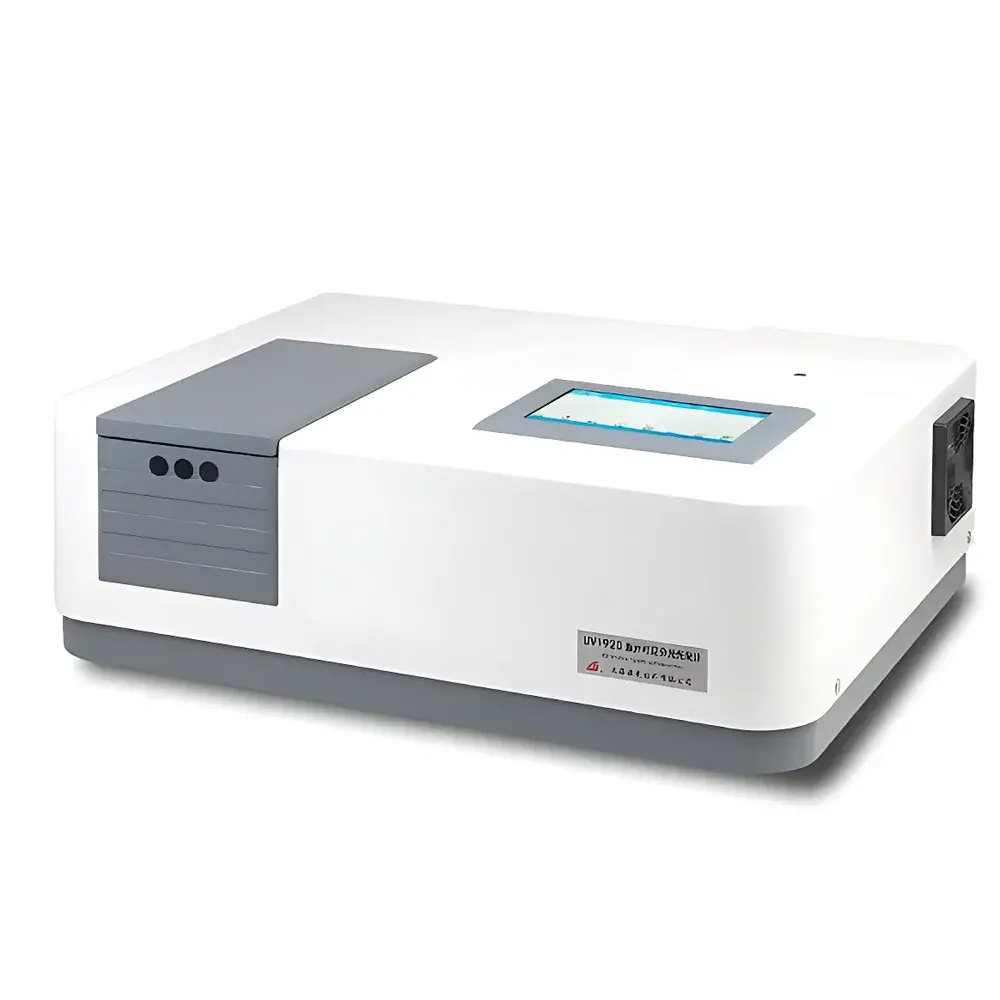
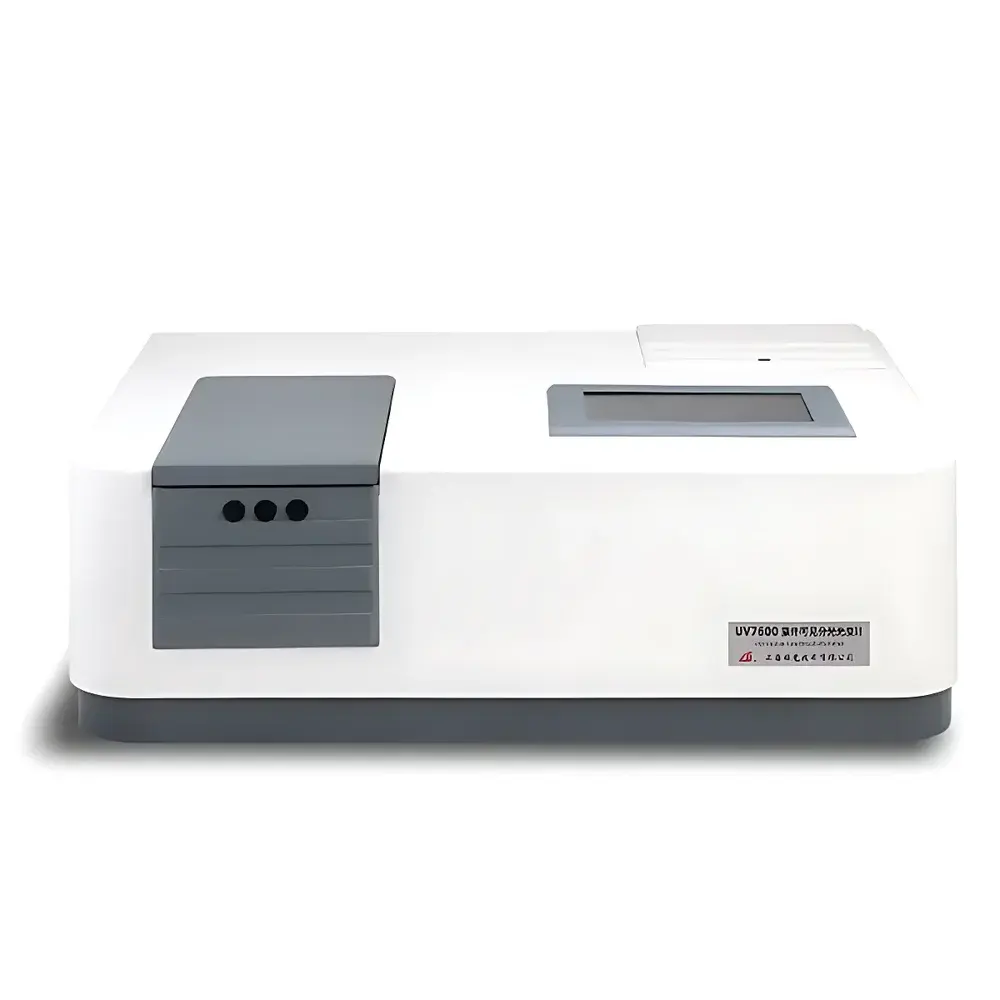
Lengguang Tech. UV1920 Dual-Beam Ultraviolet-Visible Spectrophotometer
| Brand | Lengguang Tech. |
|---|---|
| Origin | Shanghai, China |
| Manufacturer Type | Original Equipment Manufacturer (OEM) |
| Product Category | Domestic |
| Model | UV1920 |
| Optical System | Dual-beam |
| Detector Type | Silicon Photocell |
| Wavelength Range | 190–1100 nm |
| Wavelength Accuracy | ±0.3 nm |
| Wavelength Repeatability | ≤0.1 nm |
| Spectral Bandwidth | 2 nm |
| Stray Light | ≤0.03% T |
| Data Interface | USB |
| Display | 7-inch color capacitive touchscreen |
| Dimensions | 600 × 475 × 220 mm |
| Weight | 18 kg |
Overview
The Lengguang Tech. UV1920 Dual-Beam Ultraviolet-Visible Spectrophotometer is a precision optical instrument engineered for quantitative and qualitative analysis across the ultraviolet, visible, and near-infrared spectral regions (190–1100 nm). It employs a dual-beam Czerny-Turner monochromator architecture with a high-efficiency 1200 lines/mm holographic grating, enabling real-time reference beam compensation to minimize drift from source intensity fluctuations, thermal effects, or detector response variations. This design ensures long-term baseline stability (< ±0.0008 A), critical for kinetic assays, low-transmittance measurements, and regulatory-compliant workflows. The system integrates a Hamamatsu long-life deuterium lamp (≥2000 h) and imported tungsten-halogen lamp, automatically switched via a motorized mirror that self-locates optimal alignment—eliminating manual optical recalibration during lamp replacement. Its optical path is optimized for minimal stray light (≤0.03% T at 220 nm and 340 nm), supporting accurate absorbance measurements up to 4.0 A with photometric linearity validated per ISO 6223 and ASTM E275.
Key Features
- Dual-beam optical architecture with real-time digital ratio feedback for enhanced baseline stability and reduced photometric drift (≤0.0005 A/h).
- Fixed 2 nm spectral bandwidth, delivering consistent resolution suitable for pharmacopeial methods (e.g., USP , EP 2.2.25) and routine QC applications.
- High-precision wavelength drive mechanism achieving ±0.3 nm accuracy and ≤0.1 nm repeatability; auto-calibration using internal spectral reference lines (e.g., holmium oxide) ensures traceable wavelength integrity over time.
- 7-inch full-color capacitive touchscreen interface enabling standalone operation: wavelength scanning, time-based kinetics, multi-wavelength quantitation, and standard curve generation—with method and data export directly to USB storage.
- Comprehensive photometric performance: transmittance range 0.0–200.0% T, absorbance range –4.0 to +4.0 A, photometric accuracy ±0.3% T, and noise levels ≤0.05% T (0% T) and ≤0.1% T (100% T).
- Modular accessory compatibility—including 6-position and 8-position automated sample changers, variable-pathlength cuvettes (1–100 mm), and solid-sample holders—supporting liquid, suspension, film, and thin-film measurements.
Sample Compatibility & Compliance
The UV1920 accommodates standard quartz, glass, and plastic cuvettes (1–100 mm pathlength), as well as membrane and micro-volume adapters. Its optical design meets key international standards for spectrophotometric validation, including ISO/IEC 17025:2017 (for laboratory competence), ASTM E275 (describing spectrophotometer performance testing), and USP General Chapter (UV-Vis spectrophotometry). When operated with the optional PC software, the system supports audit-trail-enabled user management, electronic signatures, and 21 CFR Part 11–compliant data integrity controls—making it suitable for GLP and GMP environments in pharmaceutical, biotechnology, and contract research organizations.
Software & Data Management
The UV1920 connects to Windows-based PCs via USB 2.0 and is supported by Lengguang’s proprietary SpectraPro software. This application enables advanced acquisition modes—including wavelength scanning, time-scan kinetics, DNA/RNA purity assessment (A260/A280, A260/A230), and multi-point calibration curves with linear/nonlinear regression. All instrument operations are logged with timestamped operator ID, parameter settings, and raw spectral data. Export formats include CSV, TXT, and native .SPR files compatible with third-party analysis tools (e.g., OriginLab, MATLAB). Software supports IQ/OQ documentation templates aligned with pharmaceutical validation requirements and includes built-in performance verification protocols per USP .
Applications
The UV1920 serves diverse analytical functions across academic, industrial, and regulatory laboratories. Typical use cases include: quantification of nucleic acids and proteins; determination of enzyme kinetics and inhibitor screening; quality control of active pharmaceutical ingredients (APIs) and excipients; water quality analysis (e.g., nitrate, phosphate); colorimetric assay development (e.g., ELISA, BCA, Bradford); and spectral characterization of nanomaterials and organic dyes. Its low stray light and stable baseline make it especially suited for high-absorbance samples such as concentrated dye solutions or turbid suspensions where conventional single-beam instruments exhibit nonlinearity.
FAQ
Does the UV1920 support GLP/GMP-compliant data handling?
Yes—when used with the optional SpectraPro software, the system provides user-level access control, electronic signatures, and immutable audit trails meeting FDA 21 CFR Part 11 requirements.
Can I perform DNA/RNA purity analysis directly on the instrument?
Yes—the onboard method library includes preconfigured A260/A280 and A260/A230 ratio calculations with customizable thresholds and pass/fail reporting.
Is wavelength calibration traceable to NIST standards?
The instrument uses internal holmium oxide and didymium filters for automatic wavelength validation; external calibration with NIST-traceable standards is supported via software-guided procedures.
What cuvette pathlengths are supported?
Standard 10 mm cells are default; optional holders accommodate 1 mm, 2 mm, 5 mm, 20 mm, 50 mm, and 100 mm pathlengths—including matched quartz pairs for high-precision work.
How is lamp replacement performed without optical realignment?
The UV1920 features plug-and-play deuterium and tungsten lamps with an auto-positioning mirror; no collimation or alignment tools are required post-replacement.





