
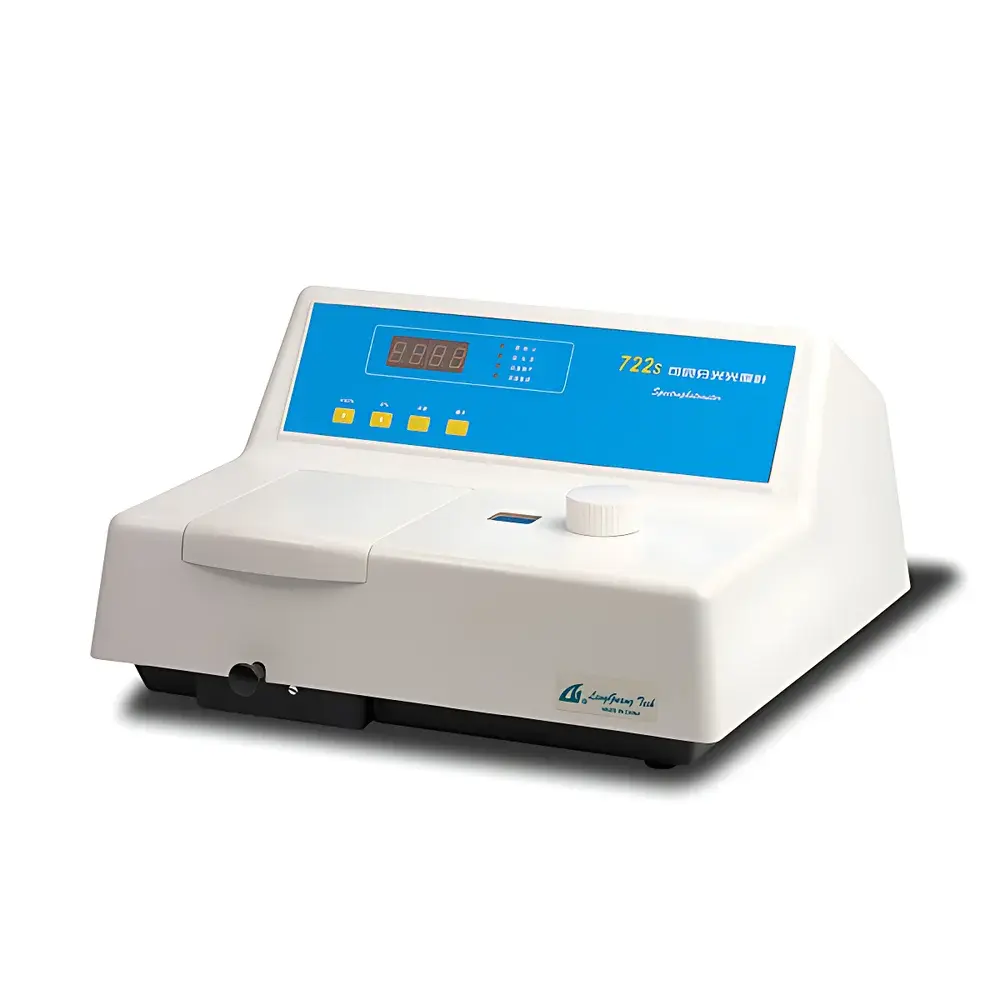
Lengguang Tech. 722S Visible Spectrophotometer
| Brand | Lengguang Tech. |
|---|---|
| Origin | Shanghai, China |
| Manufacturer Type | Original Equipment Manufacturer (OEM) |
| Product Origin | Domestic (China) |
| Model | 722S |
| Optical System | Single-beam Czerny-Turner monochromator with holographic grating |
| Detector | Photodiode array |
| Wavelength Range | 340 nm – 1000 nm |
| Wavelength Accuracy | ±2.0 nm |
| Wavelength Repeatability | ≤1.0 nm |
| Spectral Bandwidth | 6 nm |
| Stray Light | ≤0.5% T |
| Photometric Accuracy | ±0.5% T |
| Photometric Repeatability | ≤0.2% T |
| Photometric Range | 0.0–199.9% T / −0.3–2.999 A |
| Dimensions | 370 × 320 × 190 mm |
| Net Weight | 7 kg |
| Interface | RS232 serial port |
Overview
The Lengguang Tech. 722S Visible Spectrophotometer is a precision single-beam optical instrument engineered for routine quantitative and qualitative analysis in the visible to near-infrared spectral region (340–1000 nm). Based on the Czerny-Turner monochromator architecture with a high-efficiency holographic diffraction grating, the 722S delivers stable spectral dispersion and consistent photometric performance across its operational range. Its optical design incorporates rigorously aligned optical components—including a pre-calibrated 20W/12V halogen lamp and optimized collimating/focusing optics—to ensure long-term baseline stability and minimal thermal drift. The instrument operates on fundamental Beer-Lambert law principles, converting measured transmittance (T) into absorbance (A) with high linearity and low noise. Designed for laboratories requiring robustness without complexity, the 722S serves as a foundational tool in environments where regulatory traceability, method reproducibility, and ease of maintenance are prioritized over automated scanning or multi-wavelength kinetics.
Key Features
- Single-beam Czerny-Turner monochromator with holographic grating—optimized for resolution and throughput in the visible-NIR range.
- Pre-aligned, user-replaceable 20W/12V halogen lamp with integrated spectral energy correction algorithm for consistent intensity calibration.
- Photodiode array detector enabling rapid signal acquisition and high signal-to-noise ratio at fixed wavelengths.
- Dedicated microprocessor-based measurement system supporting automatic zero adjustment, 100% T calibration, direct concentration readout, and customizable concentration factor input.
- RS232 serial interface compliant with standard ASCII protocol—enables direct connection to serial printers or integration with third-party data acquisition software under Windows/Linux platforms.
- Die-cast aluminum chassis providing mechanical rigidity, thermal stability, and electromagnetic interference (EMI) shielding—critical for sustained operation in shared lab environments.
Sample Compatibility & Compliance
The 722S accommodates standard 10 mm pathlength cuvettes (glass, quartz, or plastic), supporting liquid-phase absorbance measurements across diverse matrices including aqueous buffers, organic solvents, cell culture supernatants, and environmental water extracts. It complies with core international performance standards for visible spectrophotometers, including ISO 8577-2:2017 (spectrophotometer verification procedures) and ASTM E275-22 (standard practices for describing and measuring performance of UV-Vis-NIR spectrophotometers). While not inherently 21 CFR Part 11 compliant out-of-the-box, its RS232 interface supports external audit-trail-capable software solutions used in GLP and GMP-regulated quality control labs. Instrument validation documentation—including wavelength accuracy verification reports and photometric linearity test records—can be generated using optional calibration kits traceable to NIST SRM 2031 and SRM 930e filters.
Software & Data Management
The 722S operates autonomously via front-panel controls but interfaces seamlessly with PC-based data handling tools. Its RS232 output transmits formatted ASCII strings containing wavelength, %T, A, and timestamp metadata—enabling import into spreadsheet applications (e.g., Microsoft Excel), statistical packages (e.g., JMP, Minitab), or LIMS systems via simple serial-to-USB adapters. Optional Lengguang-provided software (v3.x) offers linear regression analysis for standard curve generation, batch sample reporting, and export to CSV/PDF formats. All data files retain immutable timestamps and operator ID fields when paired with compatible authentication modules—supporting ALCOA+ data integrity principles in regulated QC workflows.
Applications
- Clinical biochemistry: Quantification of hemoglobin derivatives, bilirubin, total protein (Biuret), and enzymatic assays (e.g., LDH, ALT) per CLSI EP10-A3 guidelines.
- Environmental monitoring: Measurement of nitrate, phosphate, and heavy metal complexes (e.g., Cr(VI)-diphenylcarbazide) in wastewater per EPA Method 353.2 and ISO 6878.
- Pharmaceutical QC: Assay of active pharmaceutical ingredients (APIs) in tablet dissolution samples and excipient purity screening in accordance with USP .
- Food & beverage: Colorimetric determination of anthocyanins, chlorophyll, and sulfite residues per AOAC 990.25 and ISO 10426-2.
- Academic teaching labs: Hands-on instruction in spectroscopic theory, calibration methodology, and error propagation analysis for undergraduate chemistry curricula.
FAQ
Is the 722S suitable for UV-range measurements below 340 nm?
No. The 722S is optimized for visible and near-infrared wavelengths (340–1000 nm) and lacks UV-transmitting optics or deuterium lamp source; it cannot perform measurements below 340 nm.
Can the instrument be validated for ISO/IEC 17025 accredited testing?
Yes—when used with documented calibration procedures, certified reference materials (e.g., NIST-traceable filters), and controlled environmental conditions (20–25°C, <60% RH), the 722S meets metrological requirements for scope inclusion in ISO/IEC 17025 accreditation.
What maintenance is required for long-term photometric stability?
Annual verification of wavelength accuracy (using holmium oxide or didymium filters) and photometric linearity (using neutral density filters) is recommended; lamp replacement every 1,000–1,500 operating hours ensures optimal signal consistency.
Does the 722S support kinetic or scanning modes?
No. As a manually tuned single-beam instrument, it measures one discrete wavelength at a time; spectral scanning requires external motorized wavelength drives not included in this model.
Is firmware upgrade capability available?
Firmware updates are distributed exclusively through authorized Lengguang service centers and require proprietary diagnostic hardware; no field-upgradable flash memory is provided in the base unit.






