
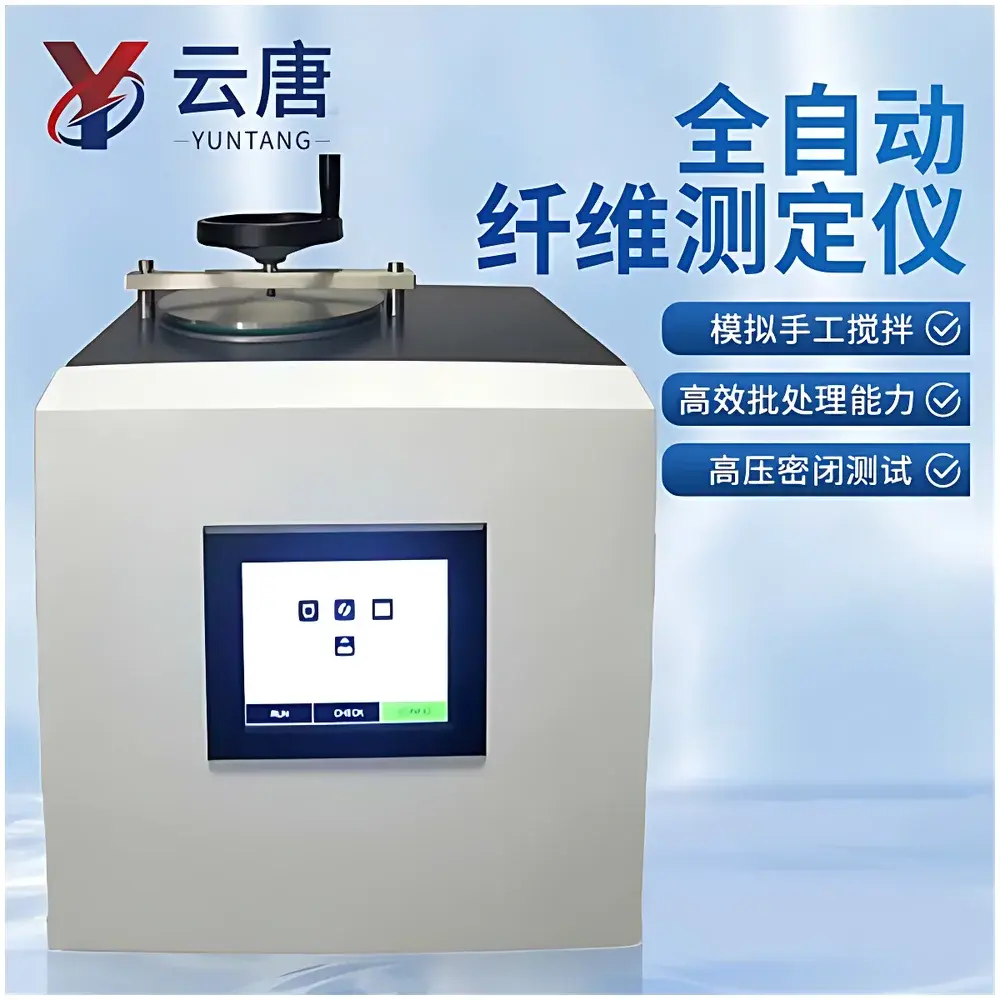
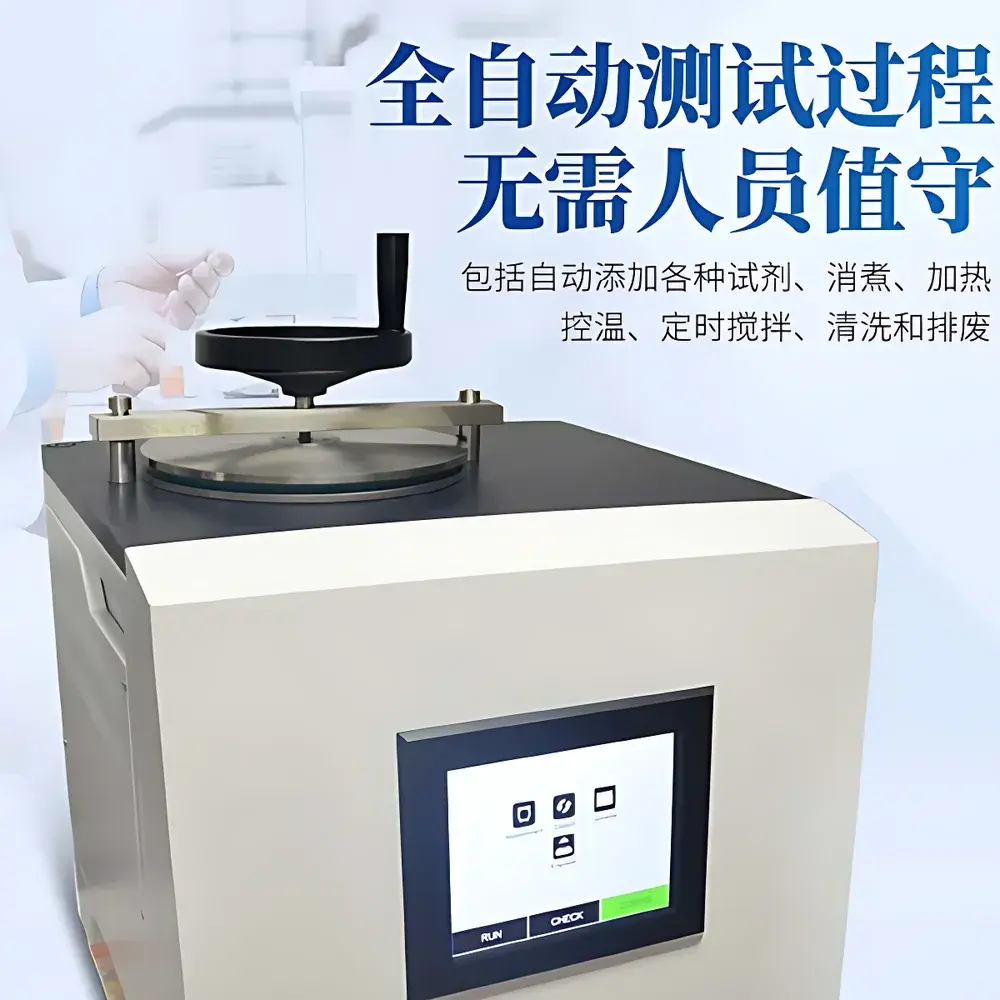
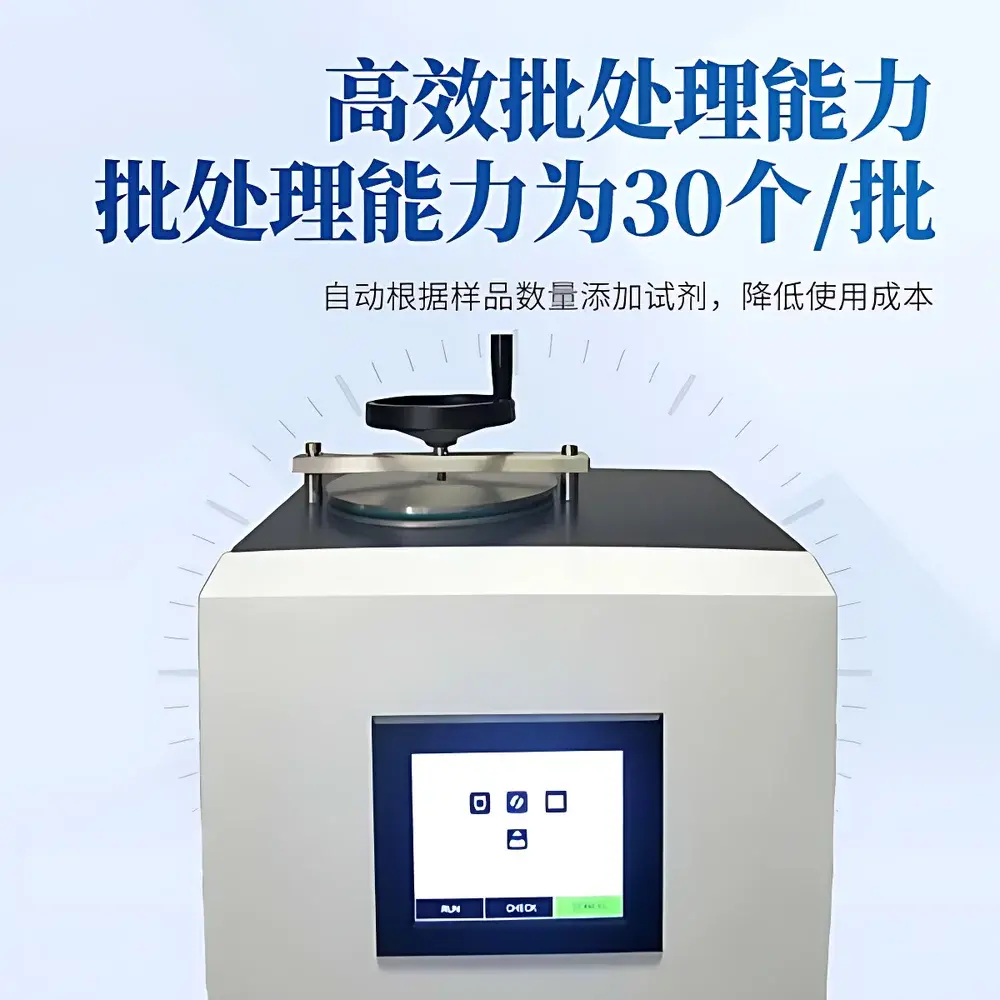
Yuntang YT-SF20 Automated Dietary Fiber Analyzer
| Brand | Yuntang |
|---|---|
| Origin | Shandong, China |
| Manufacturer Type | Manufacturer |
| Country of Origin | China |
| Model | YT-SF20 |
| Power Supply | AC 220 V / 50 Hz |
| Sample Capacity per Bag | 0.1–5.0 g |
| Batch Processing Capacity | 1–30 samples |
| Daily Throughput | 90–180 samples |
| Temperature Range | Ambient to 100 °C |
| Temperature Control Accuracy | ±0.1 °C |
| Filter Bag Pore Size | Standard 25 µm (optional 15 µm or 10 µm) |
| Stirring Speed | 15 rpm |
| Stirring Cycle | Intermittent (1 min on / 1 min off) |
| Repeatability | ≤0.5% RSD |
| Pressure-Sealed Digestion System | Yes |
| Cooling Water Required | No |
| Laboratory Ventilation Requirement | None (no fume hood needed) |
| Construction Material | Non-glass, corrosion-resistant, high-pressure rated vessel assembly |
Overview
The Yuntang YT-SF20 Automated Dietary Fiber Analyzer is an integrated, fully automated system engineered for precise and reproducible determination of dietary fiber fractions—including crude fiber, neutral detergent fiber (NDF), acid detergent fiber (ADF), acid detergent lignin (ADL), and insoluble dietary fiber—in food, feed, beverage, and agricultural research laboratories. It implements the standardized acid-base digestion methodology aligned with AOAC Official Methods 978.10, 985.29, and 991.43, as well as ISO 6865, EN 13905, and GB/T 6434–2006. Unlike open-beaker or semi-automated systems, the YT-SF20 employs a sealed, high-pressure digestion architecture that eliminates solvent evaporation losses, minimizes operator exposure to hazardous reagents (e.g., sulfuric acid, sodium hydroxide, and alpha-amylase solutions), and ensures consistent thermal and chemical exposure across all samples within a batch.
Key Features
- High-integrity filter bag technology with standard 25 µm pore size (15 µm and 10 µm options available) enabling quantitative retention of fibrous residues while permitting complete reagent penetration and wash efficiency.
- Corrosion-resistant, pressure-rated digestion vessels constructed from reinforced polymer composites—no internal glass components—designed for long-term reliability under repeated exposure to concentrated acids and alkalis at elevated temperatures.
- Intelligent intermittent stirring mechanism (15 rpm, 1-min on/1-min off cycle) replicating manual agitation kinetics to ensure homogeneous sample–reagent interaction without splashing, leakage, or uneven digestion.
- Full-parameter real-time monitoring: digital temperature profiling (±0.1 °C accuracy), pressure sensing, and volumetric reagent dispensing feedback—each parameter logged with timestamp for audit compliance.
- Touchscreen HMI with intuitive workflow-guided interface; color LCD display supports multilingual operation (English default) and step-by-step protocol navigation.
- Water-free operation: sealed digestion eliminates need for external cooling water circuits, reducing infrastructure dependency and environmental footprint.
- Compact benchtop footprint with Class I laboratory compatibility—no fume hood or dedicated exhaust required due to fully enclosed reagent handling and vapor containment.
Sample Compatibility & Compliance
The YT-SF20 accommodates a broad spectrum of solid and semi-solid matrices: cereal grains, legumes, forages, pet food, infant formula, bakery products, and processed meats. Each sample (0.1–5.0 g) is loaded into a pre-weighed, ash-free filter bag compatible with gravimetric post-digestion analysis. The system meets functional requirements for GLP-compliant environments, supporting full traceability through embedded event logging (start time, max temperature reached, stir cycles completed, reagent volume dispensed). While not inherently 21 CFR Part 11–validated out-of-the-box, its data integrity architecture—including non-erasable audit trails and user-access-controlled method files—facilitates qualification under FDA, EFSA, and national feed safety regulatory frameworks.
Software & Data Management
The embedded firmware enables method storage (up to 50 customizable protocols), automatic calculation of NDF, ADF, ADL, and crude fiber mass percentages per AOAC equations, and export of raw sensor logs and final results in CSV format via USB port. Optional PC-based software (Yuntang FiberSuite™ v3.2) adds trend analysis, inter-batch comparison, calibration certificate management, and PDF report generation with digital signature fields—fully compatible with LIMS integration via HL7 or ASTM E1384 interfaces.
Applications
- Feed formulation labs verifying compliance with NRC and EU Regulation (EC) No 767/2009 nutrient labeling requirements.
- Food safety accreditation bodies conducting routine verification of fiber content claims per FDA 21 CFR §101.9(c)(6)(i).
- Academic nutrition research groups studying fermentable vs. non-fermentable fiber fractions in human clinical trials.
- Contract testing laboratories performing AOAC-certified dietary fiber analyses for third-party certification (e.g., USDA Organic, Non-GMO Project).
- Quality control departments in flour mills and extruded snack manufacturers validating raw material consistency across harvest seasons.
FAQ
Does the YT-SF20 comply with AOAC Official Method 991.43 for total dietary fiber?
Yes—the instrument’s digestion kinetics, temperature stability (±0.1 °C), and filter bag retention characteristics have been verified against AOAC 991.43 reference materials (e.g., wheat bran, soybean flour) in independent inter-laboratory studies.
Can the system be validated for GMP environments?
It supports IQ/OQ documentation packages; PQ must be performed using site-specific reference standards and matrix-matched controls per ICH Q2(R2) guidelines.
What maintenance is required beyond routine cleaning?
Annual recalibration of temperature and pressure sensors is recommended; filter bag dispenser alignment check every 500 batches.
Is method transfer possible from traditional reflux-based systems?
Yes—comparative validation studies show <0.8% absolute difference in NDF values versus AOAC 2002.04 when using identical reagent lots and sample prep protocols.
How is reagent consumption minimized during batch processing?
Reagents are dosed volumetrically per sample—not per batch—ensuring stoichiometric precision and eliminating overuse typical in shared-vessel digestion systems.





