
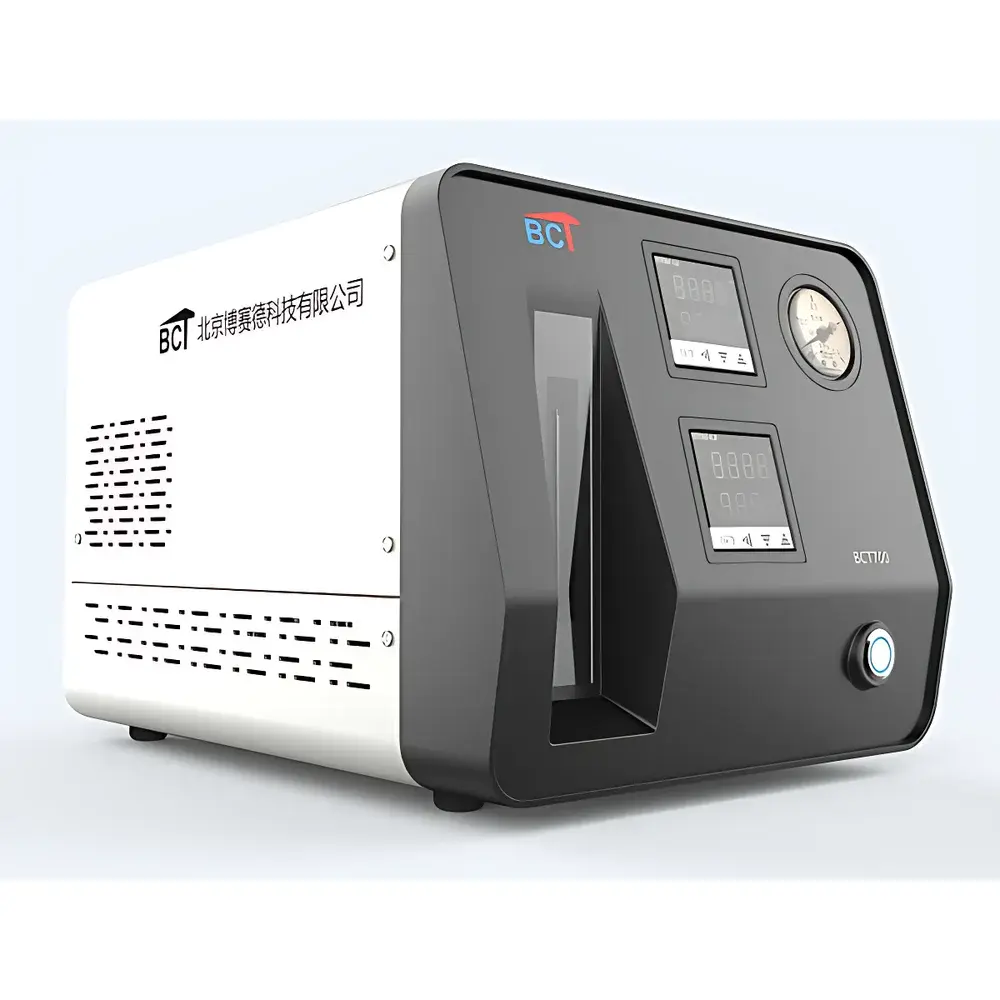
BCT BCT-700 Adsorption Tube Aging Instrument
| Brand | BCT |
|---|---|
| Origin | Beijing, China |
| Manufacturer | Yes |
| Type | Domestic |
| Model | BCT-700 |
| Temperature Control Range | 0–45 °C (ambient operating environment) |
| Gas Flow Rate | 0.1 MPa, 100 mL/min ±5 mL/min |
| Tube Capacity | 21 positions (3 independent zones × 7 tubes each) |
| Aging Zone Temperature Range | Ambient to 400 °C ±1 °C |
| Vaporization Zone Temperature Range | 0–200 °C ±1 °C |
| Aging Time Setting | 0–999 min |
| Sample Introduction Flow (Calibration Standard Prep) | 0–100 mL/min ±1 mL/min |
| Input Pressure Limit | ≤0.4 MPa |
| Power Supply | AC 220 V, 50–60 Hz, 400 W |
| Dimensions | 380 × 270 × 230 mm |
| Weight | ≤10 kg |
Overview
The BCT BCT-700 Adsorption Tube Aging Instrument is a precision-engineered benchtop system designed for the thermal conditioning and regeneration of sorbent-packed sampling tubes used in thermal desorption–gas chromatography (TD–GC) workflows. It operates on the principle of controlled thermal purging: inert carrier gas (typically nitrogen or helium), heated to precise temperatures, flows through conditioned adsorbent tubes to remove residual volatile organic compounds (VOCs), moisture, and contaminants accumulated during prior sampling or storage. This process restores tube integrity, minimizes background interference, and ensures analytical reproducibility across sequential sampling campaigns—critical for compliance with EPA Method TO-17, ISO 16017-1, and ASTM D6196. Unlike generic ovens or hot-air systems, the BCT-700 integrates dual-zone thermal control, programmable aging duration, and independently regulated gas flow paths to meet the stringent requirements of accredited environmental, occupational health, and indoor air quality laboratories.
Key Features
- Dual-Zone Independent Temperature Control: Separate aging chambers (up to 400 °C ±1 °C) and a dedicated vaporization zone (0–200 °C ±1 °C) enable simultaneous tube regeneration and calibration standard preparation without cross-contamination or thermal crosstalk.
- Modular 21-Position Tube Configuration: Three thermally isolated aging zones (7 positions each) support flexible operation—users may activate one, two, or all three zones based on throughput needs, optimizing carrier gas consumption and energy use.
- Precision Flow Regulation: Each aging zone features calibrated mass flow control; nominal aging flow is 100 mL/min ±5 mL/min at 0.1 MPa, while the vaporization zone supports adjustable flow from 0–100 mL/min ±1 mL/min for quantitative standard generation.
- Programmable Aging Protocol: Timer-based operation allows aging durations from 0 to 999 minutes with automatic termination and audible/visual notification, supporting method-defined hold times per regulatory protocols.
- Low-Maintenance Architecture: Solid-state heating elements, digital PID temperature controllers, and front-panel LED interface eliminate need for tools or technical training—ideal for routine QC/QA environments under GLP or ISO/IEC 17025 management systems.
Sample Compatibility & Compliance
The BCT-700 accommodates standard 1/4-inch OD stainless steel or glass sorbent tubes (e.g., Tenax TA, Carbopack B/C, Carboxen 1000) commonly used in EPA TO-11A, TO-15, and TO-17 applications. Tube holders are mechanically robust and thermally insulated to ensure uniform heat distribution and prevent cold spots. The instrument’s design aligns with fundamental requirements for equipment qualification under ISO/IEC 17025:2017 (Clause 6.4.3), including documented temperature uniformity, flow stability verification, and traceable calibration procedures. While not certified to IEC 61000 or UL 61010 by default, its electrical safety architecture complies with CE-marked industrial equipment norms for laboratory use (EN 61326-1, EN 61000-6-3). All thermal and flow parameters are digitally logged via optional RS-232 or USB interface for audit-ready record retention.
Software & Data Management
The BCT-700 operates via an embedded microcontroller with real-time digital display of setpoint/actual temperature, elapsed time, and active zone status. For laboratories requiring electronic records and 21 CFR Part 11 compliance, optional firmware upgrade enables timestamped event logging (start/stop, temperature deviation alerts, flow fault detection) exportable as CSV files. These logs integrate with LIMS platforms or internal QA databases without proprietary software dependencies. No cloud connectivity or remote access is implemented—data remains local and under user control, consistent with institutional cybersecurity policies for analytical instrumentation.
Applications
- Regulatory-compliant regeneration of sorbent tubes prior to reuse in ambient air, workplace, or stack emission monitoring (EPA, EU Directive 2004/107/EC).
- Pre-conditioning of new tubes to eliminate manufacturing residues and establish baseline blank performance.
- In-lab preparation of liquid calibration standards via controlled volatilization into GC carrier stream—eliminating need for separate syringe-based injection or external vaporizers.
- Method development for multi-analyte VOC profiling where tube history directly impacts sensitivity and quantitation accuracy.
- Supporting ISO 16000-6 indoor air testing protocols requiring strict blank control and inter-laboratory reproducibility.
FAQ
What tube dimensions does the BCT-700 support?
Standard configuration accepts 1/4-inch OD metal or glass tubes up to 3.5 inches in length; custom fixtures are available upon request for alternative diameters or geometries.
Can the BCT-700 be integrated into automated TD–GC workflows?
Yes—via RS-232 or USB serial output, the instrument can synchronize start/stop signals with thermal desorbers or GC autosamplers using user-defined TTL or ASCII command sets.
Is temperature uniformity validated across all 21 positions?
Per factory acceptance testing, axial and radial temperature deviation within any active zone is ≤±1.5 °C at 300 °C; users may perform periodic verification using NIST-traceable thermocouples.
Does the BCT-700 meet FDA or EMA requirements for GMP environments?
While not pre-certified, its deterministic operation, audit trail capability (with optional logging), and configurable alarm thresholds support validation under Annex 11 and ICH Q9 principles when incorporated into a documented IQ/OQ/PQ protocol.
How is carrier gas consumption minimized during low-throughput operation?
Each of the three aging zones has independent solenoid-valve control; unused zones are fully isolated—no gas flows unless actively engaged—reducing typical daily N₂ consumption by up to 67% compared to fixed-flow alternatives.
Related Products





