
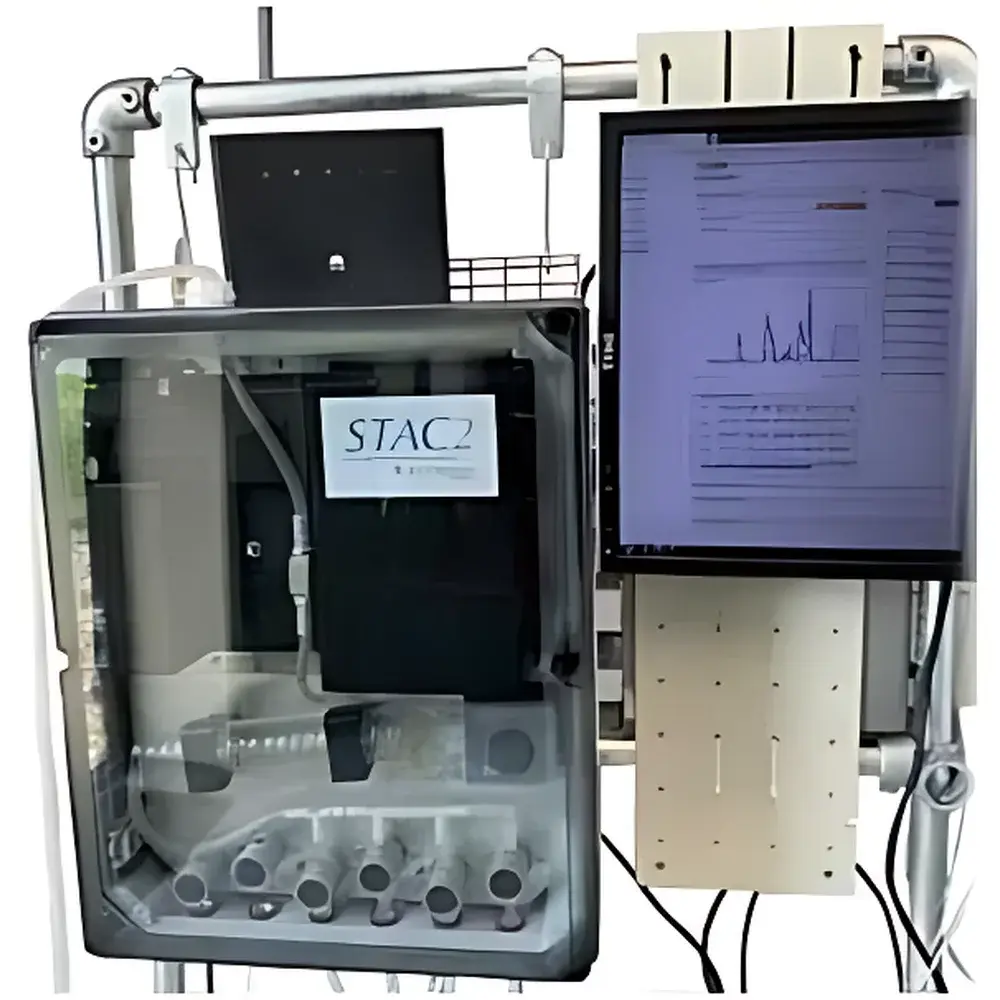
AQUALABO STAC2 Online UV-VIS Full-Spectrum Water Quality Early-Warning Analyzer
| Brand | AQUALABO |
|---|---|
| Origin | France |
| Model | STAC2 |
| Instrument Type | Online Water Quality Analyzer |
| Detection Parameters | BOD, COD, TOC, TSS, Nitrate |
| Wavelength Range | 190–800 nm |
| Optical Bandwidth | 1 nm |
| Sample Channels | 4 |
| Flow Cell Path Lengths | 2, 5, 50 mm |
| Measurement Cycle | < 2 min |
| Power Supply | 24 V DC (±0.5 V), 3 A or 100–240 V AC (50–60 Hz) optional |
| Enclosure Rating | IP53 |
| Dimensions (L×W×H) | 400 × 265 × 500 mm |
| Weight | 18 kg |
| Data Interfaces | 1× Ethernet (MODBUS TCP/IP & HMI), 1× Wi-Fi (HMI), 1× USB (data backup/export) |
| Cleaning System | Automatic, compressed air and/or chemical line purge |
| Light Source | Xenon lamp |
| Data Storage | Internal SD card with daily secure backup |
| Operating Temperature | 10–40 °C |
| Mounting | Wall-mounted |
| Digital I/O | MODBUS TCP/IP and RTU compliant |
| Turbidity Compensation | Yes |
Overview
The AQUALABO STAC2 Online UV-VIS Full-Spectrum Water Quality Early-Warning Analyzer is an advanced, reagent-free optical instrument engineered for continuous, real-time monitoring of organic contamination and key water quality indicators in municipal, industrial, and environmental applications. Based on the fundamental principle of ultraviolet–visible (UV-VIS) absorbance spectroscopy, the STAC2 captures high-resolution spectral fingerprints across a broad wavelength range—from 190 nm to 800 nm—with a fixed 1 nm optical bandwidth. Unlike conventional wet-chemistry analyzers, it relies solely on the intrinsic absorption characteristics of dissolved and suspended constituents: organic compounds (e.g., aromatic hydrocarbons, phenols, pesticides), nitrate ions, and light-scattering particulates all contribute distinct spectral signatures. By applying multivariate calibration models—developed and validated against reference laboratory methods (e.g., ISO 6060 for COD, ISO 7827 for BOD, ISO 8245 for TOC)—the system quantifies critical parameters including biochemical oxygen demand (BOD), chemical oxygen demand (COD), total organic carbon (TOC), total suspended solids (TSS), and nitrate (NO₃⁻). Its design emphasizes early anomaly detection: deviations from baseline spectral profiles trigger configurable alerts, enabling rapid response to accidental spills, process upsets, or seasonal source-water shifts.
Key Features
- Reagent-free operation: Eliminates consumables, hazardous chemicals, and associated disposal compliance burdens—ideal for unattended, long-term deployment.
- High-speed full-spectrum acquisition: Complete 190–800 nm scan in under 120 seconds, supporting sub-hourly trend resolution and event-driven sampling protocols.
- Multi-channel architecture: Four independent sample inlets support concurrent monitoring of intake, effluent, bypass, and reference streams—each configurable with dedicated calibration matrices.
- Adaptive spectral fingerprinting: Stores and compares time-series absorbance spectra; detects non-target contaminants (e.g., industrial solvents, pesticides) through pattern recognition, not just pre-defined analytes.
- Robust optical design: Pulsed xenon lamp ensures stable intensity over >20,000 hours; interchangeable flow cells (2 mm, 5 mm, 50 mm path lengths) accommodate wide concentration ranges without dilution.
- Integrated cleaning and maintenance: Automated pneumatic and optional chemical line purging prevents biofilm buildup and fouling—validated per EN 14181 for continuous emission monitoring systems (CEMS) reliability.
- Embedded web-based HMI: Local access via Wi-Fi or Ethernet; responsive interface displays real-time spectra, parameter trends, alarm logs, and diagnostic status—no proprietary software required.
- Power resilience: Supports 24 V DC primary operation with seamless failover to AC input (100–240 V); optional battery-backed measurement restart upon power recovery.
Sample Compatibility & Compliance
The STAC2 is validated for use with raw surface water (rivers, lakes, reservoirs), treated drinking water, wastewater influent/effluent, and industrial process streams—including those with elevated chloride, organic solvent load, or variable turbidity. Its turbidity compensation algorithm corrects for Mie scattering effects, ensuring accuracy even at TSS levels up to 2500 mg/L. The analyzer meets essential regulatory and operational standards: CE marking per EU Machinery Directive 2006/42/EC and EMC Directive 2014/30/EU; IP53 ingress protection for indoor and sheltered outdoor installations; and electrical safety compliance with IEC 61010-1. While not certified as a primary reference method, its performance aligns with data quality objectives outlined in ISO 5667-2 for routine monitoring and early-warning applications. When deployed in GLP or GMP environments, audit trails (via SD card logging), user-access controls, and MODBUS TCP/IP integration support traceability requirements under FDA 21 CFR Part 11 when paired with validated third-party data management platforms.
Software & Data Management
Data acquisition, processing, and visualization are handled by the onboard Linux-based firmware. Spectral data (absorbance vs. wavelength) and derived parameter values are timestamped and stored redundantly: primary logging to internal SD card with daily cryptographic checksums; secondary backup to removable USB flash drives. All data exports comply with CSV and JSON formats for interoperability with SCADA, LIMS, and cloud analytics platforms (e.g., AWS IoT Core, Microsoft Azure IoT Hub). Remote configuration, firmware updates, and spectral library management are performed securely via HTTPS-enabled web interface or MODBUS register mapping. Alarm logic supports multi-level thresholds (warning, critical, maintenance), hysteresis filtering, and email/SMS notifications via external gateways. No cloud subscription is required—the system operates fully offline, preserving data sovereignty while enabling optional hybrid deployments.
Applications
- Municipal wastewater treatment plants: Real-time monitoring of influent shock loads, nitrification/denitrification efficiency, and effluent compliance.
- Drinking water intakes: Early detection of algal blooms, pesticide runoff, or accidental hydrocarbon contamination in rivers and reservoirs.
- Industrial pretreatment verification: Continuous assessment of COD/BOD removal upstream of municipal sewer connections per local discharge ordinances.
- Pharmaceutical and chemical manufacturing: Tracking organic solvent carryover or nitrate accumulation in process cooling water or rinse streams.
- Environmental surveillance networks: Multi-site deployment with synchronized spectral baselines for watershed-scale contamination mapping.
FAQ
Does the STAC2 require daily calibration or standard additions?
No—calibration is matrix-specific and performed during initial commissioning using representative field samples and lab-verified reference data. Recalibration is only recommended following significant source-water changes or after major maintenance.
Can the STAC2 replace certified laboratory methods for regulatory reporting?
It is designed for trending, early warning, and process control—not as a standalone legal compliance tool. However, its outputs are routinely used to trigger confirmatory lab analysis per ISO/IEC 17025-accredited procedures.
How is spectral drift corrected over time?
The xenon lamp’s pulsed operation and internal reference photodiode enable real-time intensity normalization; additionally, periodic air/water blank measurements (automated or manual) correct for optical aging and window fouling.
Is remote diagnostics supported?
Yes—via encrypted web interface and MODBUS registers. Field engineers can access live spectra, error codes, and hardware status without physical site visits.
What validation documentation is provided?
Each unit ships with Factory Acceptance Test (FAT) report, spectral linearity verification (NIST-traceable deuterium/halogen lamps), and application-specific calibration certificates generated using client-supplied water matrices.
Related Products







