ARtrix2021 HUD Optical Design & Simulation Suite
| Origin | Shanghai, China |
|---|---|
| Manufacturer Type | Authorized Distributor |
| Origin Category | Domestic (China-made) |
| Model | ARtrix2021 |
| Pricing | Available Upon Request |
Overview
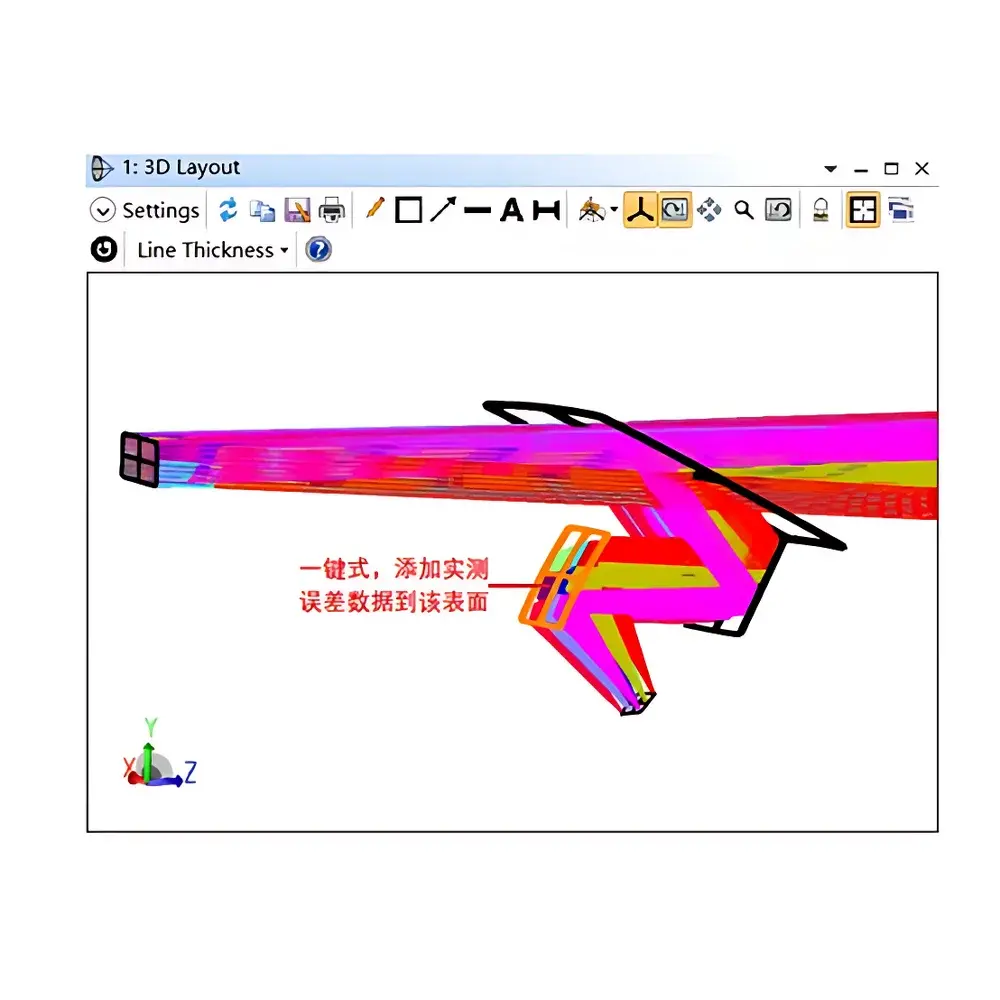
ARtrix2021 is a comprehensive, system-level optical design and simulation software platform engineered specifically for Augmented Reality Head-Up Display (AR HUD) development. Built upon rigorous physical optics principles and tightly integrated with industry-standard optical design environments—particularly Zemax OpticStudio—the suite enables high-fidelity modeling of complex optical interactions between HUD projectors, waveguides, diffractive elements, and automotive windshields. Its core architecture supports both sequential and non-sequential ray tracing paradigms, with native interoperability for coordinate transformation, surface fitting, and bidirectional data exchange between CAD and optical simulation domains. Unlike generic optical tools, ARtrix2021 addresses the unique metrological and manufacturing constraints inherent in mass-produced AR HUD systems—including PVB interlayer wedge variation, thermo-mechanical deformation, multi-layer laminated glass structures, and real-world solar path–dependent glare evaluation.
Key Features
- Fresnel lens design module with parametric optimization and tolerance-aware performance prediction
- Waveguide optical modeling engine supporting guided-mode analysis and out-coupling efficiency mapping
- Volumetric Bragg grating (VBG) simulation module with angular/spectral response calibration against measured diffraction efficiency
- Phase-only optical element synthesis for beam shaping and aberration correction in compact HUD architectures
- Cascaded grating modeling for multi-stage spectral filtering and polarization management
- Freeform surface optimization and fabrication-aware tolerance analysis (RMS/PV input supported)
- Automated windscreen-to-optical-coordinate alignment tool for seamless CAD-to-Zemax workflow integration
- High-fidelity, geometry-aware PVB wedge film modeling—including variable-angle, anisotropic stretch direction, and post-forming shrinkage compensation
- One-click conversion from sequential ray trace to non-sequential stray light model with auto-extraction of critical ghost paths
- Solar path–driven glare analysis using geolocated, time-resolved astronomical ephemeris data (integrated via NOAA/NASA solar databases)
- Adaptive ray sampling for sun-source illumination—reducing computation load by 2–3 orders of magnitude while preserving SNR and image fidelity
- Photo-realistic double-image (ghost) rendering with spectral weighting, MTF degradation, and observer-position-dependent occlusion modeling
Sample Compatibility & Compliance
ARtrix2021 is validated for use with automotive-grade laminated windshields conforming to ISO 3538, SAE J1756, and ECE R43 standards. It supports import of industrial CAD formats (STEP, IGES, Parasolid) and direct interface with Zemax OpticStudio (v22+), enabling traceable, audit-ready optical development workflows. The software’s tolerance analysis modules comply with ISO 10110–8 (surface irregularity) and ISO 11432 (optical component testing), facilitating GLP-aligned documentation for Tier-1 supplier validation reports. While not a regulated medical or pharmaceutical tool, its structured reporting outputs—including automated PDF/HTML export of optical performance metrics, ghost intensity maps, and solar angle sensitivity curves—meet internal quality system requirements for IATF 16949-certified OEM development processes.
Software & Data Management
ARtrix2021 operates as a Zemax-native extension, requiring no standalone runtime environment. All optical models, parameter sets, and simulation results are stored in encrypted, version-controlled project files (.arxproj) compatible with standard enterprise backup and revision control systems (e.g., Git LFS, Perforce). Audit trails record user actions—including model edits, parameter changes, and report generation—with timestamps and operator IDs. Export options include CSV (for statistical process control), PNG/SVG (for technical documentation), and ZOSAPI-compatible scripts for batch automation. No cloud-based telemetry or remote data transmission is enabled by default; all processing occurs locally on Windows 10/11 x64 platforms with NVIDIA GPU acceleration support (CUDA 11.2+).
Applications
- Early-stage feasibility assessment of AR HUD optical architectures (e.g., combiner-based vs. windshield-integrated)
- Quantitative ghost image prediction under dynamic solar elevation conditions across global vehicle deployment regions
- PVB wedge film specification validation against manufacturing capability (e.g., Eastman Chemical’s variable-angle interlayers)
- Windshield steepness and footprint line analysis to guide mechanical packaging and projector placement constraints
- Stray light budget allocation and baffling design verification prior to prototype fabrication
- Optical tolerance stack-up analysis at sub-component (lens, grating) and system (HUD + windshield) levels
- Support for regulatory compliance documentation including ISO 15008 visibility assessments and UNECE R121 glare thresholds
FAQ
Is ARtrix2021 compatible with Zemax OpticStudio versions prior to v22?
No—ARtrix2021 requires Zemax OpticStudio v22 or later due to dependencies on updated ZOSAPI interfaces and non-sequential object handling capabilities.
Does the software support GPU-accelerated ray tracing?
Yes—select modules (e.g., solar path rendering, ghost image simulation) leverage CUDA-enabled NVIDIA GPUs to reduce computation time by up to 95% compared to CPU-only execution.
Can ARtrix2021 import measured windscreen surface data from coordinate measuring machines (CMM)?
Yes—point-cloud and deviation map inputs (ASCII XYZ, CSV, or .STL with normal vectors) are supported for high-accuracy windscreen fitting and distortion-aware optical modeling.
Is there built-in support for ISO 15008 photometric evaluation?
ARtrix2021 provides raw luminance and contrast output data required for ISO 15008 Annex C calculations; full compliance reporting requires integration with third-party photometry software or custom MATLAB/Python post-processing.
How is software licensing managed?
Licensing is node-locked to a hardware fingerprint and delivered via offline activation file; floating licenses are available upon request for enterprise deployments with centralized license server configuration.