
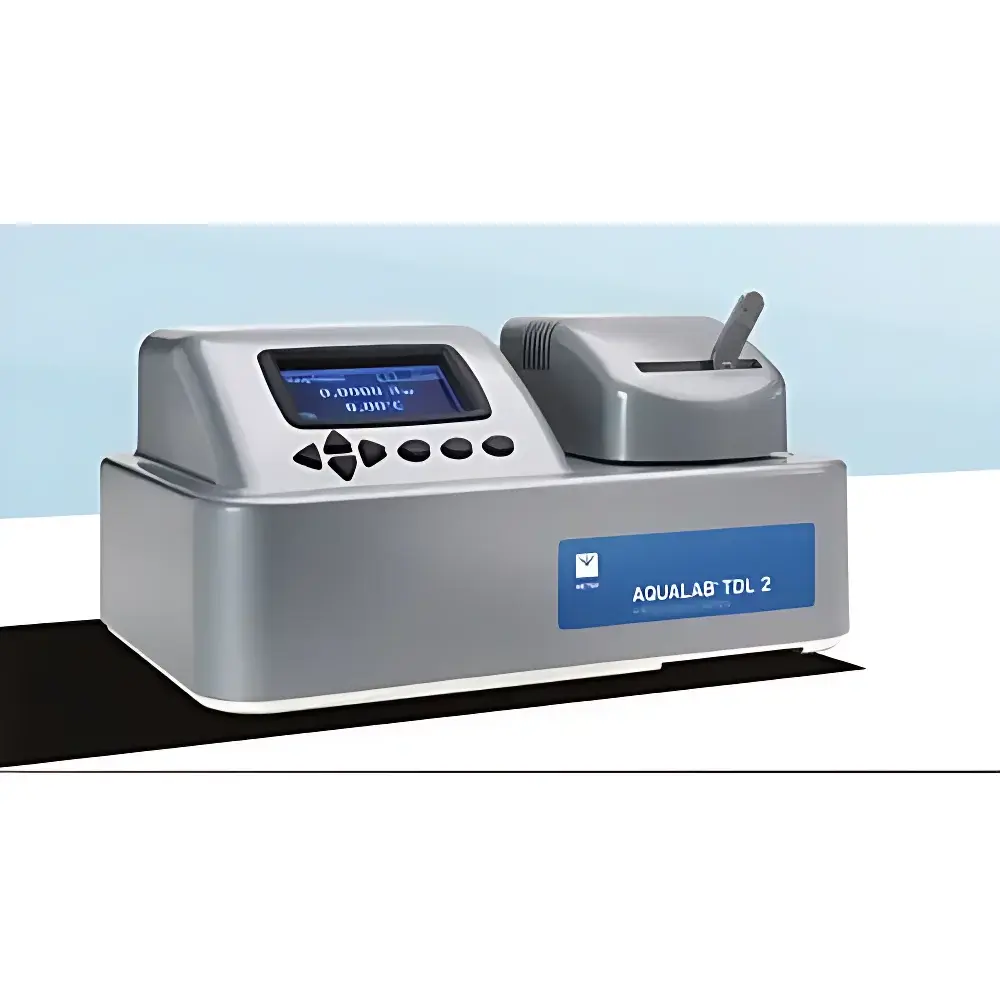
METER AquaLab TDL 2 Tunable Diode Laser Water Activity Analyzer
| Brand | AQUALAB |
|---|---|
| Origin | USA |
| Model | AquaLab TDL 2 |
| Measurement Principle | Tunable Diode Laser Absorption Spectroscopy (TDLAS) at H₂O-specific isotopic absorption line (1368.59 nm) |
| Range | 0.0000–1.0000 aw |
| Resolution | 0.0001 aw |
| Accuracy | ±0.005 aw @ 25 °C |
| Repeatability | ±0.001 aw |
| Temperature Control Range | 15–50 °C |
| Temp. Accuracy | ±0.1 °C |
| Measurement Time | ≤5 min (standard), 1 min (optional rapid mode) |
| Operating Environment | 0–90% RH non-condensing, 4–50 °C ambient |
| Interface | RS-232 & USB |
| Compliance | USP <922>, AOAC Official Method 2014.01, ISO 21807:2022, ASTM F1980-22 |
Overview
The METER AquaLab TDL 2 is an advanced water activity (aw) analyzer engineered for precision, robustness, and unambiguous molecular specificity in demanding industrial and regulated laboratory environments. Unlike conventional chilled-mirror or capacitive dew-point sensors—whose readings are susceptible to interference from volatile organic compounds (VOCs), alcohols, acids, or solvents—the TDL 2 employs tunable diode laser absorption spectroscopy (TDLAS) at a narrow-band, isotopically selective water vapor absorption line near 1368.59 nm. This fundamental physical measurement principle enables direct, real-time quantification of water vapor partial pressure in the headspace above a sample, independent of co-volatiles. As a result, the instrument delivers traceable, first-principles-based aw values without empirical calibration offsets or chemical compensation algorithms. Designed for compliance-critical workflows, it operates within a thermally stabilized measurement chamber (15–50 °C, ±0.1 °C accuracy) and achieves full equilibrium determination in ≤5 minutes—even for highly volatile matrices such as ethanol-based sanitizers, acetone-rinsed pharmaceutical intermediates, or propylene glycol-containing topical formulations.
Key Features
- Molecular-Specific Detection: Laser wavelength tuned exclusively to the 16O1H2 isotopic transition—ensuring zero cross-sensitivity to VOCs, CO2, ethanol, isopropanol, toluene, or acetic acid.
- Regulatory-Grade Accuracy: ±0.005 aw absolute accuracy at 25 °C, validated per USP <922> and AOAC Official Method 2014.01; resolution of 0.0001 aw supports statistical process control (SPC) and stability protocol thresholds.
- No Consumables or Filters: Eliminates membrane degradation, sensor poisoning, and recalibration drift associated with polymer-based or electrochemical sensors.
- High Reproducibility: ±0.001 aw repeatability across operators, instruments, and laboratories—enabling multi-site method transfer and harmonized quality agreements.
- Compact & Maintenance-Free Architecture: 3.5 kg benchtop footprint; no moving parts, no optical alignment required, no routine service intervals.
- Rapid Equilibrium Mode (Optional): Achieves valid aw results in under 60 seconds for low-diffusivity solids or routine QC screening, without compromising traceability.
Sample Compatibility & Compliance
The TDL 2 measures water activity across the full theoretical range (0.0000–1.0000 aw) for heterogeneous, viscous, volatile, or reactive samples—including APIs, lyophilized biologics, spray-dried excipients, fermented foods, pet food, cosmetics, adhesives, and solvent-based coatings. Its VOC immunity eliminates the need for sample dilution, headspace purging, or pre-treatment steps that compromise integrity or introduce bias. The system complies with ISO 21807:2022 (Food and animal feeding stuffs — Determination of water activity), ASTM F1980-22 (Standard Guide for Accelerated Aging of Sterile Barrier Systems), and supports audit-ready documentation for FDA 21 CFR Part 11, EU Annex 11, and GLP/GMP environments via configurable user access levels and electronic audit trails (when integrated with compliant LIMS or ELN platforms).
Software & Data Management
Instrument operation is managed via intuitive on-device LED interface or PC-connected software (AquaLab Connect). All measurements include timestamped metadata: sample ID, operator, chamber temperature, equilibration curve, raw absorbance signal, and uncertainty estimation. Data export supports CSV, PDF report generation, and direct integration with Teraterm-compatible automation scripts. Optional firmware modules enable password-protected method locking, electronic signature capture, and configurable alarm thresholds for out-of-specification (OOS) detection—aligning with data integrity requirements under ALCOA+ principles (Attributable, Legible, Contemporaneous, Original, Accurate, Complete, Consistent, Enduring, Available).
Applications
- Pharmaceutical: API stability profiling, excipient compatibility assessment, lyophilization cycle development, packaging moisture barrier validation.
- Food Science: Predictive microbiology modeling, shelf-life extension studies, intermediate moisture food formulation, HACCP critical control point monitoring.
- Chemical & Coatings: Solvent-borne resin drying kinetics, catalyst hydration state verification, corrosion inhibitor efficacy testing.
- Academic Research: Validation of thermodynamic models (e.g., GAB, BET), interfacial water structure studies, cryoprotectant mechanism analysis.
FAQ
Does the TDL 2 require calibration with saturated salt solutions?
No—while saturated salt standards may be used for periodic verification, the instrument’s primary calibration is traceable to NIST-certified water vapor standards via its fundamental spectroscopic measurement. Routine calibration is not required between verifications.
Can it measure samples containing high concentrations of ethanol or acetone?
Yes—uniquely among commercial aw analyzers, the TDL 2 provides accurate, interference-free results for samples with >90% v/v volatile content, including neat solvents.
Is the measurement truly equilibrium-based, or does it rely on kinetic extrapolation?
It measures true thermodynamic equilibrium: the laser continuously monitors water vapor concentration until change falls below programmable stability threshold (default: 0.0002 aw/30 sec), ensuring compliance with ISO 21807 definition of equilibrium.
What maintenance is required over its operational lifetime?
None—no consumables, no optical cleaning, no sensor replacement. The solid-state laser source has >100,000-hour lifetime; electronics are rated for continuous 24/7 operation.
How does it support regulatory submissions?
Full measurement traceability, configurable audit logs, electronic signatures, and IQ/OQ documentation packages are available to support FDA, EMA, PMDA, and Health Canada submissions.





