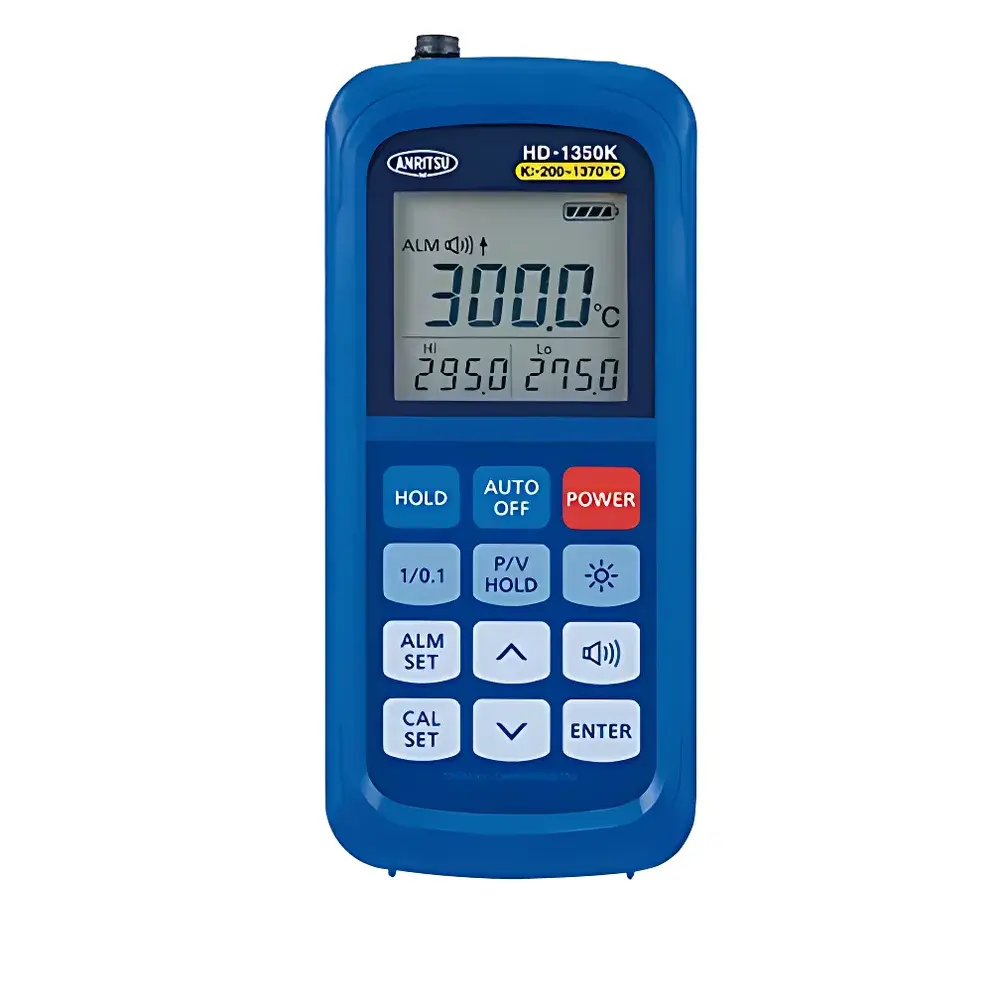
Anritsu Meter HD-1350E / HD-1350K Handheld Thermometer
| Brand | Anritsu Meter |
|---|---|
| Origin | Japan |
| Model | HD-1350E / HD-1350K |
| Temperature Range (E-type) | −200 to 800 °C |
| Temperature Range (K-type) | −200 to 1370 °C |
| Resolution | 1 °C or 0.1 °C (auto-switching) |
| Accuracy (0.1 °C mode) | ±(0.05% of reading + 0.2 °C) from 0 °C |
| Reference Junction Compensation Accuracy | ±0.2 °C at 25 °C ±10 °C |
| Sampling Rate | ~300 ms |
| Input | Single-channel thermocouple (E or K standard |
| Display | Backlit LCD |
| Power | 4 × AA alkaline batteries (300 h typical life) or optional AC adapter |
| IP Rating | Waterproof housing (IEC 60529 IP54 equivalent) |
| Compliance | CE, RoHS |
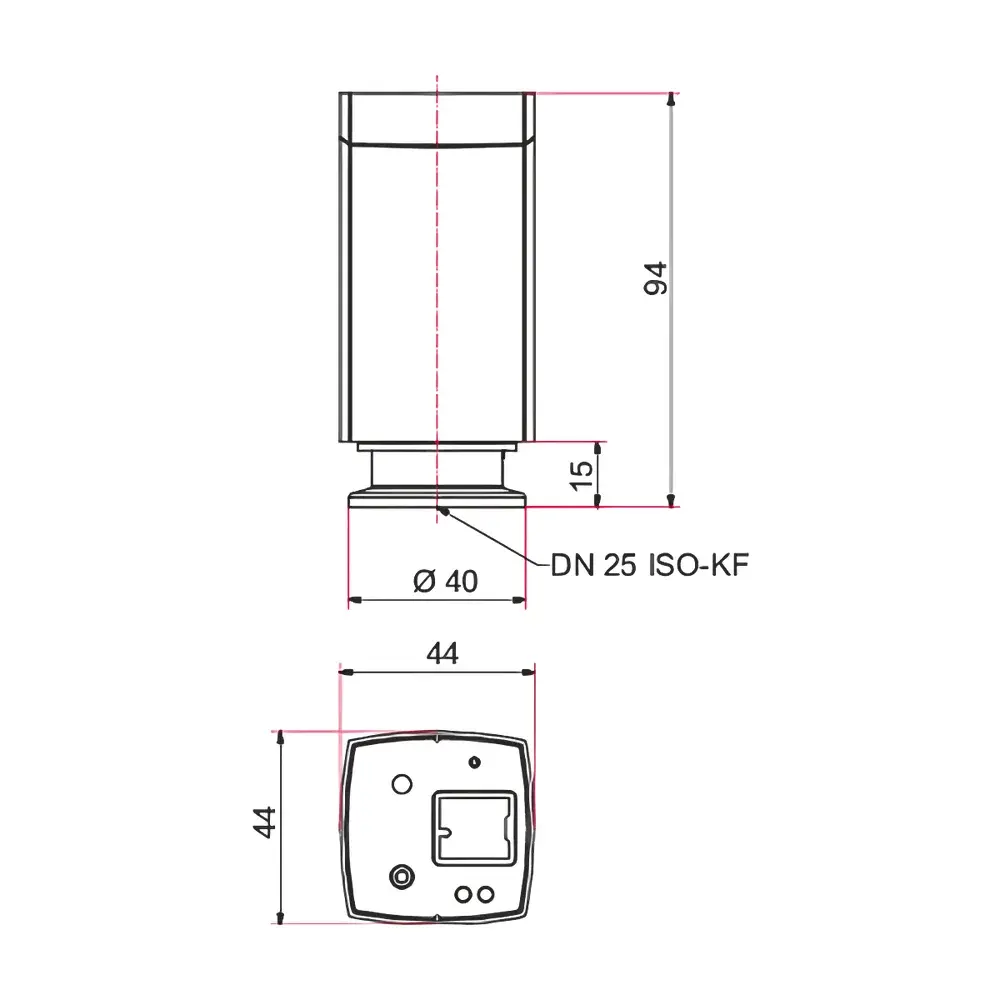
| Dimensions | 76 × 167 × 36 mm (W×H×D, excl. protrusions) |
| Weight | ~350 g (incl. batteries) |
Overview
The Anritsu Meter HD-1350E and HD-1350K are precision-engineered handheld thermometers designed for industrial field service, quality control verification, maintenance diagnostics, and laboratory spot-check applications. These instruments employ cold-junction-compensated thermocouple measurement technology—conforming to IEC 60584-1:2013—enabling high-fidelity temperature acquisition across wide operational ranges. The HD-1350 series supports two primary thermocouple types: Type E (−200 to +800 °C) and Type K (−200 to +1370 °C), with automatic resolution switching between 1 °C and 0.1 °C based on measured value magnitude. Built around a digital linearization engine compliant with international thermocouple standards, the device delivers traceable accuracy without external calibration software dependencies. Its rugged, waterproof enclosure (IP54-equivalent per IEC 60529), compact form factor (76 × 167 × 36 mm), and 350 g mass—including four AA alkaline cells—make it suitable for extended use in manufacturing floors, HVAC commissioning, furnace validation, and thermal mapping audits.
Key Features
- Single-channel thermocouple input compatible with E- and K-type sensors as standard; optional support for J, T, and R types via firmware-configurable input settings
- Intelligent auto-resolution: dynamically switches between 0.1 °C and 1 °C display resolution depending on process temperature zone (e.g., 0.1 °C within −104.9 to +504.9 °C range; 1 °C outside)
- Real-time peak (P) and valley (V) hold function accessible via dedicated soft key, enabling transient thermal event capture without external logging
- Backlit LCD with adjustable illumination—operable in low-light environments such as boiler rooms, cleanroom utility tunnels, or nighttime facility inspections
- Configurable alarm output (TTL-level, 5 V/0 V logic) with independent upper and lower limit thresholds; supports up to 5 mA sink/source current per channel
- Manual calibration offset adjustment via CAL SET key—facilitates field verification against NIST-traceable reference sources without PC connectivity
- Auto-power-off after 5 minutes of inactivity; battery life rated at 300 hours under typical intermittent-use conditions
Sample Compatibility & Compliance
The HD-1350 series interfaces exclusively with standard miniature thermocouple probes (ANP connector type) having source impedance ≤500 Ω. It is not intended for RTD, thermistor, or infrared-based measurements. All models meet CE marking requirements under the EU Electromagnetic Compatibility Directive 2014/30/EU and RoHS 2011/65/EU restrictions on hazardous substances. While not certified for intrinsic safety (ATEX/IECEx), its IP54-rated housing provides protection against dust ingress and water splashing from any direction—making it appropriate for non-hazardous industrial zones classified per IEC 60079-0. Reference junction compensation adheres to ISO/IEC 17025-recommended practices for thermocouple instrumentation, ensuring metrological consistency during ambient temperature fluctuations (0–40 °C operating range). Storage specifications (−20 to +50 °C, 0–85 %RH non-condensing) align with ASTM E2251-21 guidelines for portable thermal measurement devices.
Software & Data Management
The HD-1350 operates as a standalone instrument with no embedded Bluetooth, USB, or wireless data transmission capabilities. All data acquisition, display, and alarm functions are executed locally using onboard firmware. Peak/valley values and current readings are retained in volatile memory only until power cycle or manual reset. For regulatory environments requiring audit trails—such as pharmaceutical manufacturing (FDA 21 CFR Part 11) or aerospace MRO—users must manually record observed values or integrate the unit into external data acquisition systems via its analog alarm output (0–5 V TTL-compatible signal). Calibration records and factory test reports are supplied with each unit and conform to ISO/IEC 17025 documentation standards. Optional AC adapter (sold separately) enables continuous operation during benchtop calibration verification.
Applications
- Preventive maintenance of electric motors, transformers, and switchgear where surface temperature deviations indicate insulation degradation or load imbalance
- Thermal validation of sterilization cycles (autoclaves, dry heat ovens) per ISO 17665 and EN 285 requirements
- Food processing line monitoring—checking holding temperatures against HACCP critical limits (e.g., hot holding ≥60 °C for ≥2 hours)
- Building automation system (BAS) commissioning—verifying duct sensor outputs, chiller return temps, or radiant floor loop performance
- Research lab benchwork involving rapid thermal profiling of reaction vessels, soldering stations, or cryogenic dewar surfaces
- Calibration cross-checks for fixed-mount temperature transmitters in compliance with ANSI/ISA-84.00.01 functional safety lifecycle protocols
FAQ
Does the HD-1350 support data logging or PC connectivity?
No. The HD-1350 is a self-contained measurement instrument with no built-in memory storage, USB port, or wireless interface. Data must be recorded manually or captured externally via its TTL alarm output.
Can the unit measure below −200 °C or above 1370 °C?
No. Measurement ranges are strictly limited by thermocouple physics and internal amplifier design: −200 to +800 °C for E-type, −200 to +1370 °C for K-type. Exceeding these limits may cause sensor damage or erroneous readings.
Is the calibration offset adjustment traceable to national standards?
The CAL SET function allows user-applied offsets but does not generate NIST-traceable certificates. For accredited calibration, third-party labs must perform full metrological verification per ISO/IEC 17025.
What is the maximum allowable source impedance for connected thermocouples?
500 Ω, as specified in the input circuit design. Higher impedances may degrade accuracy and increase susceptibility to electromagnetic interference.
How does the reference junction compensation perform outside 25 °C ±10 °C?
Compensation accuracy degrades linearly at ±0.01 % of full scale per °C deviation beyond the 15–35 °C reference band, consistent with thermocouple standard error modeling.