
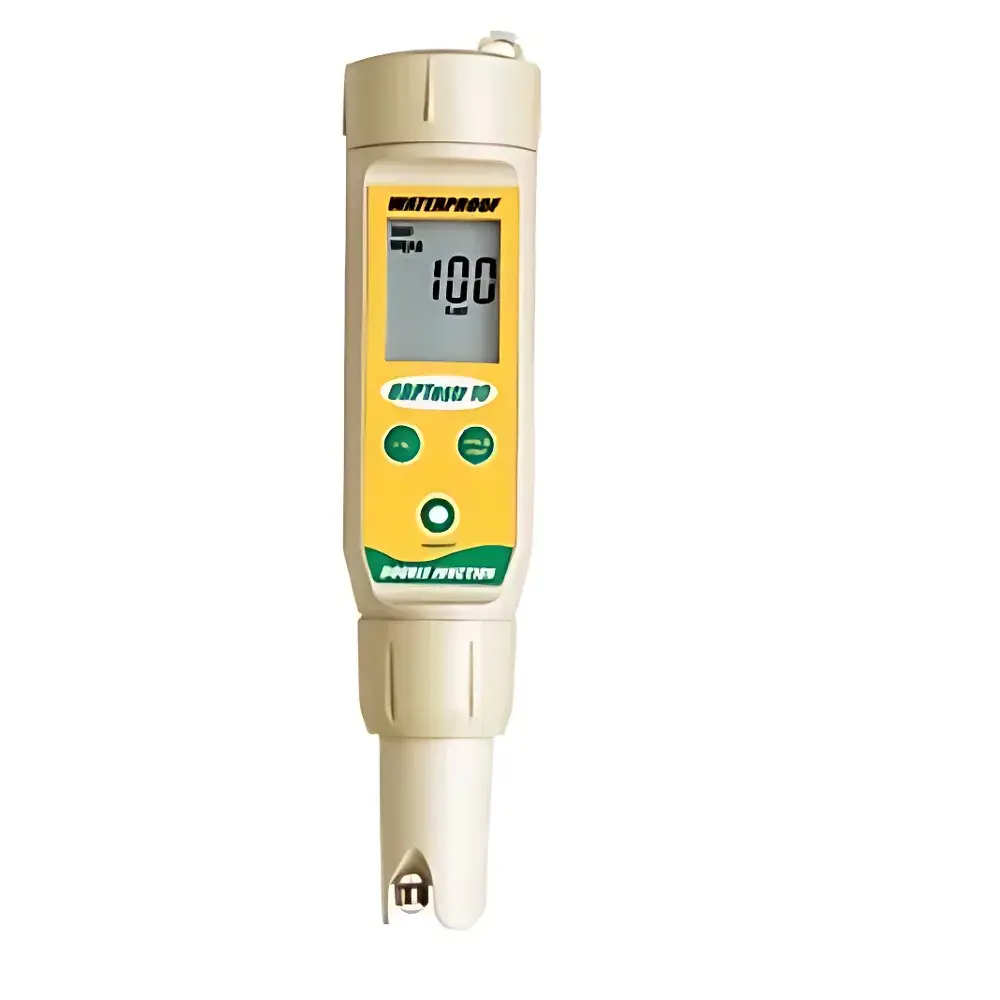
Eutech ORPTEST10 Waterproof ORP Test Pen
| Brand | Eutech |
|---|---|
| Origin | USA |
| Model | ORPTEST10 |
| Instrument Type | Laboratory & Field-Portable ORP Meter |
| Measurement Range | −999 to +1000 mV |
| Resolution | 1 mV |
| Accuracy | ±2 mV |
| Calibration | Manual 1-point |
| Electrode Type | Replaceable Double-Junction Ag/AgCl |
| Power Supply | 4 × A76/LR44 batteries |
| Battery Life | >500 hours |
| Auto-Off | 8.5 min idle |
| Operating Temperature | 5–45 °C |
| IP Rating | IP67 |
| Display | Dual-line LCD (2.1 × 2.7 cm) |
| Dimensions | 16.5 × 3.8 cm |
| Weight | 90 g |
| Data Hold & Low-Battery Indication | Yes |
| Temperature Compensation | None (ORP-only measurement) |
Overview
The Eutech ORPTEST10 is a compact, rugged, and fully portable ORP (Oxidation-Reduction Potential) test pen engineered for rapid, reliable field and laboratory measurements in water quality monitoring, environmental sampling, wastewater treatment, food safety verification, and biomedical process control. Unlike combination pH/ORP meters, the ORPTEST10 is purpose-built exclusively for redox potential determination—eliminating cross-sensitivity and calibration ambiguity associated with multi-parameter devices. It operates on the fundamental electrochemical principle of measuring the voltage difference between a stable reference electrode (double-junction Ag/AgCl) and an inert sensing electrode (typically platinum or gold), immersed in solution. This voltage—expressed in millivolts (mV)—quantifies the thermodynamic tendency of a system to gain electrons (reduction) or lose electrons (oxidation), serving as a critical surrogate for disinfectant residual efficacy (e.g., chlorine, ozone), microbial activity, and redox status in natural and engineered aqueous systems.
Key Features
- High-precision ORP measurement with ±2 mV accuracy across the full range of −999 to +1000 mV—meeting ASTM D1293 and ISO 5814 requirements for routine redox monitoring.
- Replaceable double-junction Ag/AgCl reference electrode module minimizes junction clogging and liquid junction potential drift—extending operational stability in turbid, high-protein, or sulfide-rich samples.
- IP67-rated housing ensures complete dust ingress protection and submersion resistance up to 1 meter for 30 minutes; unit is buoyant and floats upright for hands-free operation in open water or tanks.
- Dual-line LCD display (2.1 × 2.7 cm) simultaneously shows measured ORP value and real-time status indicators—including battery level, measurement readiness, and calibration mode—enabling unambiguous interpretation without menu navigation.
- Intuitive tactile keypad and integrated protective cap—doubles as a 10-mL sample cup and benchtop stand—optimizes ergonomics during repetitive spot checks or extended field surveys.
- Energy-efficient design delivers >500 hours of continuous operation on four standard A76/LR44 button-cell batteries, with automatic shutdown after 8.5 minutes of inactivity to preserve power.
Sample Compatibility & Compliance
The ORPTEST10 is validated for use with aqueous samples across diverse matrices including potable water, swimming pools, cooling towers, aquaculture systems, fermentation broths, soil leachates, and treated effluents. Its double-junction electrode architecture resists poisoning from heavy metals, cyanide, and organic fouling agents commonly encountered in industrial and environmental applications. While not temperature-compensated (per design intent for ORP-only use), the device maintains specified accuracy within its operating range of 5–45 °C. The instrument conforms to IEC 60529 (IP67), CE marking directives for electrical safety, and RoHS-compliant material specifications. It supports GLP-aligned workflows through non-volatile memory retention of last-measured value and battery status—even after power loss.
Software & Data Management
As a standalone handheld instrument, the ORPTEST10 does not interface with PC-based software or cloud platforms. All data handling is local and manual: users record values directly from the LCD display. However, its consistent output format, stable zero-point repeatability, and built-in data hold function facilitate traceable manual logging in paper-based or electronic lab notebooks compliant with 21 CFR Part 11 when paired with appropriate documentation controls. No firmware updates or driver installation are required—ensuring long-term operational continuity without dependency on proprietary software ecosystems.
Applications
- Verification of free chlorine and ozone residual in municipal drinking water distribution systems and recreational facilities.
- Monitoring redox conditions in activated sludge processes, anaerobic digesters, and denitrification basins.
- Assessing sterilization efficacy in pharmaceutical clean-in-place (CIP) rinse cycles and bioreactor sparging lines.
- Field screening of sediment redox potential (Eh) in wetland restoration and contaminated site characterization.
- Quality assurance of sanitizing solutions in food processing environments per FDA Food Code guidelines.
- Educational demonstrations of electrochemical principles in undergraduate chemistry and environmental science laboratories.
FAQ
Does the ORPTEST10 measure temperature?
No. The ORPTEST10 is a dedicated ORP-only instrument and does not include a temperature sensor or compensation algorithm.
Can the electrode be replaced in the field?
Yes. The double-junction Ag/AgCl reference module is user-replaceable using standard tools—no recalibration is required after replacement.
Is the device suitable for saline or seawater measurements?
Yes. The IP67 housing and double-junction electrode provide robust performance in high-conductivity media, though users should rinse thoroughly with deionized water after exposure to brine.
What calibration standard is recommended?
A certified ORP buffer solution (e.g., ±225 mV Zobell’s solution or ±430 mV Light’s solution) is advised for single-point verification prior to critical measurements.
How is measurement stability ensured during field use?
The microprocessor-controlled circuitry applies digital filtering and adaptive response algorithms to suppress transient noise from electromagnetic interference or mechanical vibration—yielding stable readings within 5 seconds under typical conditions.





