
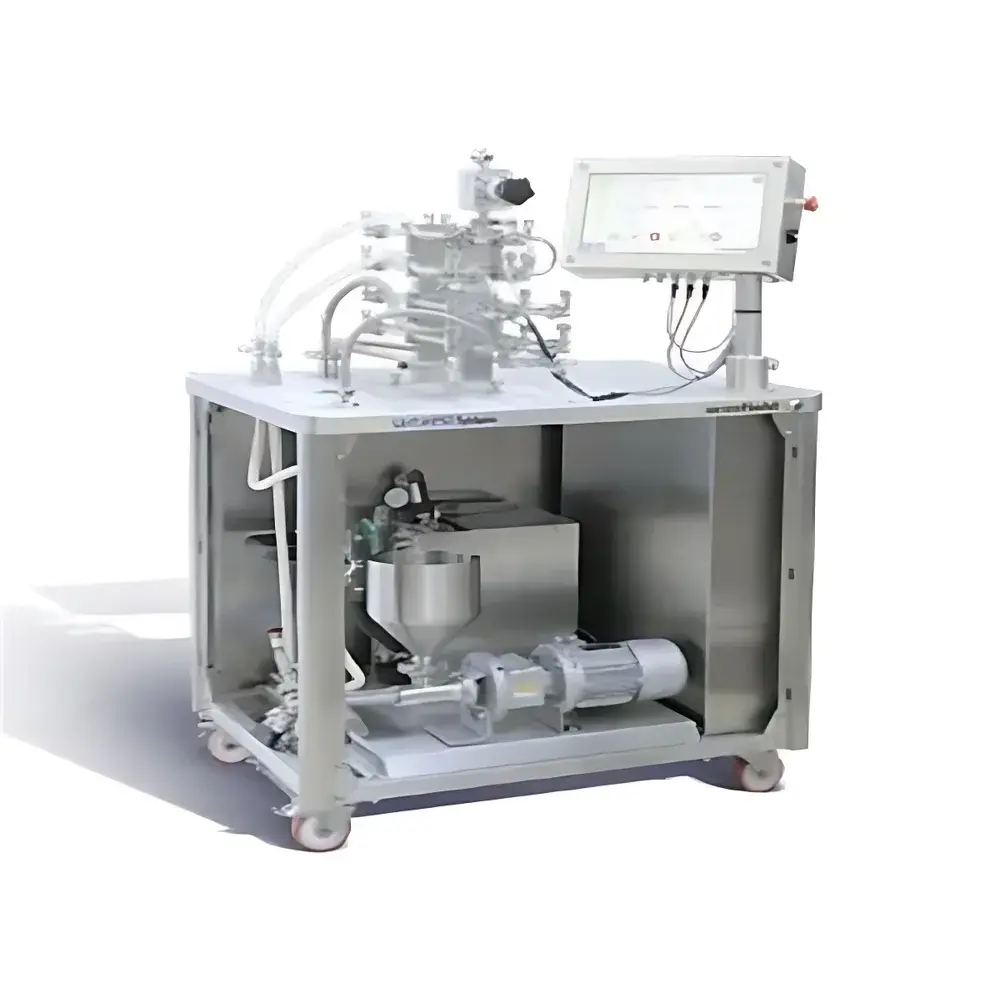
Armfield FT74XTS UHT/HTST Pilot-Scale Thermal Processing System
| Brand | Armfield |
|---|---|
| Origin | United Kingdom |
| Model | FT74XTS |
| Maximum Sterilization Temperature | 150 °C |
| Product Flow Rate | 20 L/h |
| CIP Flow Rate | 120 L/h |
| Sterilization Capacity | 50 L/h (with plate heat exchanger) |
| Holding Time Display | Yes |
| F₀ Calculation & Display | Yes |
| Touchscreen Interface | 800 × 480 px Full-Color LCD |
| Pre-set Programs | 32 |
| Data Logging | USB Storage (standard), PC Connectivity (optional) |
| Flow Measurement | Electromagnetic Flow Sensor |
| Holding Tube | Adjustable |
| Cooling Stages | Single-stage standard, dual-stage optional |
| Heat Exchanger Configurations | Interchangeable plate or tubular modules |
| CIP System | Integrated high-pressure hot water recirculation |
| Enclosure | Integrated stainless-steel cabinet |
| Environmental Rating | IP54-rated for humid laboratory environments |
| Level Sensing | Product tank ultrasonic level sensor |
Overview
The Armfield FT74XTS is a pilot-scale Ultra-High Temperature (UHT) and High-Temperature Short-Time (HTST) thermal processing system engineered for rigorous process development, formulation validation, and regulatory pre-compliance testing in food, dairy, pharmaceutical, and functional beverage R&D laboratories. Operating on the fundamental principles of continuous-flow heat transfer and time-temperature lethality integration, the FT74XTS delivers precise, repeatable thermal treatment profiles under fully instrumented and programmable conditions. Its modular architecture enables seamless transition between plate-type and tubular heat exchanger configurations—allowing users to evaluate product behavior across distinct flow regimes, shear histories, and residence time distributions. Designed to ASTM E1563 and ISO 11133-compliant validation frameworks, the system supports generation of thermally validated process data required for hazard analysis (HACCP), shelf-life modeling, and submission-ready documentation for regulatory review.
Key Features
- Full-color 800 × 480 px touchscreen HMI with real-time temperature profile visualization across all critical zones: regeneration, heating, holding, and cooling.
- Integrated electromagnetic flow sensor with volumetric accuracy ±0.5% of reading, enabling precise mass balance calculations and flow-dependent parameter control.
- Adjustable insulated holding tube with digital dwell-time display and automatic F₀ calculation per ISO 11137 and FDA 21 CFR Part 11–compliant audit trail (when paired with optional PC logging software).
- Interchangeable heat exchanger modules: rapidly switch between gasketed plate (for low-viscosity, particulate-free liquids) and stainless-steel tubular (for higher viscosity or shear-sensitive formulations) without tooling or recalibration.
- Self-contained CIP circuit with high-pressure hot water recirculation (up to 95 °C), integrated pump, and conductivity-based endpoint detection—validated per EHEDG Guideline Doc. 8 and 3-A Sanitary Standards 3A 05-01.
- Compact, mobile stainless-steel enclosure (IP54 ingress protection) suitable for placement in controlled-humidity labs or near existing production lines; footprint < 1.2 m².
Sample Compatibility & Compliance
The FT74XTS accommodates a broad range of liquid and semi-liquid matrices including milk, plant-based beverages, fruit pulps (≤ 5% particulates < 200 µm), nutritional emulsions, and low-acid aqueous pharmaceutical suspensions. Its sanitary 316L stainless-steel wetted path complies with FDA 21 CFR 110, EC 1935/2004, and 3-A Symbol 3A 05-01 requirements. All sensors—including ultrasonic tank level detection, PT100 Class A temperature probes, and pressure transducers—are calibrated traceable to NIST standards. The system supports GLP/GMP-aligned operation through user-level access control, electronic signature capability (optional), and full data integrity features including timestamped event logs and immutable USB-stored records.
Software & Data Management
The embedded controller stores up to 32 user-defined thermal protocols with independent setpoints for inlet temperature, steam pressure, flow rate, and holding time. All operational parameters—including real-time F₀, cumulative lethality, and differential temperature gradients—are logged at 1-second intervals and exportable via USB to CSV format. The optional PC-based ArmField DataLink software extends functionality with automated report generation (per ISO 22000 Annex SL structure), trend analysis, deviation alerting, and 21 CFR Part 11-compliant electronic signatures, audit trails, and role-based permissions. Raw datasets are compatible with JMP, MATLAB, and Python-based thermal modeling workflows.
Applications
- Development and optimization of UHT sterilization cycles for novel dairy alternatives and probiotic-fortified beverages.
- Validation of thermal stability for heat-labile active ingredients in nutraceutical suspensions and parenteral pre-formulations.
- Comparative evaluation of fouling propensity and cleaning efficiency between plate and tubular heat exchange geometries.
- Generation of D-value and z-value kinetic data for microbial challenge studies using spore suspensions (e.g., Geobacillus stearothermophilus).
- Scale-down correlation studies supporting tech transfer from pilot to commercial thermal processing lines.
- Training platform for food safety auditors and process engineers on thermal lethality principles and HACCP critical limit determination.
FAQ
What is the minimum product volume required for a valid thermal run?
Typical startup and stabilization volume is ~3.5 L; steady-state processing begins after 2 minutes of continuous flow at target parameters.
Can the system be integrated with external PLCs or SCADA systems?
Yes—via Modbus RTU (RS-485) or optional Ethernet/IP interface for bi-directional setpoint and status exchange.
Is the holding tube length adjustable in situ?
Yes—the insulated holding section features a calibrated linear actuator allowing dynamic adjustment from 12 to 36 seconds nominal dwell time while maintaining laminar flow integrity.
Does the system meet hygiene requirements for pharmaceutical use?
It meets core hygienic design criteria per ASME BPE-2023 (Category 2) and is routinely deployed in early-phase aseptic process development under GMP Annex 1 guidance.
What validation documentation is supplied with the system?
Factory acceptance test (FAT) report, IQ/OQ protocol templates, calibration certificates for all primary sensors, and material compliance declarations (PED 2014/68/EU, RoHS, REACH).






