
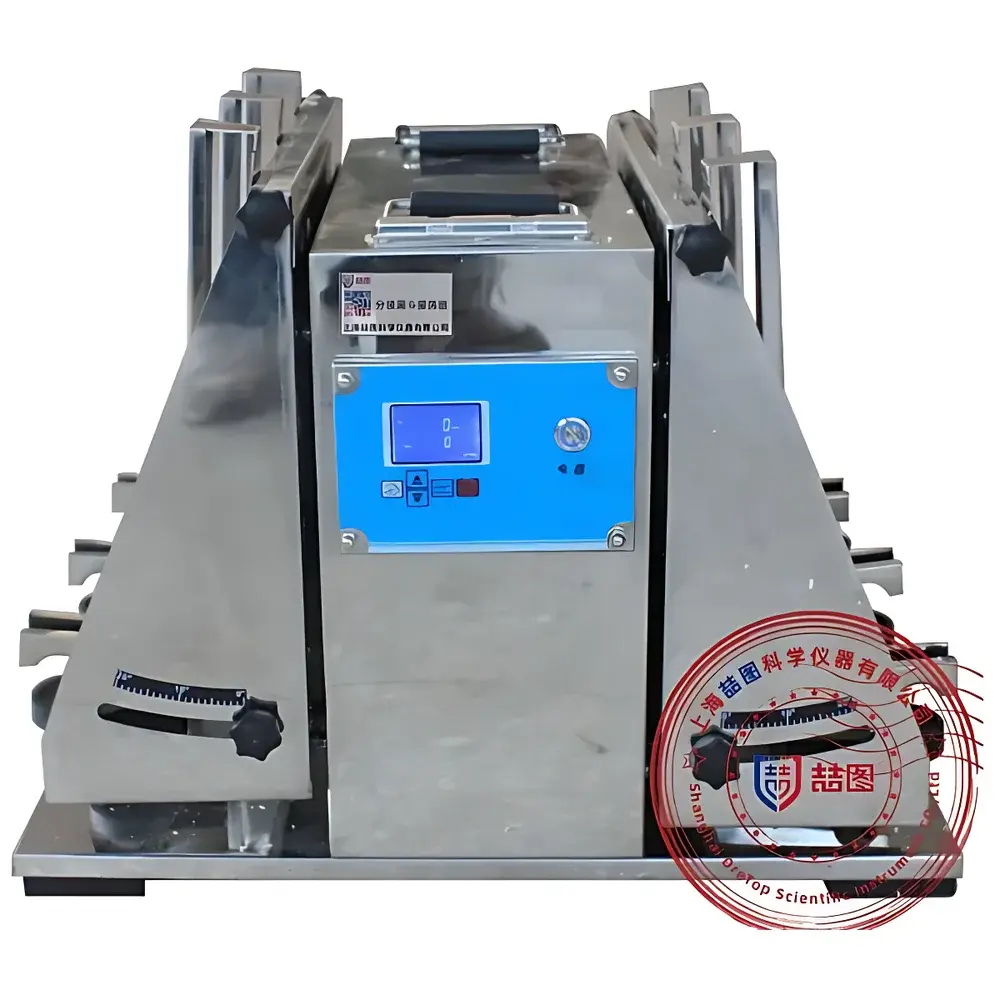
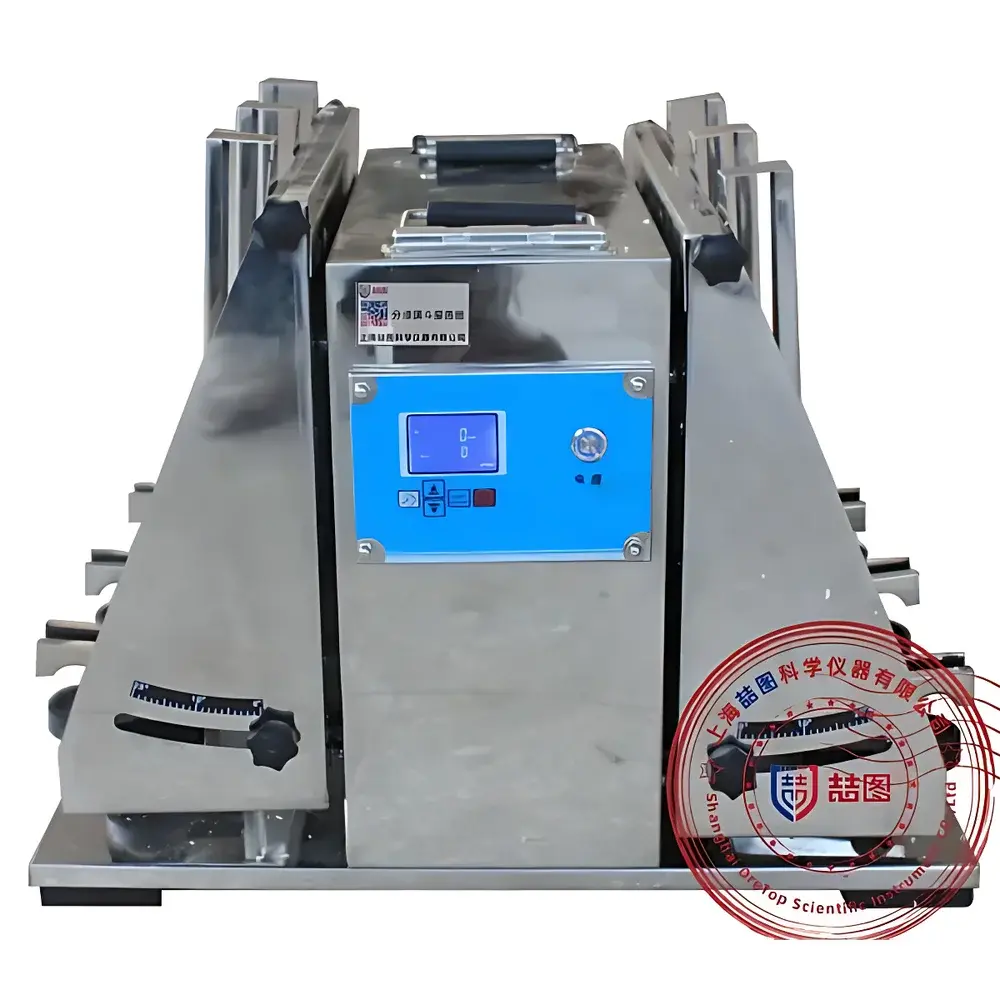
DRETOP F8-2000 Separatory Funnel Shaker
| Brand | DRETOP |
|---|---|
| Origin | Shanghai, China |
| Manufacturer Type | Direct Manufacturer |
| Product Category | Domestic |
| Model | F8-2000 |
| Instrument Type | Separatory Funnel Shaker |
| Timer Range | 0–9999 min |
| Oscillation Frequency | 0–300 cycles/min |
| Oscillation Amplitude | ≥40 mm (customizable) |
| Temperature Control | Not integrated (ambient operation only) |
| Tray Configuration | Single-tier shaker platform for 8 × 2000 mL separatory funnels |
| Power Supply | 220 V, 50 Hz |
| Display | LCD control panel |
| Drive System | Stepless speed regulation with buffered start/stop |
| Oscillation Modes | Dual-mode — vertical reciprocating or adjustable-angle tilting (0–20°) |
| Compatible Funnel Sizes | 125–2000 mL |
Overview
The DRETOP F8-2000 Separatory Funnel Shaker is an engineered laboratory instrument designed specifically for high-efficiency liquid–liquid extraction workflows in environmental, food safety, agricultural, and regulatory testing laboratories. It operates on a robust reciprocating oscillation principle—employing dual-symmetric linear motion along a horizontal axis—to induce controlled, reproducible phase separation in separatory funnels without vortex formation or emulsion over-stabilization. Unlike orbital or rotary shakers, the F8-2000 delivers precise mechanical agitation optimized for density-driven partitioning of analytes between immiscible solvents (e.g., dichloromethane/water, ethyl acetate/hexane), minimizing interfacial film retention and maximizing recovery yield. Its low center-of-gravity structural design ensures operational stability during extended runs—even at maximum frequency—and incorporates a buffered acceleration/deceleration profile to prevent funnel cap loosening or solvent splashing upon startup or shutdown.
Key Features
- Single-platform configuration supporting up to eight 2000 mL separatory funnels simultaneously—enabling parallel processing for throughput-critical applications such as EPA Method 508.1 (halogenated organic compounds) or ISO 18332:2016 (pesticide residue analysis).
- Stepless frequency control (0–300 cycles/min) with real-time LCD feedback, permitting fine-tuned optimization for diverse solvent systems and viscosity ranges—from low-viscosity hexane to higher-density chlorinated solvents.
- Dual oscillation modes: selectable vertical reciprocating motion for standard extractions, or tilting oscillation (0–20° adjustable angle) to enhance interfacial contact area and improve mass transfer efficiency in viscous or surfactant-containing matrices.
- Modular sample holder system with vertically sliding clamps—allowing rapid loading/unloading of funnels across multiple volume classes (125 mL to 2000 mL) without tools or reconfiguration.
- Industrial-grade AC motor coupled with reinforced steel frame and vibration-damping feet—designed for continuous duty cycles under GLP-compliant laboratory conditions.
- No integrated heating or cooling; intended for ambient-temperature extraction protocols where thermal stability of target analytes is critical (e.g., volatile organics, thermolabile pesticides).
Sample Compatibility & Compliance
The F8-2000 accommodates standard ground-glass jointed separatory funnels (ISO 4788, ASTM E180) ranging from 125 mL to 2000 mL, including PTFE stopcocks and pressure-relief caps. Its mechanical design conforms to IEC 61010-1:2010 safety standards for laboratory electrical equipment. While the unit itself does not provide temperature regulation, its ambient-only operation aligns with method requirements specified in US EPA SW-846 Methods 3510C (separatory funnel extraction) and AOAC Official Method 2007.01 (multiresidue pesticide analysis). The absence of internal electronics near solvent pathways eliminates ignition risk—making it suitable for use in Class I, Division 2 hazardous locations when operated with appropriate ventilation.
Software & Data Management
The F8-2000 utilizes a microprocessor-based controller with non-volatile memory for parameter retention across power cycles. All operational settings—including timer value, set frequency, and selected oscillation mode—are stored locally and displayed via a backlit LCD interface. No external software, USB connectivity, or data logging capability is provided, consistent with its role as a dedicated benchtop extraction tool rather than a networked analytical platform. For laboratories requiring audit trails or electronic records, integration with LIMS can be achieved via optional dry-contact relay outputs (available upon request) for run-start and run-complete signaling—supporting basic 21 CFR Part 11 compliance when paired with validated third-party middleware.
Applications
- Environmental testing: Extraction of PAHs, PCBs, organochlorine pesticides, and phthalates from soil, sediment, and aqueous samples per EPA Methods 3510C, 3520C, and 8082A.
- Food and feed analysis: Isolation of mycotoxins (e.g., aflatoxin B1), veterinary drug residues, and fat-soluble vitamins using AOAC and EN 15662-compliant workflows.
- Pharmaceutical QC: Recovery of lipophilic active pharmaceutical ingredients (APIs) from aqueous bioreactor harvests or dissolution media prior to HPLC analysis.
- Academic research: Standardized solvent partitioning in natural product isolation, metabolite profiling, and synthetic chemistry workups.
FAQ
Is the F8-2000 compatible with glassware other than separatory funnels?
No—it is mechanically optimized for ground-glass-jointed separatory funnels only. Use with non-standard vessels may compromise clamp integrity or oscillation symmetry.
Does the unit support programmable multi-step protocols (e.g., variable speed over time)?
No. It supports single-setpoint operation only: fixed frequency, fixed duration, and fixed oscillation mode per run.
Can the tilt angle be calibrated or locked at intermediate positions?
Yes—the 0–20° tilt adjustment is manually set via precision-machined locking levers and verified using an included bubble level indicator.
What maintenance is required for long-term reliability?
Annual inspection of drive belt tension, clamp spring elasticity, and motor brush wear (if applicable); no scheduled lubrication is required due to sealed bearing construction.
Is CE or UL certification available for export markets?
CE marking is available upon request for EU shipment; UL listing is not currently held but complies with underlying IEC 61010-1 requirements.




