
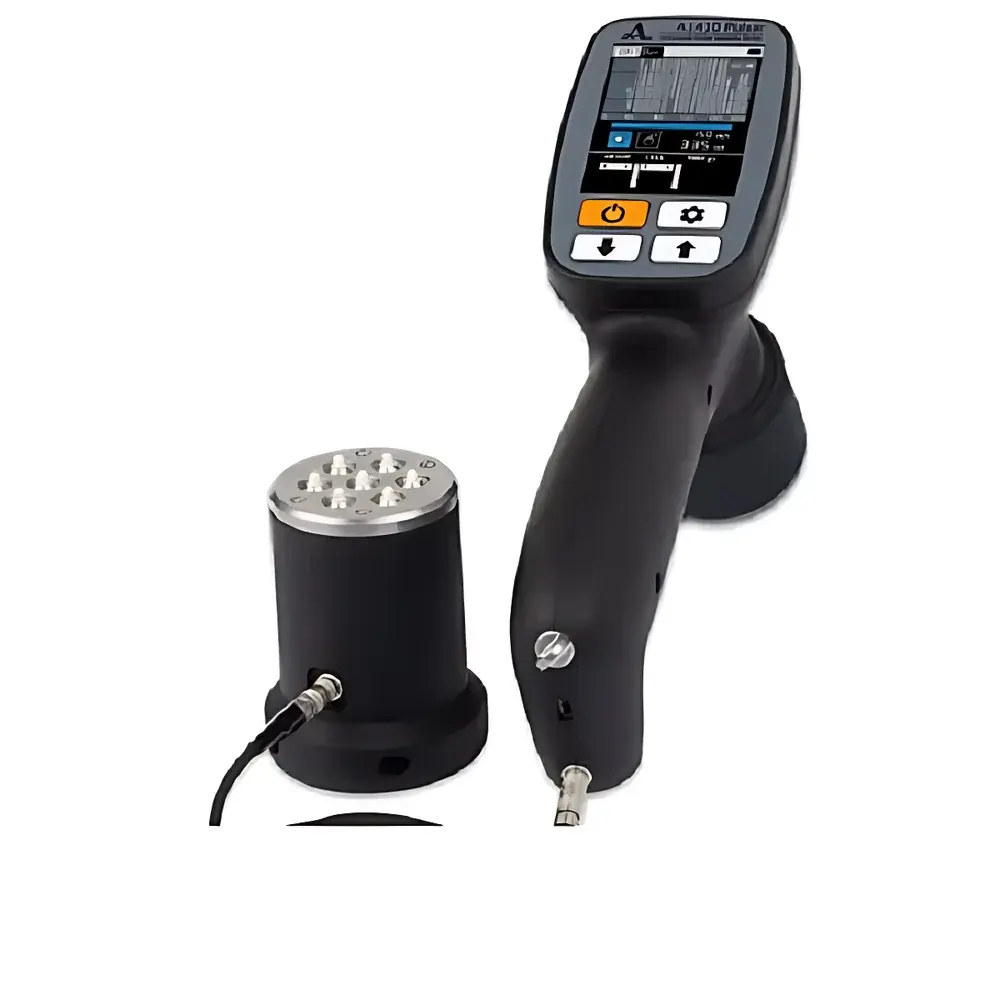
ACS A1410 Pulsar Ultrasonic Pulse Velocity Tester
| Brand | ACS |
|---|---|
| Origin | Italy |
| Manufacturer Type | Authorized Distributor |
| Origin Category | Imported |
| Model | A1410 Pulsar |
| Price | USD 6,800 (FOB Italy) |
Overview
The ACS A1410 Pulsar Ultrasonic Pulse Velocity Tester is a portable, ergonomically engineered instrument designed for in-situ non-destructive evaluation (NDE) of concrete structural integrity. It operates on the principle of ultrasonic pulse velocity (UPV) measurement—transmitting high-frequency mechanical waves (typically 54 kHz) through concrete and precisely measuring the transit time between two dry-point contact transducers. Based on the established empirical correlation between longitudinal wave velocity and compressive strength, modulus of elasticity, and internal homogeneity, the A1410 Pulsar delivers quantitative, repeatable data for condition assessment without surface preparation or coupling agents. Its robust architecture supports field deployment under variable ambient conditions, with an effective penetration depth up to 2 meters in standard reinforced concrete—enabling rapid screening of columns, beams, slabs, and precast elements during construction QA/QC, forensic investigation, or long-term infrastructure monitoring.
Key Features
- Dry-coupled ceramic transducer pair with wear-resistant, low-impedance ceramic faces—eliminates need for gel, grease, or water coupling; insensitive to surface roughness, moisture, or minor contamination
- Compact, lightweight housing constructed from impact-resistant polymer with integrated ergonomic grip and anti-slip texture for extended one-handed operation
- Integrated non-volatile memory storing up to 50,000 timestamped test records, organized into user-defined groups with metadata (location ID, operator code, date/time, sensor spacing)
- USB 2.0 interface compliant with CDC class drivers—enables direct connection to Windows-based PCs without proprietary software installation; exports ASCII-delimited (.csv) files compatible with Excel, MATLAB, and LIMS platforms
- Built-in real-time signal validation: automatic waveform acquisition trigger, peak detection algorithm, and transit time uncertainty estimation based on signal-to-noise ratio (SNR) and zero-crossing stability
- Compliance-ready firmware supporting audit trails: all parameter changes, calibration events, and data export actions are logged with UTC timestamps and operator identifiers
Sample Compatibility & Compliance
The A1410 Pulsar is validated for use on hardened Portland cement-based concretes (normal, lightweight, and high-strength grades), grouted masonry, and cementitious composites—including fiber-reinforced concrete (FRC) and ultra-high-performance concrete (UHPC). It is not intended for metallic, highly porous aerated blocks (>15% void content), or saturated soils. The instrument meets essential safety and electromagnetic compatibility requirements per CE marking (2014/30/EU EMC Directive and 2014/35/EU LVD Directive). Its measurement methodology aligns with internationally recognized standards including ASTM C597–16 (Standard Test Method for Pulse Velocity Through Concrete), BS 1881–203:1986 (Recommendations for Measurement of Pulse Velocity in Concrete), DIN EN 12504–4 (Testing Concrete — Part 4: Determination of Ultrasonic Pulse Velocity), and IS 13311 (Part 1):1992 (Non-destructive Testing of Concrete — Methods of Ultrasonic Pulse Velocity Testing). It also supports implementation within GLP/GMP-regulated environments when paired with documented calibration procedures traceable to NIST or EU-accredited metrology labs.
Software & Data Management
The A1410 Pulsar does not require proprietary desktop software for basic operation or data retrieval. Raw transit time values (µs), calculated velocities (km/s), and derived indices (e.g., quality index QI = vmeasured/vreference) are viewable directly on the device’s backlit LCD. For advanced analysis, exported .csv files contain full waveform metadata and support post-processing in third-party tools. Optional ACS DataBridge Utility (v3.2+) provides batch statistical reporting, spatial mapping (via optional GPS-tagged survey mode), outlier detection using IQR filtering, and automated report generation compliant with ISO/IEC 17025 documentation requirements. All data handling adheres to FDA 21 CFR Part 11 principles where electronic records are employed in regulated workflows—ensuring secure user authentication, immutable audit logs, and electronic signature capability.
Applications
- On-site estimation of in-place compressive strength of concrete elements using calibrated velocity–strength correlations per ACI 228.2R or EN 13791
- Detection and localization of internal discontinuities—including honeycombing, delamination, and micro-cracking—through velocity reduction, signal attenuation, and waveform distortion analysis
- Assessment of concrete aging effects via longitudinal velocity drift monitoring over time (e.g., carbonation front progression or alkali-silica reaction onset)
- Quality verification of post-tensioned duct grouting by comparing UPV profiles across tendon lengths
- Characterization of material heterogeneity in mass concrete placements, shotcrete linings, and repair overlays
- Supporting structural health monitoring (SHM) programs by establishing baseline velocity maps for trend analysis during service life
FAQ
Does the A1410 Pulsar require calibration before each use?
No—factory calibration is stable for 12 months under normal operating conditions. Annual recalibration against certified delay-line reference blocks (e.g., PANAMETRIC NIST-traceable standards) is recommended per ISO/IEC 17025.
Can it measure through steel reinforcement?
Yes—provided rebar diameter is ≤25 mm and spacing ≥100 mm center-to-center; velocity interpretation must account for path deviation using correction models per RILEM TC-178.
Is firmware upgrade supported in the field?
Yes—via USB-connected PC using ACS Firmware Updater Tool; version history and release notes are publicly available on the ACS Technical Portal.
What is the typical measurement repeatability?
Under controlled lab conditions (ASTM C597 setup), coefficient of variation (CV) is ≤1.2% for triplicate measurements on homogeneous specimens.
Does it comply with ISO 9001 or ISO 14001 requirements?
The instrument itself is not certified to these management system standards; however, its traceable measurement capability and documentation features support integration into ISO 9001-certified QA processes.



