
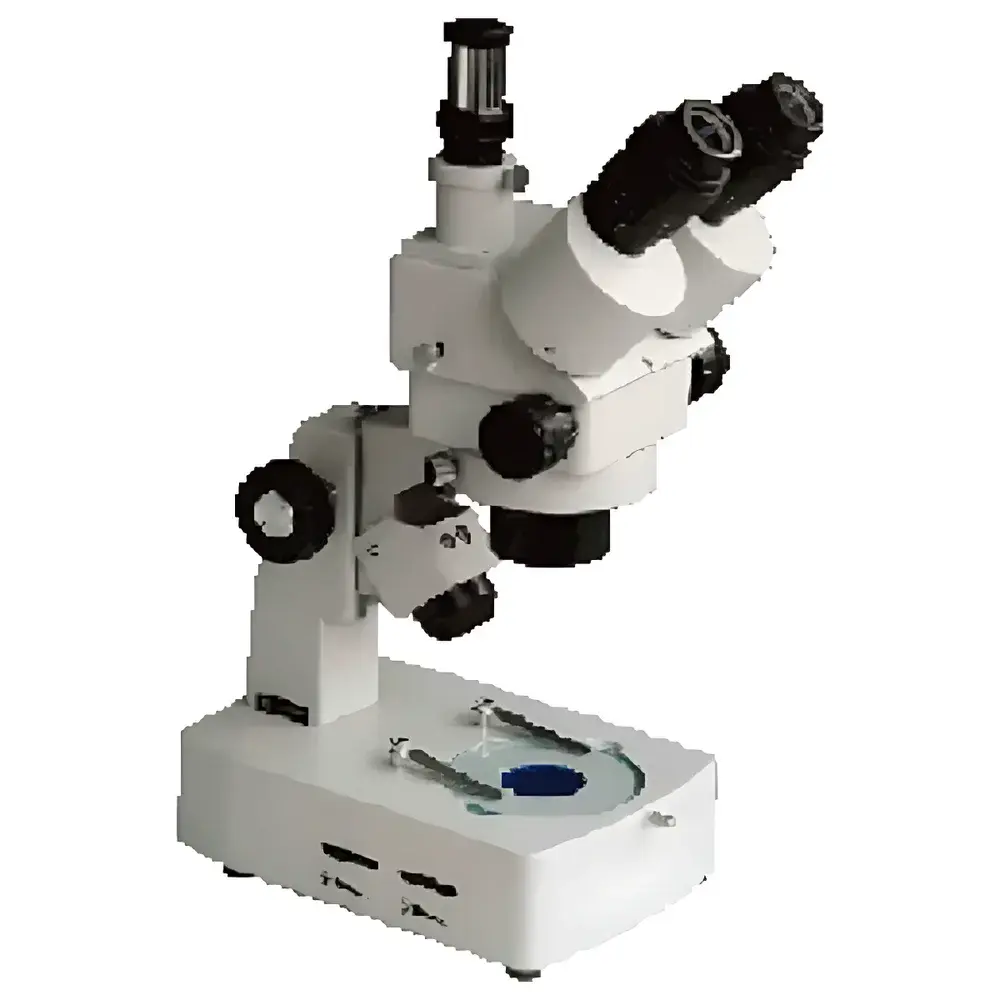
YANRUN XTZ-E Series Trinocular Continuous Zoom Stereo Microscope
| Brand | YANRUN |
|---|---|
| Origin | Shanghai, China |
| Manufacturer Type | Direct Manufacturer |
| Country of Origin | China |
| Model | XTZ-E Series Trinocular Continuous Zoom Stereo Microscope |
| Price | USD 1 (Reference Only) |
| Zoom Ratio | 6.5:1 (0.7× to 4.5×) |
| Working Distance | 95 mm |
| Objective Magnification Range | 0.7× to 4.5× |
| Eyepieces | Wide-Field 10× (20 mm Field Number) |
| Field of View | 5.1 mm to 33 mm |
| Interpupillary Adjustment Range | 55–75 mm |
| Stage Diameter | 95 mm (Round) |
| Illumination | Adjustable 10 W Halogen Lamp, 110–220 V AC Input with 12 V DC Output |
| Optional Accessories | Wide-Angle Eyepieces (5×, 12.5×, 15×, 20×, 25×, SWF10×), Auxiliary Objectives (0.5×, 0.75×, 1.5×, 2×), Ring Light |
Overview
The YANRUN XTZ-E Series Trinocular Continuous Zoom Stereo Microscope is engineered for high-fidelity stereoscopic observation in industrial quality control, electronics assembly, biological specimen documentation, and educational laboratories. It employs a Galilean-type zoom optical system with an internal inclined light path, delivering true stereoscopic imaging through dual independent optical channels. The 13° and 45° inclined viewing angles accommodate ergonomic seated or standing operation, while the trinocular port enables simultaneous visual inspection and high-resolution digital imaging via C-mount or dedicated microscope cameras. Designed for long-term stability and optical consistency, the XTZ-E series utilizes precision-machined aluminum alloy housings and anti-reflective coated optics to minimize chromatic aberration and maximize contrast across its full magnification range.
Key Features
- Continuous zoom optics with 6.5:1 magnification ratio (0.7× to 4.5× objective magnification), enabling seamless adjustment without discrete steps or lens swapping
- Fixed working distance of 95 mm—optimized for hands-on manipulation of samples under observation, including soldering, micro-assembly, and dissection tasks
- Wide-field 10× eyepieces (20 mm field number) provide extended depth of field and comfortable viewing; interpupillary distance adjustable from 55 mm to 75 mm to accommodate diverse user anthropometry
- Dual-angle inclined binocular head (13° and 45°) supports both upright benchtop and angled workstation configurations, reducing operator fatigue during extended use
- Stable round stage (95 mm diameter) with non-slip surface and optional stage clips ensures secure sample positioning during fine manipulation
- Integrated halogen illumination system (10 W, 12 V DC output) features continuous brightness control and wide-input voltage compatibility (110–220 V AC), ensuring consistent color temperature and illumination uniformity
Sample Compatibility & Compliance
The XTZ-E microscope accommodates a broad spectrum of opaque, translucent, and low-contrast specimens—including printed circuit boards (PCBs), metallographic sections, botanical specimens, entomological mounts, and polymer components—without requiring specialized preparation. Its long working distance and large depth of field facilitate integration with auxiliary tools such as micromanipulators, soldering irons, and forceps. While not certified to ISO 10993 or ASTM E2928 for medical device inspection, the instrument meets general laboratory equipment requirements per IEC 61010-1 (Safety Requirements for Electrical Equipment for Measurement, Control, and Laboratory Use). Its modular design supports GLP-compliant documentation workflows when paired with validated camera systems and calibrated stage micrometers.
Software & Data Management
The trinocular port accepts standard C-mount adapters (1× or 0.5× reduction) for coupling with USB3.0 or HDMI-based digital cameras. When used with third-party imaging software (e.g., ToupView, Ocular, or ImageJ-compatible drivers), the system supports measurement annotation, image stacking, time-lapse capture, and export in TIFF, PNG, or JPEG formats. Audit trails, user access logs, and metadata embedding (magnification, timestamp, scale bar) are achievable via compliant software configurations aligned with FDA 21 CFR Part 11 requirements when deployed in regulated environments. Firmware updates and calibration records are maintained externally by the end-user’s IT or QA department.
Applications
- Electronics manufacturing: PCB inspection, solder joint assessment, component placement verification, and rework guidance
- Materials science: Surface defect analysis of coatings, weld seams, and composite laminates
- Life sciences education: Dissection support, arthropod morphology studies, and plant tissue examination
- Forensic labs: Toolmark comparison, fiber identification, and document authenticity evaluation
- Quality assurance departments: Incoming material checks, finished product sampling, and dimensional verification using calibrated reticles
FAQ
What is the maximum total magnification achievable with the XTZ-E series?
With the standard 10× eyepieces and 4.5× objective, total magnification reaches 45×. Using optional 25× eyepieces and a 2× auxiliary objective, total magnification extends to 225×—though resolution and depth of field decrease accordingly.
Is the microscope compatible with machine vision cameras?
Yes—the C-mount interface supports most industrial CMOS/CCD cameras with 1/2″ or 1/3″ sensors. Mechanical back focal length alignment must be verified per camera manufacturer specifications.
Can the halogen lamp be replaced with LED illumination?
While the base unit uses a 12 V halogen bulb, third-party LED ring lights or coaxial illuminators with compatible mounting threads (M32×0.75 or standard dovetail) may be retrofitted without modification to the optical path.
Does the XTZ-E series support motorized zoom or focus?
No—the XTZ-E is manually operated. Motorized zoom and focus functions are available in YANRUN’s higher-tier XTZ-M series, which includes RS-232/USB control interfaces and programmable preset recall.
What documentation is provided for regulatory validation?
YANRUN supplies optical performance test reports (including resolution charts at specified magnifications), mechanical drawings, and RoHS/CE declarations. Full IQ/OQ/PQ protocols must be developed internally or by a qualified third-party service provider.





