
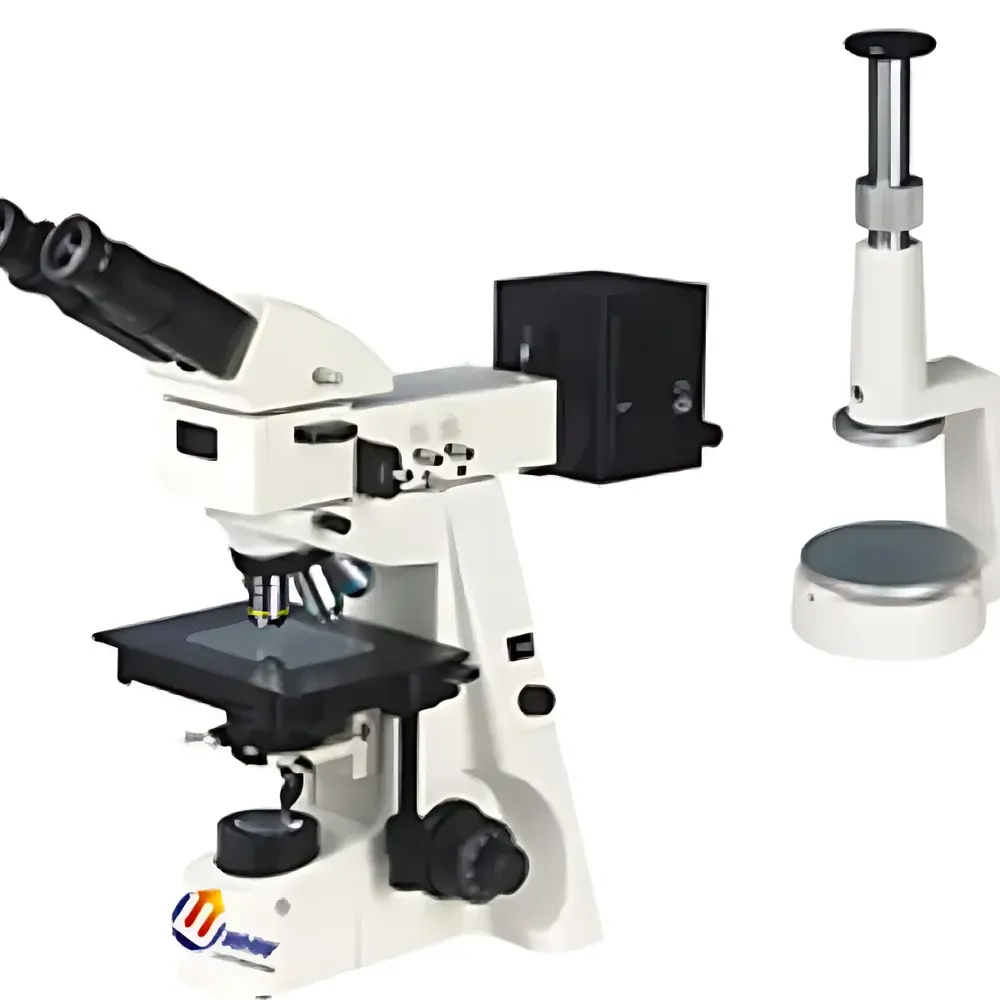
YANRUN 9XB Upright Polarizing Metallurgical Microscope
| Brand | YANRUN |
|---|---|
| Origin | Shanghai, China |
| Manufacturer Type | Direct Manufacturer |
| Product Origin | Domestic (China) |
| Model | 9XB Upright Polarizing Metallurgical Microscope |
| Configuration | Upright |
| Image Analysis System | Not Included |
| Eyepieces | Widefield 10× (22 mm field number), Widefield 10× (20 mm field number) with 0.1 mm reticle scale |
Overview
The YANRUN 9XB Upright Polarizing Metallurgical Microscope is an engineered optical instrument designed for high-precision microstructural analysis of opaque, reflective specimens—primarily metallic alloys, ceramics, composites, and geological thin sections. Built on an infinite-conjugate optical pathway, it supports both incident (epi-illumination) and transmitted light observation modes, enabling comprehensive material characterization across metallurgical, failure analysis, quality control, and academic research laboratories. Its integrated polarizing optics—including a rotatable analyzer (0–360°) and removable polarizer—facilitate birefringence detection, extinction angle measurement, and crystallographic orientation assessment in anisotropic materials. The microscope conforms to fundamental ISO 10934-1 (optical microscopy terminology) and ASTM E3 (standard guide for preparation of metallographic specimens) frameworks, supporting standardized reporting in GLP-compliant environments.
Key Features
- Upright configuration with ergonomic 30° inclined binocular head (interpupillary adjustment range: 55–75 mm) for extended operator comfort during routine inspection.
- Four-position objective turret accommodating parfocal, infinity-corrected achromatic objectives: 4×/0.10 (WD 29.4 mm), 10×/0.25 (WD 16 mm), 20×/0.40 (WD 10.6 mm), and 40×/0.60 (WD 5.4 mm), all optimized for flat-field imaging and minimal chromatic aberration.
- Dual-illumination system: Köhler-illuminated epi-illumination with adjustable aperture and field diaphragms; transmitted illumination via 12 V / 30 W halogen lamp (AC 85–230 V input) with continuous brightness control.
- Precision mechanical stage: Dual-layer mechanical platform (180 × 150 mm) with 75 × 50 mm travel range and vernier-scale positioning for repeatable specimen navigation.
- Coaxial coarse/fine focusing mechanism featuring rack-and-pinion drive; fine-focus graduation: 2 µm per division, ensuring sub-micron positional repeatability under load.
- High-NA Abbe condenser (N.A. 1.25) with iris diaphragm and filter holder for transmitted-light contrast enhancement; includes green, blue, and neutral density filter inserts.
- Calibrated reticle eyepieces (WF 10×/20 mm and WF 10×/22 mm) with 0.1 mm scale division; supplied with 0.01 mm stage micrometer for system-level magnification verification per ISO 10934-2.
Sample Compatibility & Compliance
The 9XB accommodates standard metallographic mounts (up to 30 mm diameter) and polished cross-sections up to 40 mm in height. Its rigid cast-aluminum frame and anti-vibration base minimize thermal drift and mechanical resonance—critical for long-duration static observation or manual documentation workflows. While not certified to IEC 61000-6-3 (EMC) or CE marking for EU medical device use, the system meets general electrical safety requirements per GB 4793.1 (Chinese equivalent of IEC 61010-1) for laboratory equipment. It supports documentation traceability required under ISO/IEC 17025 for testing laboratories and aligns with foundational elements of FDA 21 CFR Part 11 when paired with validated external image capture hardware and audit-trail-enabled software (not included).
Software & Data Management
The 9XB operates as a standalone optical platform without embedded digital imaging capability. However, it is fully compatible with third-party USB/CMOS camera adapters (e.g., C-mount 1× or 0.5× reduction lenses) and industry-standard acquisition software such as NIS-Elements, Olympus cellSens, or open-source alternatives like Micro-Manager. Optional digital accessories—including trinocular port adapters, HDMI output modules, and calibrated pixel-size mapping tools—enable quantitative image analysis (grain size per ASTM E112, inclusion rating per ASTM E45) when integrated into validated workflows. Raw optical data remains unprocessed at the microscope level, preserving measurement integrity for regulatory review.
Applications
- Metallographic phase identification and grain boundary delineation in ferrous/non-ferrous alloys.
- Crystal symmetry and twinning analysis in deformed or heat-treated microstructures using conoscopic and orthoscopic polarized light.
- Porosity, inclusion, and second-phase particle characterization in castings, weldments, and additive-manufactured components.
- Geological mineral identification via interference color charts and extinction angle quantification.
- Failure analysis root-cause investigation—including crack path tracing, corrosion morphology classification, and intergranular embrittlement assessment.
- Educational demonstration of optical anisotropy, birefringence, and stress-induced birefringence in polymeric and composite materials.
FAQ
Does the 9XB include an image analysis software package?
No—the system ships without bundled image analysis software or digital camera. It is designed for analog visual observation and optional integration with externally sourced imaging hardware and software platforms.
Is the microscope compliant with ISO or ASTM standards for metallurgical examination?
Yes—the optical design, mechanical stability, and calibration traceability support conformance with ASTM E3 (specimen preparation), ASTM E112 (grain size), and ISO 4497 (metallographic examination), provided user-defined validation protocols are implemented.
Can high-magnification objectives (e.g., 50×, 100×) be added post-purchase?
Yes—optional infinity-corrected objectives (50×, 80×, 100× oil immersion) are mechanically and optically compatible with the 9XB’s nosepiece and tube lens system.
What power supply specifications does the transmitted illuminator require?
The halogen lamp module accepts universal AC input (85–230 V, 50/60 Hz) and delivers stable 12 V / 30 W output; no external transformer is required.
Is the polarizer/analyzer system suitable for quantitative retardation measurements?
The 9XB supports qualitative and semi-quantitative birefringence evaluation (e.g., sign of elongation, approximate order determination). For precise retardation values (e.g., λ/4, λ/2), a calibrated compensator (e.g., Berek or Sénarmont type) must be added as an accessory.




