
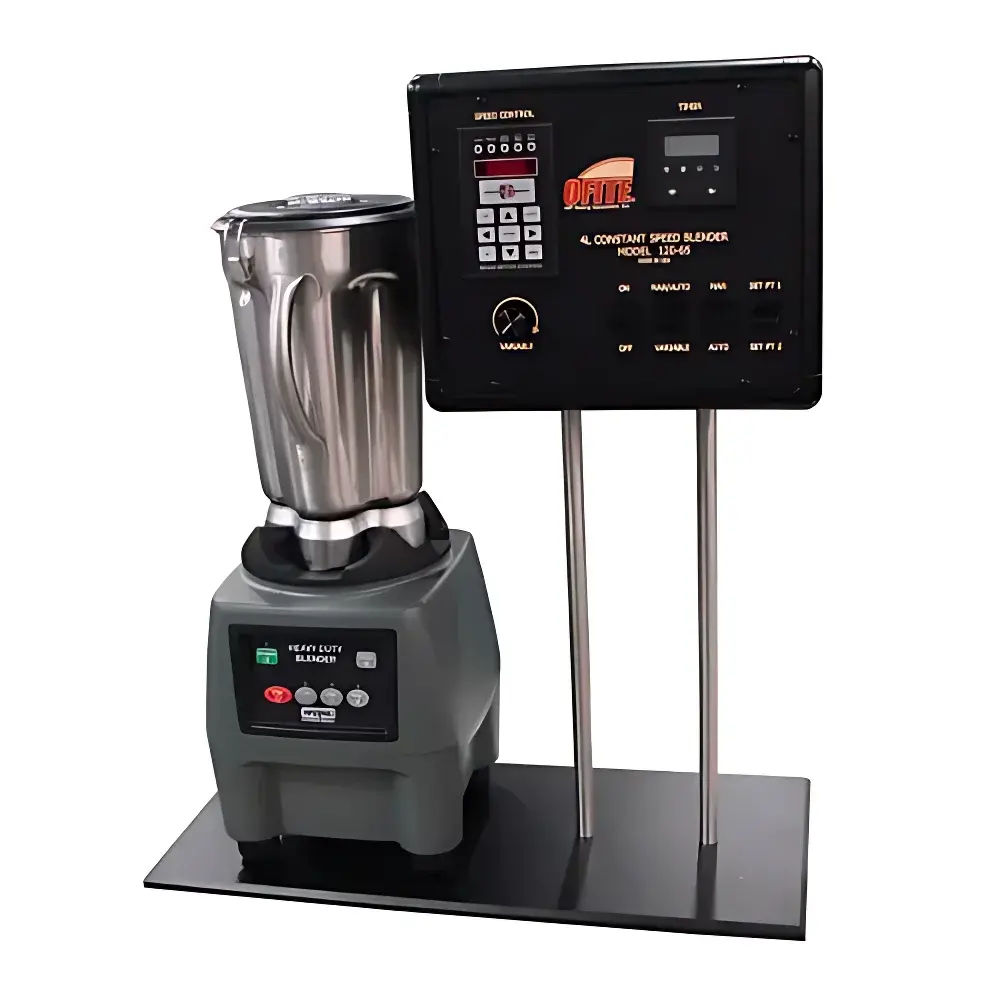
OFITE Model 20 Constant-Speed Mixer, 4 L
| Brand | OFITE |
|---|---|
| Origin | USA |
| Manufacturer Status | Authorized Distributor |
| Origin Category | Imported |
| Model | 20 |
| Quotation | Upon Request |
| Stirring Vessel Capacity | 4 L |
| Stirring Speed Range | 0–23,000 rpm |
| Preset Speeds | 4,000 rpm and 10,000 rpm |
| Adjustable Speed Control | Yes |
| Drive System | Microprocessor-Controlled DC Motor |
| Timer Function | Delay Relay with Programmable Duration |
| Display | Digital LED Readout |
| Impeller Material | Stainless Steel |
| Vessel Material | Stainless Steel (4 L) |
| Power Supply | 230 V, 50 Hz |
| Product Code | #120-65-1 (Instrument Base Unit with 4 L Vessel) |
Overview
The OFITE Model 20 Constant-Speed Mixer is an engineered laboratory instrument designed to meet the stringent mechanical reproducibility requirements of oilfield cement and fracturing fluid testing protocols specified in API RP 10B-2 (Recommended Practice for Testing Well Cements) and API RP 13I (Recommended Practice for Laboratory Testing of Drilling Fluids). Its core function is to deliver precise, repeatable rotational shear under controlled time–speed profiles—critical for simulating field-relevant hydration, dispersion, and crosslinking kinetics. Unlike variable-speed mixers subject to operator-dependent ramping or drift, the Model 20 employs a closed-loop microprocessor-regulated DC drive system that maintains setpoint speed within ±1.5% across the full 0–23,000 rpm range, ensuring consistent energy input per unit mass. This fidelity directly impacts downstream rheological measurements, compressive strength development, and fluid loss behavior—parameters routinely validated in API-certified cement labs and hydraulic fracturing formulation centers.
Key Features
- Stainless steel impeller and 4 L stainless steel mixing vessel—corrosion-resistant and compliant with API-specified material compatibility for cement slurries and polymer-based fracturing fluids.
- Dual fixed-speed presets (4,000 rpm and 10,000 rpm) aligned with standard API cement mixing procedures (e.g., 4,000 rpm for initial slurry blending; 10,000 rpm for high-shear conditioning).
- Full-range adjustable speed control (0–23,000 rpm), enabling method development for non-standard formulations including nano-enhanced cements or viscoelastic surfactant (VES) fluids.
- Microprocessor-based speed stabilization circuitry eliminates speed droop under load, maintaining torque consistency during viscosity transitions (e.g., during polymer hydration or gelation).
- Programmable delay relay timer with digital LED display allows precise control of mixing duration from 1 second to 99 minutes—essential for replicating standardized API mixing sequences (e.g., 35 seconds at 4,000 rpm followed by 30 seconds at 10,000 rpm).
- Robust mechanical architecture with heavy-duty bearing assembly and thermal overload protection ensures long-term operational stability in continuous QC environments.
Sample Compatibility & Compliance
The Model 20 is validated for use with Class A through G oilwell cements (per API Spec 10A), synthetic-based muds (SBMs), water-based muds (WBMs), and linear/gelled fracturing fluids containing guar, hydroxypropyl guar (HPG), or carboxymethyl cellulose (CMC). Its 4 L vessel volume conforms to API RP 10B-2 Annex A requirements for laboratory-scale cement slurry preparation. Optional torque measurement templates (sold separately) interface with calibrated load cells to quantify real-time resistance during hydration—supporting ASTM D3765 (Standard Test Method for Determining Gel Time of Fracturing Fluids) and internal SOPs requiring kinetic crosslink profiling. The instrument meets CE marking requirements for electrical safety (EN 61000-6-3, EN 61000-6-4) and is compatible with GLP-compliant lab documentation workflows when paired with external data loggers.
Software & Data Management
While the Model 20 operates as a standalone benchtop instrument without embedded PC connectivity, its digital timer and stable speed output enable seamless integration into regulated data acquisition systems. When used with third-party USB/RS-232 data loggers or LabVIEW-compatible DAQ hardware, users can record timestamped speed, elapsed time, and (via optional torque module) real-time torque values. Such configurations support 21 CFR Part 11 compliance when deployed with audit-trail-enabled software platforms—facilitating traceability for FDA-audited wellbore integrity studies or ISO 17025-accredited testing laboratories. All preset parameters are retained after power cycling, eliminating reconfiguration errors between test runs.
Applications
- API-standardized oilwell cement slurry preparation for compressive strength, thickening time, and fluid loss testing (ASTM C109, API RP 10B-2).
- Hydration kinetics assessment of delayed-crosslink fracturing fluids using torque vs. time profiling.
- Dispersion efficiency evaluation of nanomaterials (e.g., silica nanoparticles, graphene oxide) in cementitious suspensions.
- Quality control of pre-hydrated polymers prior to field deployment in deepwater or HPHT wells.
- Method development for low-dosage friction reducers and breakers requiring precise shear history control.
FAQ
Does the Model 20 comply with API RP 10B-2 Appendix A for cement mixing?
Yes—the 4 L stainless steel vessel, dual-speed presets (4,000/10,000 rpm), and programmable timer meet all mechanical specifications outlined in API RP 10B-2 Annex A for laboratory-scale slurry preparation.
Can the mixer be used with non-API fluids such as CO₂-foamed cement or acid-soluble diverters?
Yes—provided vessel and impeller materials remain chemically compatible; users must validate speed–time profiles against fluid-specific rheological response curves.
Is calibration certification included with purchase?
OFITE provides factory calibration verification documentation; NIST-traceable recalibration services are available through authorized service centers on an annual basis.
What maintenance intervals are recommended for sustained accuracy?
Impeller balance verification every 500 operating hours; bearing lubrication and thermal sensor validation annually or per 2,000 operational hours—whichever occurs first.






