
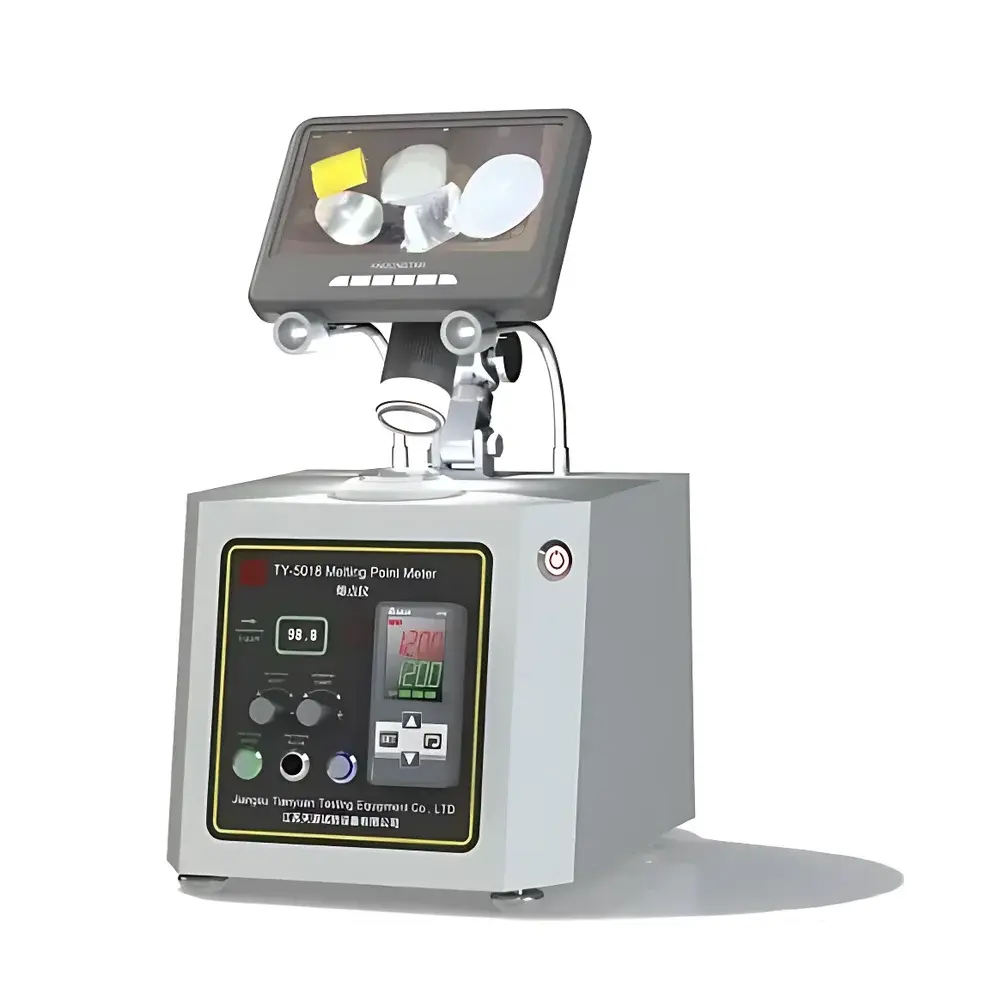
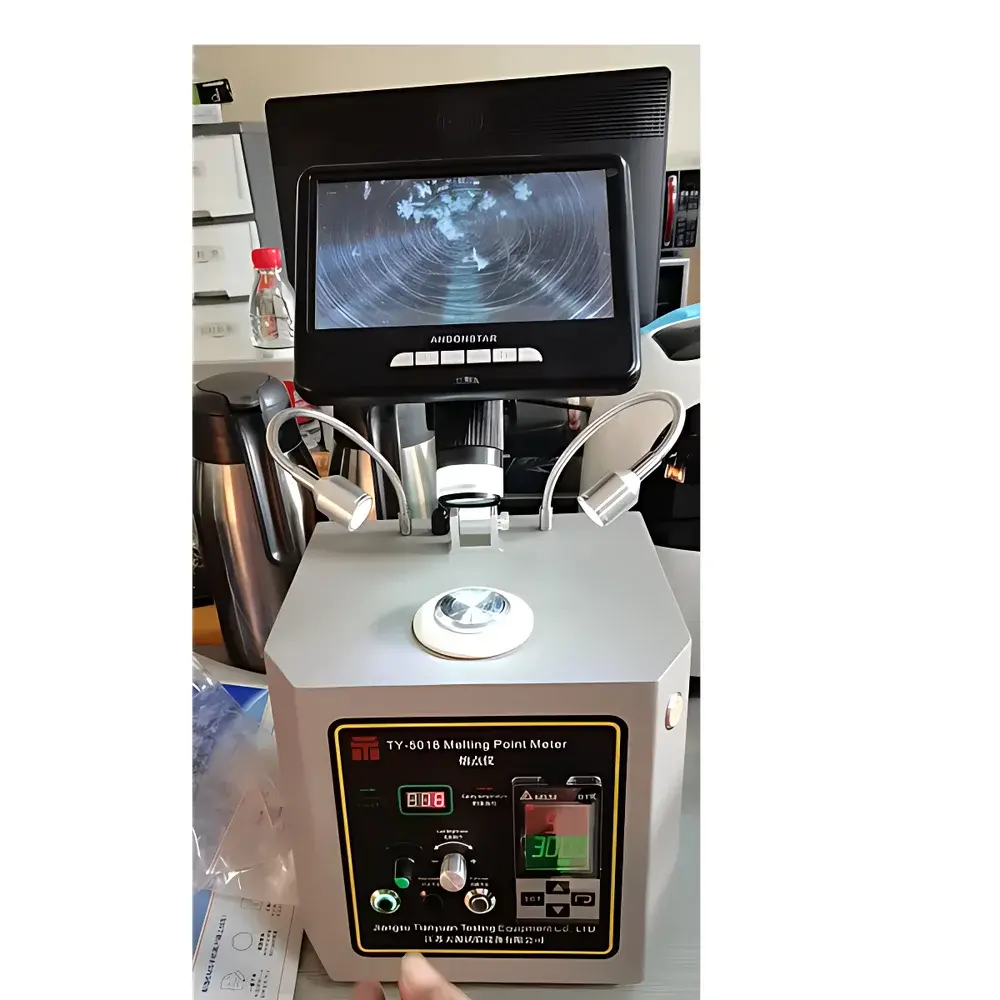
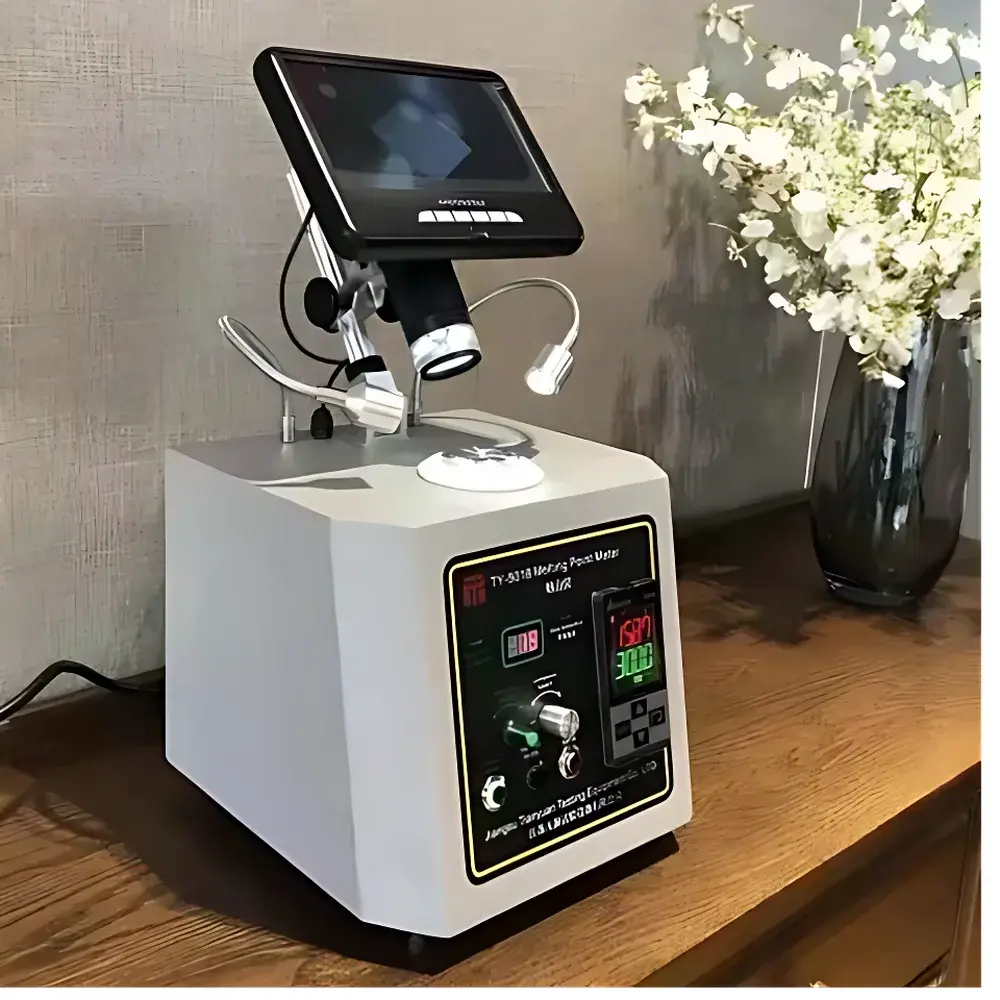
TianYuan TY-5018 Digital Melting Point Analyzer
| Brand | TianYuan |
|---|---|
| Origin | Jiangsu, China |
| Manufacturer Type | Direct Manufacturer |
| Country of Origin | China |
| Model | TY-5018 |
| Pricing | Available Upon Request |
| Temperature Range | Ambient to 300 °C (customizable up to 450 °C) |
| Temperature Resolution | 0.1 °C |
| Heating Control | 0–100% stepless PWM power regulation |
| Sample Stage | Φ19 mm concave spherical heating block |
| Optical Magnification | 10–270× mechanical (via object distance adjustment), 1000× digital (4× on-screen zoom) |
| Display | 7-inch IPS LCD, 1920×1080 @ 30 fps |
| Imaging Sensor | 12 MP CMOS, no motion blur, zero latency |
| Illumination | Dual adjustable-position LED + triple-channel PWM-controlled LED array |
| Video Output | Full HD MOV (1920×1080, 30 fps) |
| Still Image Format | JPG |
| Storage | MicroSD card (up to 32 GB, user-supplied) |
| Cooling Method | Passive natural convection |
| Power Supply | AC 220 V ±10%, 5–60 Hz, 200 W |
| Dimensions (W×D×H) | 240×240×360 mm |
| Weight | 2.8 kg |
Overview
The TianYuan TY-5018 Digital Melting Point Analyzer is a precision thermal characterization instrument engineered for reliable, real-time observation and quantitative determination of melting onset and range in thermoplastic polymers, synthetic resins, waxes, pharmaceutical excipients, and fragrance compounds. It operates on the principle of controlled ramped heating combined with high-fidelity optical monitoring—enabling direct visualization of solid-to-liquid phase transition under standardized thermal conditions. Unlike capillary-based analog systems, the TY-5018 employs a thermally uniform concave spherical heating stage (Φ19 mm) that ensures optimal contact between granular or powdered samples and the temperature-controlled surface, minimizing thermal gradient artifacts and improving reproducibility across repeated measurements. Its integrated imaging architecture—featuring a 12-megapixel low-latency CMOS sensor, 7-inch full-HD display, and dual-mode magnification—allows operators to resolve morphological changes at sub-millimeter scale during melting, supporting both ASTM D1519 and ISO 4625 compliance workflows when configured per laboratory SOPs.
Key Features
- Concave spherical heating block design ensures consistent thermal coupling with irregularly shaped polymer granules and crystalline powders.
- Stepless PWM-regulated heating control (0–100%) delivers precise thermal ramping profiles without overshoot or oscillation.
- Optical system supports 10–270× continuous mechanical magnification via calibrated focus distance adjustment, plus 4× digital zoom (1000× effective) with lossless interpolation.
- Triple-channel PWM LED illumination provides uniform, flicker-free backlighting and side lighting; two LEDs are position-adjustable to optimize contrast for translucent or reflective samples.
- Full-HD video capture (1920×1080 @ 30 fps) and still-image acquisition (12 MP JPG) enable time-resolved documentation of melt front propagation and sintering behavior.
- Passive cooling design eliminates forced-air interference during critical phase-change observation windows, preserving thermal stability near endpoint temperatures.
Sample Compatibility & Compliance
The TY-5018 accommodates bulk solids, pellets, flakes, and finely ground powders typical in rubber compounding, plastic formulation, and polymer quality assurance labs. Its open-stage architecture permits rapid sample loading and visual verification prior to thermal cycling. While not an automated compliance-certified system out-of-the-box, it supports implementation within GLP/GMP environments when paired with documented calibration procedures traceable to NIST standards. The instrument’s temperature accuracy (±0.3 °C within 50–250 °C range) and resolution (0.1 °C) meet minimum requirements for ASTM D1519 (Standard Test Method for Melting Point of Plastics by Hot-Stage Microscopy) and ISO 4625 (Plastics — Determination of Melting Temperature). Optional validation kits—including certified reference materials (e.g., indium, tin, zinc) and digital thermometer calibration logs—are available to support internal audit readiness.
Software & Data Management
The TY-5018 operates via embedded firmware with no external PC dependency. All captured video (MOV) and still images (JPG) are stored directly onto user-provided MicroSD cards (up to 32 GB). Timestamped metadata—including date/time, setpoint ramp rate, actual stage temperature, and magnification level—is embedded in file EXIF headers. No proprietary software installation is required for playback or export; standard media players and image viewers suffice. For laboratories requiring electronic record integrity, optional firmware upgrades support audit-trail logging (user login, parameter changes, start/stop events) compliant with FDA 21 CFR Part 11 Annex 11 principles—subject to site-specific configuration and validation protocols.
Applications
- Quality control of polyolefins, ABS, PET, PVC, and TPU feedstocks in extrusion and injection molding facilities.
- Batch-to-batch consistency verification of elastomer compounds and vulcanization accelerators.
- Thermal stability assessment of plasticizers, flame retardants, and pigment dispersions.
- R&D screening of copolymer composition effects on melting behavior and crystallinity onset.
- Pharmaceutical preformulation studies involving API-polymer miscibility and eutectic point identification.
FAQ
What is the recommended calibration frequency for routine QC use?
For daily production testing, calibration against certified reference standards (e.g., indium, 156.6 °C) is advised before each shift or per ASTM D1519 Section 7.2.
Can the TY-5018 be used for decomposition temperature estimation?
No—it is optimized for solid–liquid transition detection only; decomposition involves irreversible chemical change and requires TGA or DSC instrumentation.
Is the heating stage interchangeable for higher-temperature configurations?
Yes; the 450 °C extended-range version uses a modified heating element and ceramic insulation assembly, requiring factory recalibration and updated firmware.
Does the system support multi-sample sequential analysis?
Not natively—the TY-5018 is single-sample per cycle; however, average throughput exceeds 8–10 determinations per hour with trained operators.
How is temperature uniformity across the Φ19 mm stage verified?
Uniformity is validated during manufacturing using micro-thermocouple mapping; a certificate of conformance (±0.5 °C max deviation across active zone) is supplied with each unit.





