
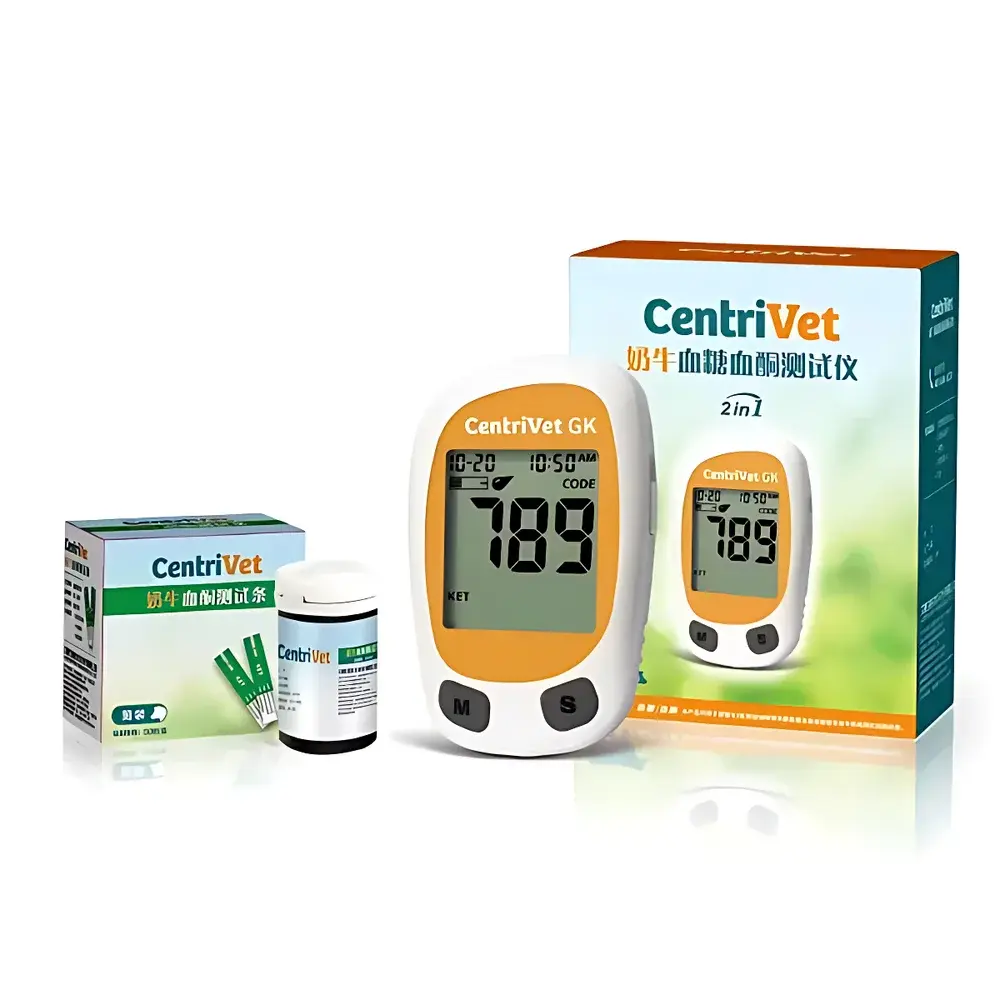
Aikonchem CentriVet Veterinary Blood Ketone Analyzer
| Brand | Aikonchem |
|---|---|
| Model | CentriVet |
| Type | Handheld Electrochemical Blood β-Hydroxybutyrate (BHB) Analyzer |
| Sample | Fresh Whole Bovine Blood |
| Sample Volume | 1.2 µL |
| Assay Time | 9 s |
| Measurement Range | 0.0–8.0 mmol/L |
| Unit | mmol/L |
| Auto Power-Off | Activated after 2 min of inactivity |
| Operating Temperature | 5–45 °C |
| Operating Relative Humidity | 10–90% RH (non-condensing) |
| Data Storage Capacity | 450 test records with timestamp |
| Power Supply | Two CR2032 3.0 V lithium coin cells |
| Battery Life | ≥3,000 tests (excluding data transmission) |
Overview
The Aikonchem CentriVet Veterinary Blood Ketone Analyzer is a portable, electrochemical point-of-care (POC) diagnostic instrument engineered for rapid, quantitative measurement of β-hydroxybutyrate (BHB) concentration in fresh whole blood from dairy cattle. It operates on the principle of enzymatic electrochemical detection: BHB in the sample reacts with β-hydroxybutyrate dehydrogenase (BHBDH) immobilized on a disposable test strip, generating a proportional electrical current that is converted into a calibrated concentration value (mmol/L). This method delivers clinically relevant results within 9 seconds—enabling real-time metabolic assessment at the barn side without laboratory infrastructure. Designed specifically for bovine ketosis management, the CentriVet supports early detection, longitudinal monitoring, and therapeutic response evaluation in accordance with standard veterinary metabolic surveillance protocols.
Key Features
- Ultra-rapid assay time of 9 seconds per test—minimizing animal handling stress and enabling high-throughput herd screening.
- Minimal sample requirement: only 1.2 µL of fresh whole blood—compatible with capillary collection via ear or tail vein puncture.
- Integrated onboard memory storing up to 450 test records, each tagged with date and time stamp for traceable longitudinal analysis.
- Robust environmental tolerance: operational across 5–45 °C ambient temperature and 10–90% non-condensing relative humidity—suitable for use in milking parlors, holding pens, and mobile veterinary units.
- Low-power architecture powered by two standard CR2032 batteries, supporting ≥3,000 tests per set under typical field conditions.
- Automatic power-off after 2 minutes of inactivity—extending battery life and reducing inadvertent discharge during transport or storage.
Sample Compatibility & Compliance
The CentriVet is validated exclusively for fresh, unhemolyzed whole bovine blood collected without anticoagulant or preservative. It is not intended for serum, plasma, or human samples. The device complies with IEC 61010-1:2010 for electrical safety of laboratory equipment and meets RoHS Directive 2011/65/EU requirements for hazardous substance restriction. While not FDA-cleared or CE-marked as an in vitro diagnostic (IVD) device under EU IVDR 2017/746, it is classified as a veterinary support tool aligned with FAO/WHO Good Practices for Veterinary Diagnostic Laboratories and consistent with ISO/IEC 17025:2017 principles for competence of testing laboratories when used within accredited farm health management systems.
Software & Data Management
The CentriVet operates as a standalone analyzer with no embedded Bluetooth, USB, or Wi-Fi connectivity. All data remain stored locally on the device’s non-volatile memory. Export functionality is not provided; users must manually record results or integrate readings into farm management software (e.g., DairyComp 305, HerdNavigator, or FarmWizard) via manual entry. Audit trails are limited to timestamped internal logs—no electronic signature, user authentication, or 21 CFR Part 11 compliance features are implemented. For GLP/GMP-aligned operations, facilities should establish documented procedures for manual data transcription, verification, and archival per internal quality SOPs.
Applications
- Early identification of subclinical ketosis in transition cows (days −14 to +30 postpartum), supporting timely nutritional intervention.
- Monitoring BHB dynamics during treatment of clinical ketosis—including evaluation of dextrose infusion efficacy or propylene glycol supplementation response.
- Supporting dry-off and pre-fresh grouping decisions based on metabolic status profiling.
- Integration into routine herd health checklists for benchmarking against established thresholds (e.g., ≥1.2 mmol/L indicating subclinical risk; ≥3.0 mmol/L suggestive of clinical ketosis).
- Field-based research applications requiring rapid, on-site quantification of bovine energy metabolism biomarkers under controlled experimental conditions.
FAQ
What sample type is required for accurate measurement?
Fresh whole bovine blood—collected without anticoagulant—is mandatory. Serum or plasma yields unreliable results due to enzymatic interference and matrix effects.
Can the CentriVet be used for other livestock species?
No. Its calibration curve and enzymatic chemistry are optimized solely for bovine whole blood. Cross-species validation has not been performed.
How often should the instrument be recalibrated?
The CentriVet requires no user-performed calibration. Each test strip contains factory-calibrated enzyme electrodes; lot-specific calibration codes are embedded in the strip packaging and automatically recognized upon insertion.
Is the device suitable for use in cold barn environments during winter?
Yes—provided ambient temperature remains ≥5 °C. Avoid prolonged exposure below this threshold, as low temperatures may delay enzymatic kinetics and affect reaction completeness.
What is the shelf life of unused test strips?
Unopened vials maintain stability for 18 months when stored at 2–30 °C in original desiccated packaging. Once opened, strips must be used within 90 days and kept sealed with desiccant.





