

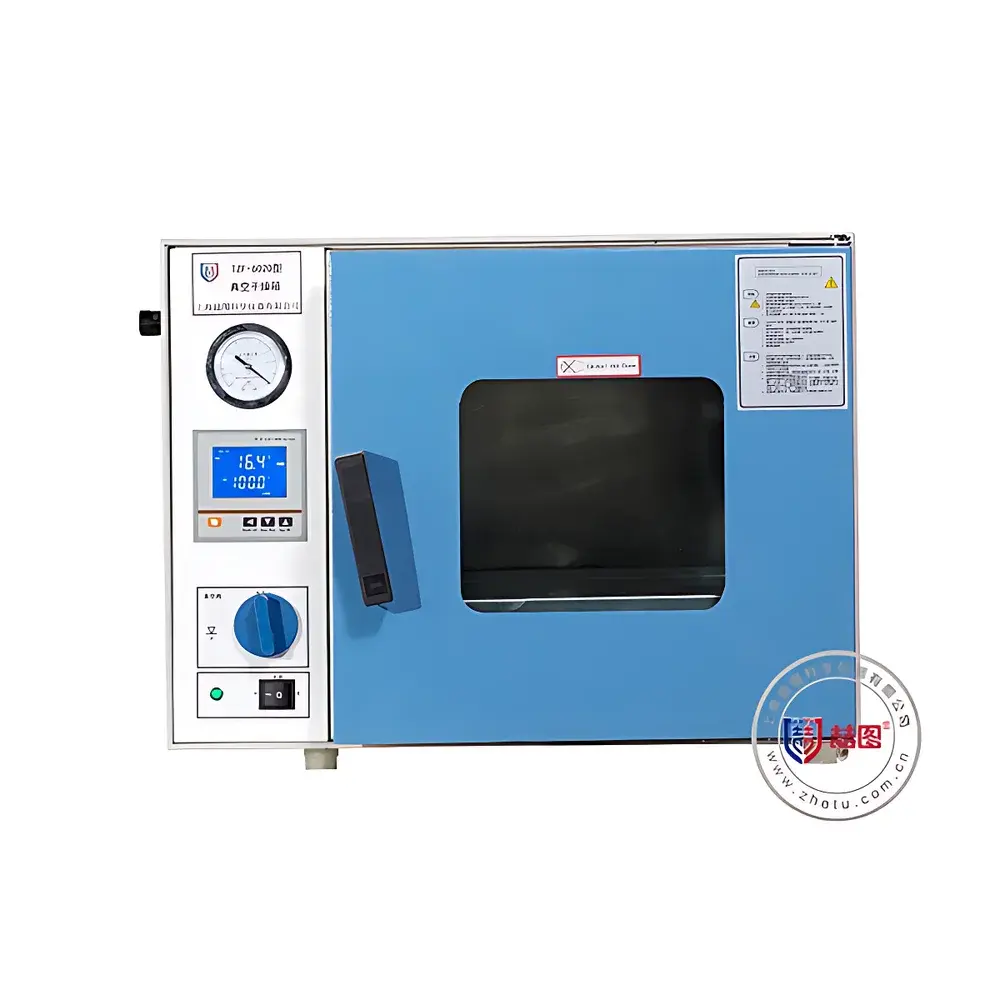
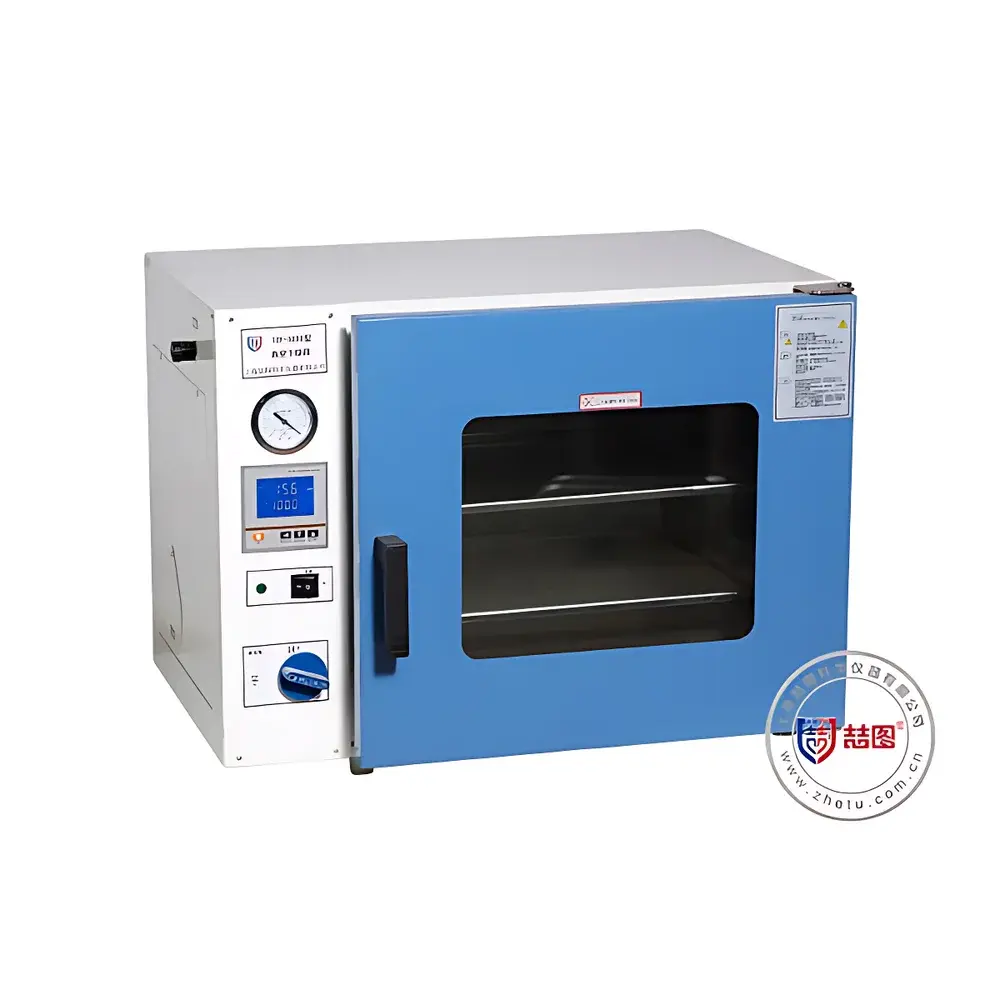
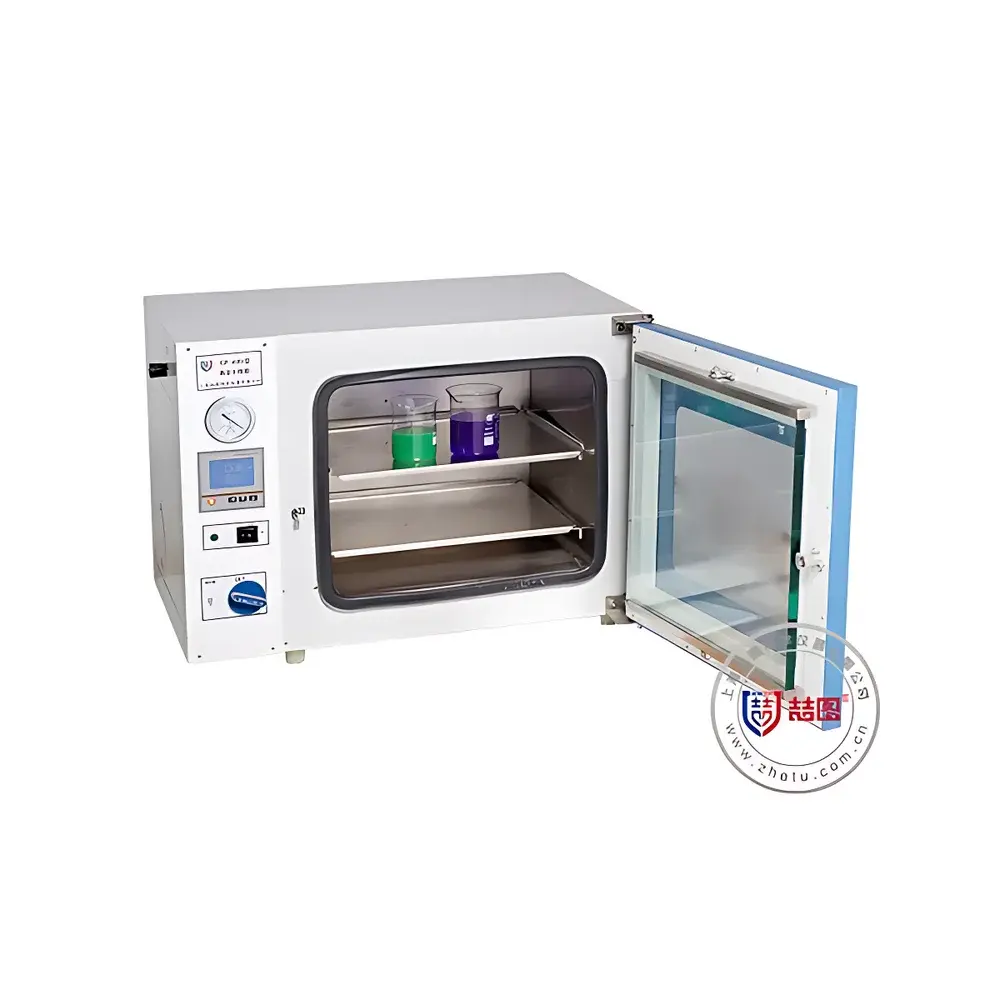
DRETOP TZF-6030 Benchtop Vacuum Drying Oven
| Brand | DRETOP |
|---|---|
| Origin | Shanghai, China |
| Manufacturer Type | Direct Manufacturer |
| Product Category | Domestic |
| Model | TZF-6030 |
| Instrument Type | Vacuum Drying Oven |
| Temperature Range | RT+10 to 250 °C |
| Temperature Fluctuation | ±0.5 °C |
| External Dimensions | 615 × 500 × 505 mm |
| Internal Chamber Dimensions | 320 × 320 × 300 mm |
| Temperature Resolution | 0.1 °C |
| Vacuum Degree | ≤133 Pa |
| Uniformity of Temperature | ±1 °C |
| Inner Chamber Material | 304 Stainless Steel |
| Heating Method | Forced-air Circulation (External Heating) |
| Operating Ambient Temperature | RT+10 to 250 °C |
Overview
The DRETOP TZF-6030 is a benchtop vacuum drying oven engineered for precision thermal processing under controlled low-pressure environments. It operates on the principle of reducing ambient pressure inside the chamber via an integrated or externally connected vacuum pump—typically achieving ≤133 Pa—to lower the boiling point of volatile components and suppress oxidative degradation. This enables gentle, residue-free dehydration of thermally sensitive, oxygen-labile, or compositionally complex samples without structural collapse, surface oxidation, or decomposition. Unlike conventional convection ovens, the TZF-6030 eliminates convective air currents that may displace fine powders or foam-like materials; instead, heat transfer occurs primarily through conduction and radiation within a sealed, inert-capable chamber. Its design complies with fundamental requirements for GLP-compliant sample preparation workflows in R&D laboratories, quality control labs, and pilot-scale manufacturing settings across semiconductor fabrication, lithium-ion battery electrode processing, optoelectronics (LED, crystal oscillators), pharmaceutical stability testing, and polymer formulation.
Key Features
- Benchtop form factor (615 × 500 × 505 mm) optimized for space-constrained lab benches and cleanroom integration;
- 304 stainless steel interior chamber (320 × 320 × 300 mm) with seamless welded corners and electropolished finish for corrosion resistance and ease of decontamination;
- Forced-air external heating system with four-sided heating elements—eliminates vacuum arcing, carbon deposition, and hot-spot formation common in internal heater configurations;
- Microprocessor-based P.I.D. temperature controller with 0.1 °C resolution, ±0.5 °C fluctuation tolerance, and programmable ramp-soak profiles;
- Double-layer tempered glass observation window with silicone gasket seal and dual-stage rotary latch mechanism ensuring vacuum integrity up to 133 Pa;
- Adjustable stainless steel wire shelving (1 standard shelf, height-adjustable); optional multi-shelf configurations available;
- Integrated safety architecture: overtemperature cut-off, short-circuit protection, ground-fault detection, and power-loss parameter retention;
- Thermal insulation using high-density glass fiber between chamber and outer shell, minimizing standby energy consumption and surface temperature rise;
- Standard vacuum interface: Bayonet-style (Bulb-type) fitting; optional KF16/KF25/KF40/KF50 flanges for modular vacuum line integration;
- Optional inert gas inlet valve (N₂-compatible) for controlled atmosphere purging prior to vacuum draw-down.
Sample Compatibility & Compliance
The TZF-6030 accommodates a broad spectrum of sample formats—including wafers, coated substrates, battery cathode/anode films, lyophilized biologics, ceramic precursors, and hygroscopic chemical intermediates—without mechanical disturbance or cross-contamination. Its vacuum-compatible chamber meets baseline mechanical and material requirements referenced in ASTM E145 (Standard Specification for Gravity-Convection and Forced-Ventilation Ovens) and ISO 17025 clause 6.4.1 (validation of environmental conditioning equipment). While not certified to IEC 61000-6-3 or UL 61010-1 out-of-the-box, the unit is designed to support laboratory adherence to FDA 21 CFR Part 11 when paired with compliant data logging systems (e.g., RS485-connected SCADA or validated USB/U-disk recording). The 304 stainless steel construction satisfies general corrosion resistance expectations per ASTM A240 for non-aggressive aqueous and organic solvent exposure during routine drying cycles.
Software & Data Management
The TZF-6030 features a dedicated microcontroller interface with real-time display of chamber temperature, elapsed time, and vacuum status (via analog pointer gauge). For enhanced traceability, optional digital vacuum gauges (second-generation LED or TFT displays) and programmable controllers (P-series or full-color touchscreen HMI) are available. These enable user-defined multi-step protocols—including vacuum hold duration, temperature ramp rates, dwell times, and endpoint criteria—with automatic cycle logging to internal memory or external storage (USB flash drive). Audit trail functionality—including operator ID tagging, parameter change timestamps, and deviation alerts—is achievable when integrated with third-party LIMS or ELN platforms via RS485 Modbus RTU protocol. All firmware supports GLP-aligned electronic record retention per ALCOA+ principles (Attributable, Legible, Contemporaneous, Original, Accurate, Complete, Consistent, Enduring, Available).
Applications
- Semiconductor: Pre-bake and post-lift-off drying of photoresist-coated wafers; moisture removal from MEMS packaging substrates;
- Lithium-ion Battery: Solvent recovery and residual moisture elimination from cathode slurries and separator films prior to cell assembly;
- Optoelectronics: Degassing and curing of encapsulants for LED modules and quartz crystal blanks;
- Pharmaceuticals: Final drying of sterile-filtered APIs, excipients, and lyophilized formulations under inert gas blanket;
- Materials Science: Thermal aging studies of polymers under reduced-oxygen conditions; solvent exchange in MOF synthesis;
- Academic Research: Controlled dehydration of biological tissues for SEM sample prep; catalyst support activation under vacuum.
FAQ
What vacuum pump is recommended for optimal performance with the TZF-6030?
A 2 L/s single-stage rotary vane pump is standard; for faster evacuation or higher moisture loads, a 4 L/s pump or diaphragm pump (oil-free operation) may be selected.
Can the TZF-6030 operate under nitrogen purge conditions?
Yes—optional inert gas inlet valve allows manual or automated N₂ backfilling before or after vacuum cycles.
Is the chamber suitable for acidic vapor exposure?
The 304 stainless steel chamber resists mild organic acids and alkaline solutions; for aggressive media (e.g., >10% HCl), optional 316L stainless steel or PTFE-coated variants are available.
Does the unit support validation documentation (IQ/OQ/PQ)?
Factory calibration certificates and dimensional test reports are provided; full qualification packages require site-specific sensor mapping and vacuum decay testing conducted by end-user QA teams.
How is temperature uniformity verified across the chamber volume?
Per ISO 17025 guidance, users perform a 9-point mapping study using calibrated PT100 probes at defined locations—results typically demonstrate ±1 °C uniformity at setpoints between 60–200 °C.
Related Products



