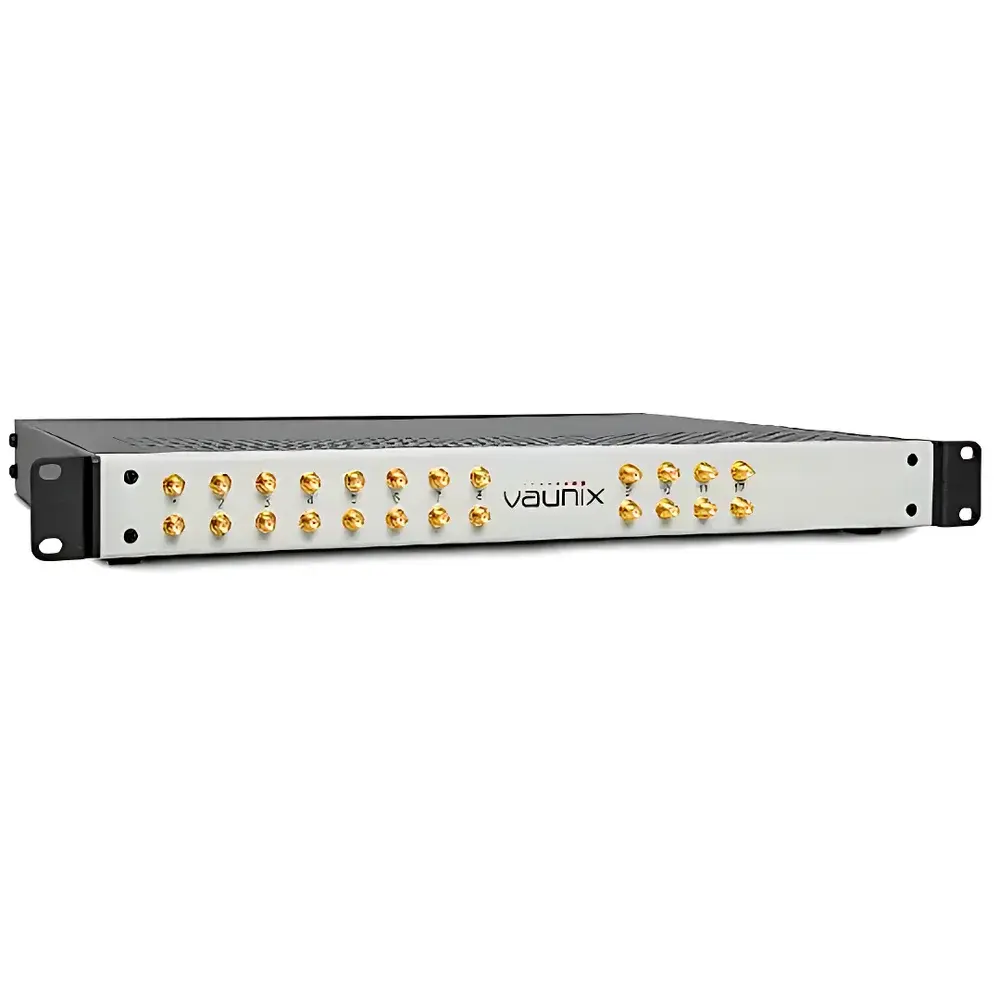
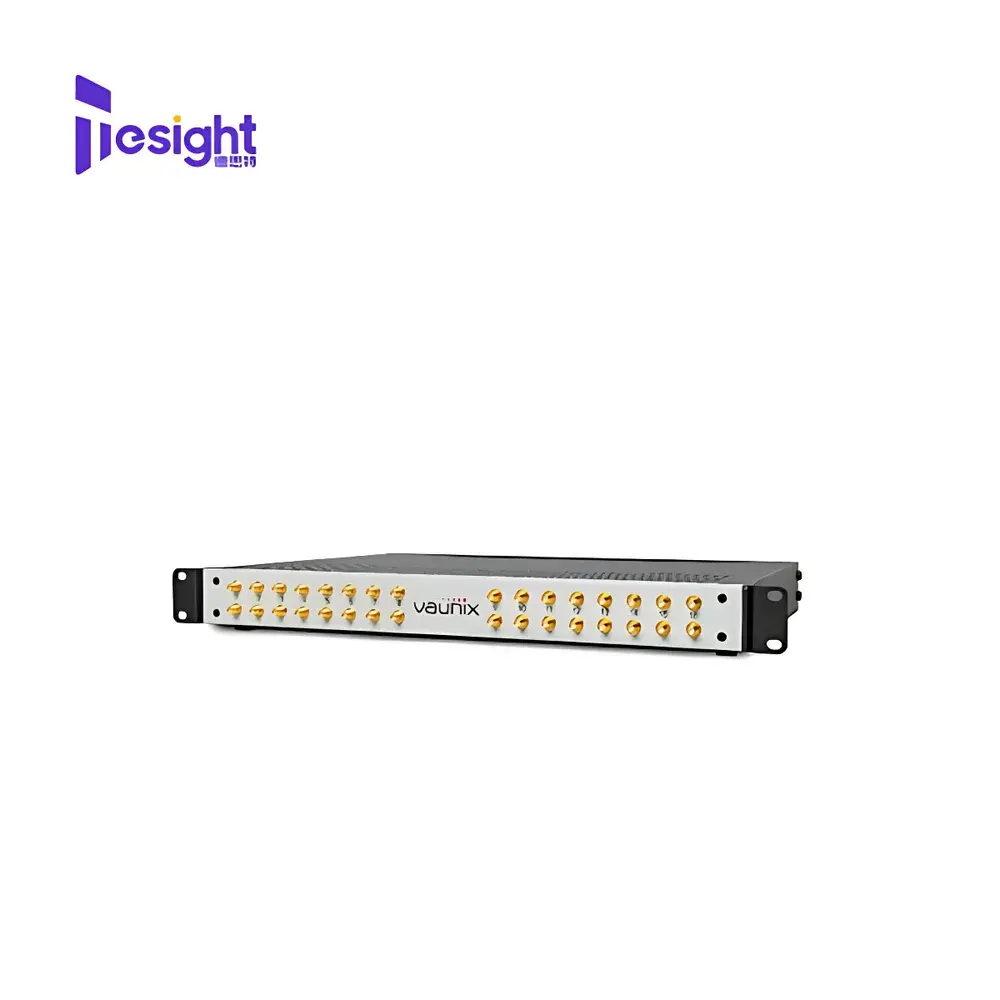
Vaunix TS-LDA-802-12 Compact Miniature RF Digital Step Attenuator
| Brand | Vaunix |
|---|---|
| Origin | Italy |
| Model | TS-LDA-802-12 |
| Frequency Range | 200–8000 MHz |
| Attenuation Range | 120 dB |
| Resolution | 0.1 dB |
| Channels | 12 |
| Impedance | 50 Ω |
| Interface | USB + Ethernet (with configurable static IP or DHCP) |
| Control Software | GUI, Windows/Linux/macOS SDK, LabVIEW VIs, Python examples |
| Rack Unit | 1U |
| Application Domain | RF ATE, 5G/Wi-Fi 6E/LTE/DVB/Microwave Radio Testing |
| Compliance | RoHS-compliant, CE-marked, FCC Part 15 Subpart B compliant |
Overview
The Vaunix TS-LDA-802-12 is a precision-engineered, rack-mountable 12-channel digital step attenuator designed for high-fidelity RF signal conditioning in automated test environments. Operating across a continuous frequency band from 200 MHz to 8 GHz, it implements solid-state PIN diode-based attenuation architecture to deliver stable, repeatable, and bidirectional 50 Ω impedance matching. Unlike electromechanical alternatives, its all-solid-state design eliminates contact wear, ensuring long-term calibration stability and sub-microsecond switching repeatability—critical for production-grade ATE systems requiring >10⁶ operational cycles. The device supports both manual configuration via intuitive GUI and full programmatic integration into test sequences, making it suitable for R&D validation, conformance testing per 3GPP/ETSI standards, and manufacturing line calibration workflows.
Key Features
- 12 independent, galvanically isolated RF channels with identical electrical specifications—enabling parallel multi-path signal conditioning without crosstalk-induced measurement uncertainty.
- 120 dB total attenuation range with 0.1 dB resolution, programmable in discrete steps or continuous sweep profiles—including linear, logarithmic, and user-defined polynomial attenuation ramps.
- Dual control interface: High-speed USB 2.0 (for local lab setup) and IEEE 802.3-compatible Ethernet (for networked ATE integration), both supporting TLS-secured communication and password-protected access control.
- On-device Ethernet stack supports static IP assignment or DHCP auto-configuration, with optional integration into enterprise DNS and NTP infrastructure for synchronized timestamping in distributed test systems.
- Full cross-platform software support: Native GUI application (Windows/macOS/Linux), comprehensive C/C++ DLLs and header files, LabVIEW 2015–2023 drivers with VI libraries, and documented Python 3.7+ examples using PySerial and socket APIs.
- 1U (44.45 mm) rack-mount form factor with front-panel SMA-F connectors and rear-mounted I/O ports—optimized for dense instrumentation racks in ISO/IEC 17025-accredited labs and Class 1000 cleanroom ATE bays.
Sample Compatibility & Compliance
The TS-LDA-802-12 maintains insertion loss <1.2 dB and VSWR ≤1.25:1 across its entire operating bandwidth, ensuring minimal signal distortion when cascaded with vector network analyzers (VNA), spectrum analyzers, or signal generators. It is validated for use with common RF test signals including OFDM (Wi-Fi 6E/802.11ax), CP-OFDM (5G NR FR1/FR2), and QAM-modulated DVB-T2 waveforms. Device firmware and host software comply with ISO/IEC 17025:2017 clause 6.4.9 (software validation for measurement equipment) and support audit-ready logging of all attenuation state changes—including user ID, timestamp (UTC), channel address, and target attenuation value—for GLP/GMP traceability. CE and FCC declarations confirm adherence to EN 61326-1:2013 (EMC for laboratory equipment) and FCC Part 15 Subpart B Class A emissions limits.
Software & Data Management
The included GUI provides real-time channel status monitoring, persistent profile storage (XML-based), and export of attenuation sweep logs in CSV format compatible with MATLAB, Python pandas, and JMP. For automated environments, the SDK implements a deterministic command-response protocol over TCP/IP or USB CDC ACM, with guaranteed response latency <5 ms (99th percentile) under sustained 100 Hz update rates. All software components undergo annual regression testing against NIST-traceable RF reference standards and include built-in self-test routines verifying DAC linearity, EEPROM integrity, and Ethernet PHY link stability. Audit trail records are stored locally on the host PC and may be exported to centralized SIEM platforms via Syslog or REST API endpoints.
Applications
- 5G NR base station receiver sensitivity testing (TS 38.141-1), including blocking and desensitization scenarios requiring precise, multi-tone attenuation gradients.
- Wi-Fi 6E and Wi-Fi 7 (802.11be) MIMO channel emulation—where independent attenuation per spatial stream enables realistic multipath fading simulation.
- Automated production testing of RF front-end modules (FEMs), power amplifiers (PAs), and low-noise amplifiers (LNAs) per IEEE 1677-2021 guidelines.
- Calibration of RF power sensors and reference receivers in metrology labs accredited to ISO/IEC 17025, leveraging its certified repeatability (<±0.02 dB over 24 h at 25 °C).
- EMC pre-compliance testing, where controlled attenuation prevents receiver saturation during radiated immunity sweeps per IEC 61000-4-3.
FAQ
Does the TS-LDA-802-12 support SCPI command syntax?
No—it uses a proprietary ASCII-based command set optimized for deterministic latency and backward compatibility; however, SCPI wrappers are available upon request for legacy system integration.
Can attenuation states be synchronized across all 12 channels with sub-microsecond jitter?
Yes—hardware-triggered simultaneous channel update is supported via TTL input on the rear panel, achieving ≤200 ns inter-channel skew.
Is firmware upgrade capability provided over Ethernet?
Yes—secure OTA updates are performed via HTTPS POST with SHA-256 signature verification; rollback to prior versions is supported.
What is the maximum sustained update rate per channel in streaming mode?
1 kHz (1000 attenuation value changes per second) per channel, with guaranteed monotonicity and no missed steps under full load.
Are calibration certificates included with shipment?
A factory calibration report (traceable to NIST via UKAS-accredited lab) is supplied; full ISO/IEC 17025 calibration with uncertainty budget is available as an optional service.