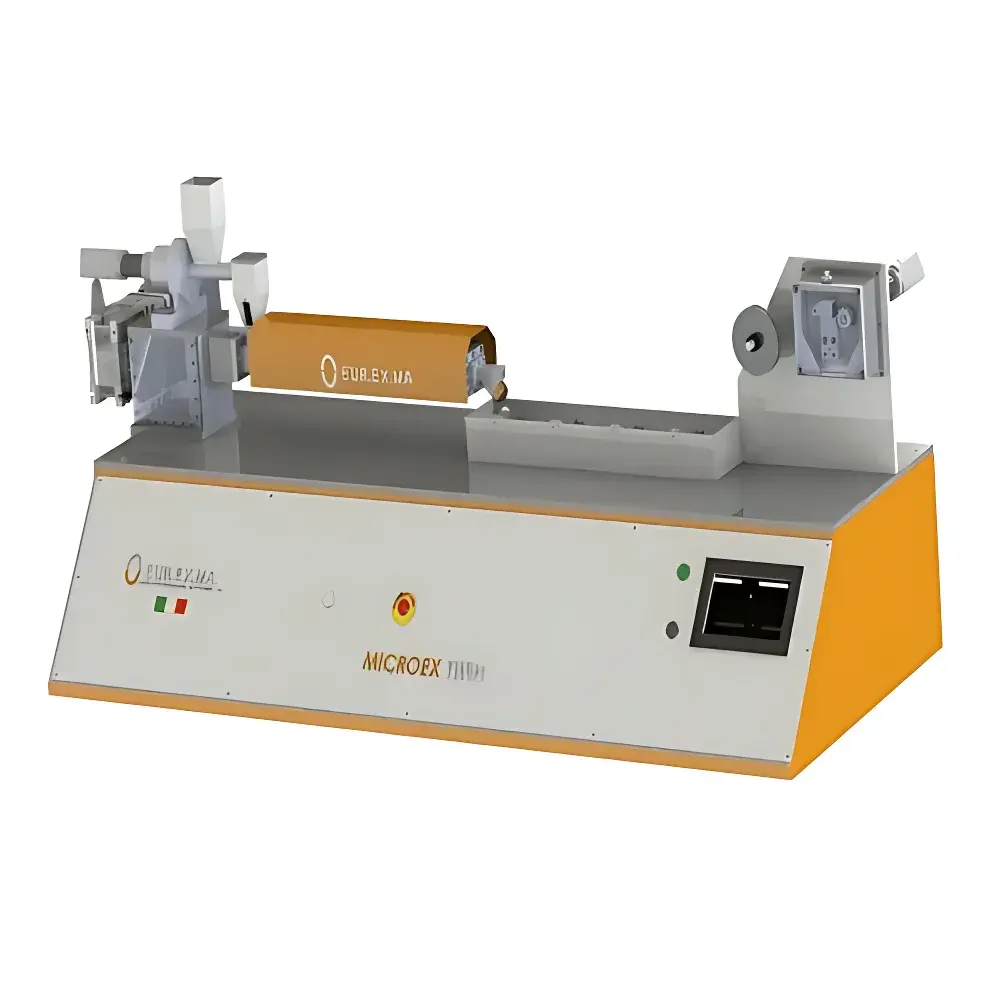
MicroEx CP Twin Laboratory-Scale Co-Rotating Twin-Screw Extrusion Granulation Line
| Brand | EUROTECH |
|---|---|
| Origin | Italy |
| Model | MicroEx CP Twin |
| Screw Diameter | 12 mm |
| L/D Ratio | 40:1 |
| Motor Power | 3 kW |
| Throughput (PE reference) | up to 1 kg/h |
| Pellet Size | 1–3 mm |
| Temperature Zones | 4 independent zones |
| Drive System | Brushless DC motor, 2.1 N·m torque, direct-coupled |
| Feeding | Volumetric feeder with stainless steel hopper and feed throat cooling |
| Barrel Cooling | Softened water circulation through transverse bores in rectangular barrel modules |
| Barrel & Screw Material | Wear-resistant alloy steel |
| Die Assembly | Interchangeable bronze nozzles, precision-calibrated |
| Granulator | Pneumatically actuated rubber-coated traction roller + hardened steel cutter (18 mm width), adjustable stationary knife |
| Control System | 7" HMI touchscreen with PID temperature control, real-time current/pressure/temperature monitoring, alarm logging, USB data export, LAN-ready for remote diagnostics |
| Compliance | Designed for GLP-compliant lab-scale polymer compounding and granulation |
Overview
The MicroEx CP Twin is a compact, benchtop co-rotating twin-screw extrusion granulation line engineered by EUROTECH (Italy) for precise, repeatable laboratory-scale polymer modification and pellet production. Based on fundamental rheological principles of melt conveying, mixing, devolatilization, and controlled solidification, the system integrates a high-torque brushless DC drive, modular 4-zone temperature-controlled barrel assembly, and a fully synchronized granulation unit. Its 12 mm screw diameter and 40:1 length-to-diameter ratio provide sufficient residence time and shear history for thorough dispersion of fillers, additives, or reactive monomers in thermoplastic matrices — making it suitable for formulation development, process parameter mapping, and small-batch pre-commercial validation prior to pilot or industrial scale-up.
Key Features
- Modular co-rotating twin-screw configuration with interchangeable screw elements (conveying, kneading, reverse, and mixing blocks), enabling tailored screw profiles for specific material behaviors and process objectives.
- Four independently controlled heating/cooling zones using cartridge heaters and softened water circulation through transverse bore channels — ensuring stable thermal profiles across the barrel length with ±1.5 °C accuracy under steady-state conditions.
- Volumetric feeding system with stainless steel hopper and active feed-throat cooling to prevent premature melting or bridging of hygroscopic or low-melting-point polymers (e.g., TPU, TPE, PA).
- Integrated venting port located downstream of the melting zone supports solvent removal, moisture evacuation, or reactive extrusion applications requiring atmospheric or vacuum-assisted degassing.
- Granulation module featuring pneumatically actuated rubber-coated traction roller and hardened steel rotary cutter (18 mm width), with adjustable stationary knife position for consistent pellet geometry and minimal fines generation.
- 7-inch industrial-grade HMI touchscreen interface supporting full PID parameter tuning, real-time visualization of motor load (%), barrel zone temperatures, melt pressure (via optional transducer), and heater duty cycles — all logged with timestamps and exportable via USB mass storage.
Sample Compatibility & Compliance
The MicroEx CP Twin is validated for processing engineering thermoplastics including polyamide (PA6, PA66), polyethylene terephthalate (PET), polyethylene (LDPE, HDPE), polycarbonate (PC), polymethyl methacrylate (PMMA), thermoplastic polyurethane (TPU), and thermoplastic elastomers (TPE). Its construction adheres to CE machinery directive 2006/42/EC and electromagnetic compatibility (EMC) directive 2014/30/EU. The control architecture supports audit-trail-capable data recording aligned with GLP practices; optional configuration enables compliance with FDA 21 CFR Part 11 requirements when paired with validated Eurotech service software and user access controls. All wetted parts contacting polymer melt are fabricated from wear-resistant alloy steels meeting ASTM A276 Type 420 or equivalent specifications.
Software & Data Management
The embedded control firmware provides deterministic real-time loop execution for temperature, motor speed, and pressure regulation. Operational parameters — including setpoints, actual values, alarm events, and motor current traces — are stored locally in non-volatile memory with configurable retention periods (default: 30 days). Data export is supported via standard USB 2.0 interface in CSV format compatible with MATLAB, Python pandas, or LIMS integration. Remote diagnostic capability is enabled through Ethernet (RJ45) connection to an external LAN infrastructure; Eurotech’s proprietary service portal allows secure technician access for firmware updates, logic tracing, and fault signature analysis — subject to customer-configured firewall policies and authentication protocols.
Applications
- Development of flame-retardant, conductive, or glass-fiber-reinforced polymer compounds.
- Reactive extrusion trials involving grafting, compatibilization, or in-situ polymerization.
- Thermal stability assessment of heat-sensitive biopolymers (e.g., PLA, PHA) under controlled shear and residence time conditions.
- Optimization of masterbatch dilution ratios and pigment dispersion efficiency.
- Validation of recycling stream compatibility — e.g., post-consumer PET blending with virgin resin or compatibilizer addition.
- Preparation of standardized granules for subsequent injection molding or compression testing per ISO 294 or ASTM D638 protocols.
FAQ
What materials are incompatible with the MicroEx CP Twin?
Highly abrasive filled compounds (e.g., >40 wt% silica or ceramic particles without lubricants) may accelerate barrel/screw wear beyond nominal service life. Highly corrosive polymers (e.g., fluoropolymers processed above 350 °C) require custom barrel lining and are not covered under standard warranty.
Is vacuum venting available as a factory option?
Yes — a dedicated vacuum venting module with dual-stage liquid ring pump and condensate trap can be integrated upstream of the die head upon request, supporting devolatilization of residual monomers or solvents per ASTM D5203.
Can the system operate under inert gas purge?
The feed hopper and vent port include standard NPT ports for nitrogen purging; full-system inert atmosphere operation requires optional sealed gearbox and modified electrical enclosures, quoted separately.
What maintenance intervals are recommended?
Screw/barrel alignment verification every 500 operational hours; gear oil replacement every 2,000 hours; HMI firmware update checks quarterly; thermocouple calibration annually or after any impact event.
Does the granulator support underwater pelletizing?
No — the standard configuration employs strand pelletizing with air-knife drying. Underwater pelletizing requires separate pressurized water tank, centrifugal dryer, and filtration system — available as a customized subsystem integration project.