
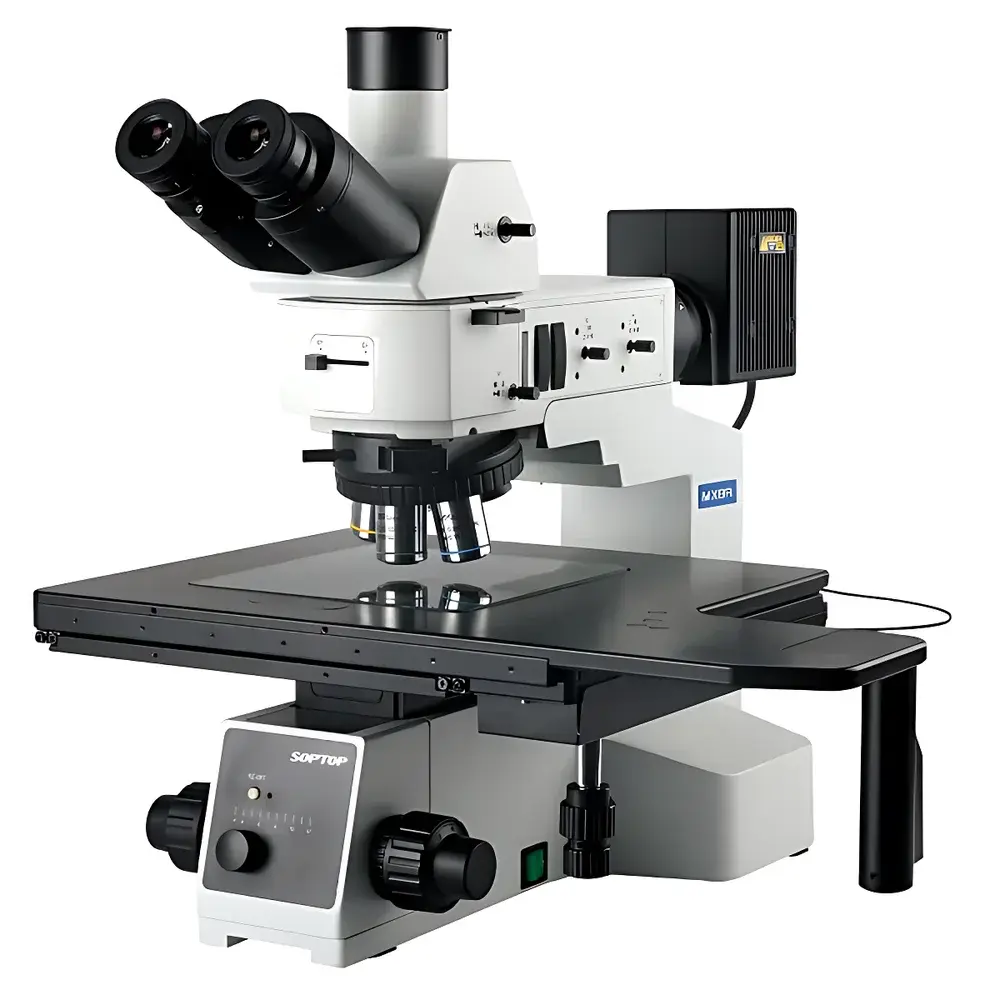
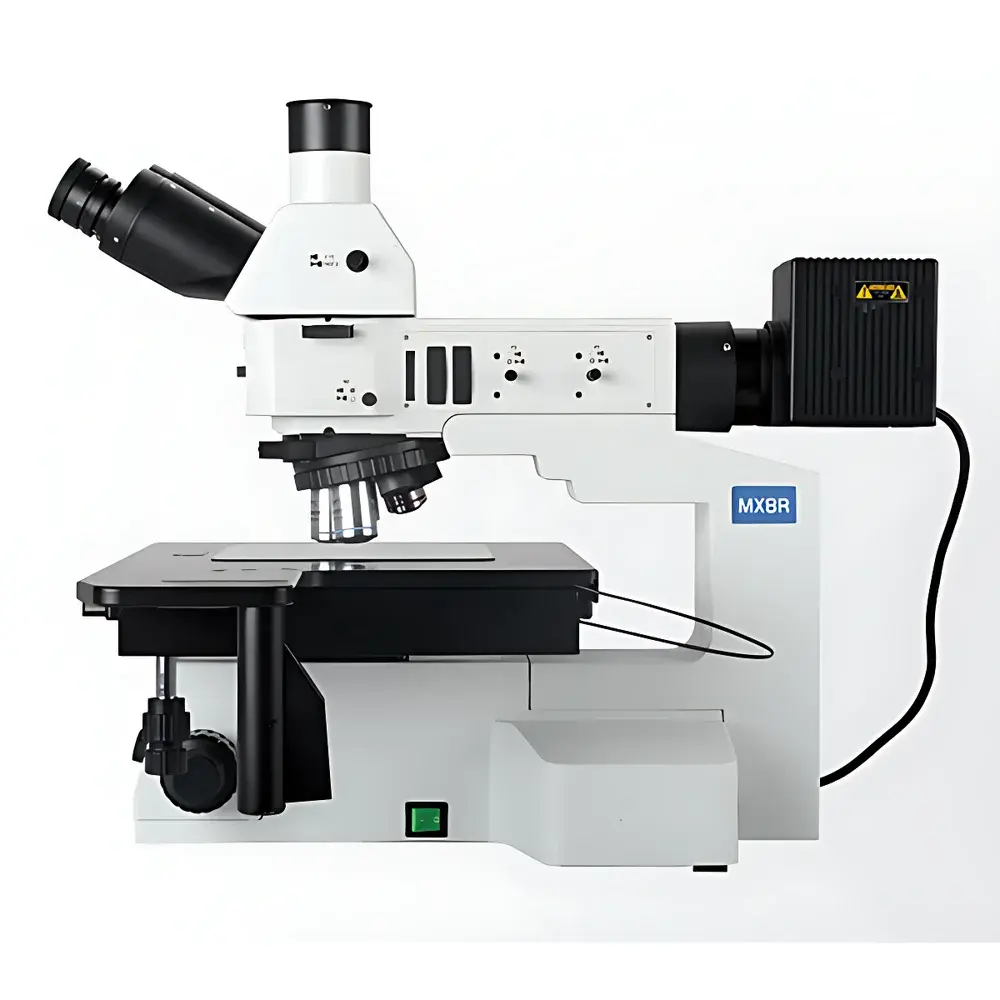
SOPTEC MX8R Upright Metallurgical Microscope
| Brand | SOPTEC |
|---|---|
| Origin | Zhejiang, China |
| Manufacturer Type | Direct Manufacturer |
| Product Origin | Domestic (China) |
| Model | MX8R |
| Mounting Type | Upright |
| Total Magnification Range | 50×–1000× |
| Eyepieces | Widefield Plan Eyepieces PL10×/25 mm & PL10×/26.5 mm (High-Eyepoint) |
| Objectives | 5×–100× Semi-Apochromatic Long Working Distance Metallurgical Objectives |
| Observation Tube | Trinocular with Adjustable Beam Splitter Ratio (e.g., 0:100 / 20:80 / 50:50 / 100:0) |
| Stage | Triple-Layer Mechanical XY Stage with 300 mm Wafer Compatibility |
| DIC System | Nomarski Differential Interference Contrast Module |
| Frame | Low-Center-of-Gravity Rigid Metal Chassis |
| Optical Path | Infinity-Corrected, Wide-Beam Imaging System |
Overview
The SOPTEC MX8R is an upright metallurgical microscope engineered for high-precision inspection of reflective, opaque specimens in semiconductor fabrication, flat panel display (FPD) manufacturing, and advanced materials QA/QC laboratories. Built upon an infinity-corrected optical architecture with a wide-beam imaging pathway, the MX8R delivers exceptional image fidelity across its full 50×–1000× magnification range. Its optical design conforms to ISO 10934-1 (Microscopy — Nomenclature of components) and supports standardized metallurgical observation protocols per ASTM E3–22 (Standard Guide for Preparation of Metallographic Specimens) and ISO 4527–1 (Metallic coatings — Microhardness testing). The system integrates a robust, low-center-of-gravity metal frame optimized for vibration damping—critical for stable imaging during extended wafer or large-panel inspections up to 300 mm diameter or 17-inch LCD substrates.
Key Features
- Upright configuration with rigid, all-metal industrial-grade chassis ensuring mechanical stability and long-term alignment retention under continuous operational loads.
- Triple-layer mechanical XY stage with precision-ground linear motion guides; accommodates wafers up to 300 mm and FPD panels up to 17 inches; compatible with 6″, 8″, and 12″ quick-change objective turrets.
- Widefield plan eyepieces (PL10×/25 mm and PL10×/26.5 mm) offering extended field number (FN26.5), improved edge-to-edge flatness, and ±5 diopter adjustable ocular compensation for diverse user ergonomics.
- Semi-apochromatic long working distance (LWD) metallurgical objectives (5×, 10×, 20×, 50×, 100×) featuring high-transmission multi-layer anti-reflection coatings and ≥10.5 mm working distance at 20×—minimizing risk of lens–specimen contact during coarse focusing or wafer handling.
- Integrated Nomarski differential interference contrast (DIC) module enabling nanoscale topographic sensitivity on uncoated or polished metallic, ceramic, and thin-film surfaces—ideal for detecting sub-micron scratches, conductive particle distribution on ITO layers, and surface relief in magnetic disk substrates.
- Trinocular observation head with four-step beam splitter ratio selection (0:100 / 20:80 / 50:50 / 100:0) for flexible allocation between visual observation, digital imaging, and photomicrography without optical realignment.
Sample Compatibility & Compliance
The MX8R is validated for routine inspection of polished metallographic sections, sintered ceramics, cast alloys, precision molds, PCB substrates, wire-bonded IC packages, and coated optical components. Its LWD objectives and large-stage travel allow safe examination of specimens up to 40 mm in thickness—including cross-sectioned power modules, heat-sink assemblies, and laminated composite structures. The system complies with CE marking requirements for laboratory equipment (2014/30/EU EMC Directive and 2014/35/EU Low Voltage Directive), and its optical performance meets ISO 9022-3 (Environmental testing — Microscopes — Part 3: Mechanical shock resistance) and ISO 10934-2 (Optical resolution verification methods). Optional DIC alignment verification kits support GLP-compliant calibration records per ISO/IEC 17025:2017.
Software & Data Management
The MX8R interfaces seamlessly with SOPTEC’s optional ImagePro Insight™ or third-party machine vision platforms (e.g., HALCON, OpenCV-based custom tools) via USB 3.0 or GigE Vision. Digital capture supports TIFF, PNG, and RAW formats with embedded EXIF metadata including objective ID, magnification, illumination intensity, and DIC retardation settings. Audit-trail functionality—when paired with compliant software—is configurable to meet FDA 21 CFR Part 11 requirements for electronic records and signatures in regulated environments. Measurement modules include calibrated length, area, grain size (ASTM E112), and phase fraction analysis with traceable NIST-traceable stage calibration certificates available upon request.
Applications
- Semiconductor process control: Defect mapping on silicon wafers, bond pad integrity verification, and post-etch residue inspection.
- FPD manufacturing: Conductive particle counting on color filter arrays, gate line continuity assessment, and micro-crack detection in TFT backplanes.
- Materials science labs: Grain boundary analysis in austenitic steels, inclusion rating per ASTM E45, and thermal spray coating porosity quantification.
- Automotive & aerospace QA: Porosity evaluation in die-cast aluminum housings, fatigue crack initiation site identification, and brazed joint integrity validation.
- Research & failure analysis: Cross-sectional analysis of solder joints, intermetallic compound (IMC) layer thickness measurement, and corrosion pit morphology characterization.
FAQ
Is the MX8R compatible with automated wafer handling systems?
Yes—the trinocular port and programmable LED illumination support integration with robotic stage controllers and SECS/GEM-compliant factory automation infrastructures.
Can the DIC module be retrofitted to earlier MX-series models?
No—Nomarski DIC requires precise optical path length matching and dedicated polarizer/analyzer alignment hardware; only MX8R and MX9R platforms are factory-integrated for DIC operation.
What is the maximum specimen height clearance under the 100× objective?
With the standard nosepiece and 100× LWD objective, vertical clearance is 3.5 mm; optional high-clearance nosepieces extend this to 12 mm for thick encapsulated samples.
Does SOPTEC provide ISO 17025-accredited calibration services?
Yes—certified calibration for magnification accuracy, stage linearity, and DIC shear direction is available through SOPTEC’s CNAS-accredited metrology lab (Registration No. CNAS L9876).
Are replacement objectives supplied with individual certification reports?
All semi-apochromatic objectives ship with individual test reports documenting transmission spectra (350–700 nm), wavefront error (≤λ/4 RMS), and focal shift over temperature (±0.02 mm from 20–25 °C).




