
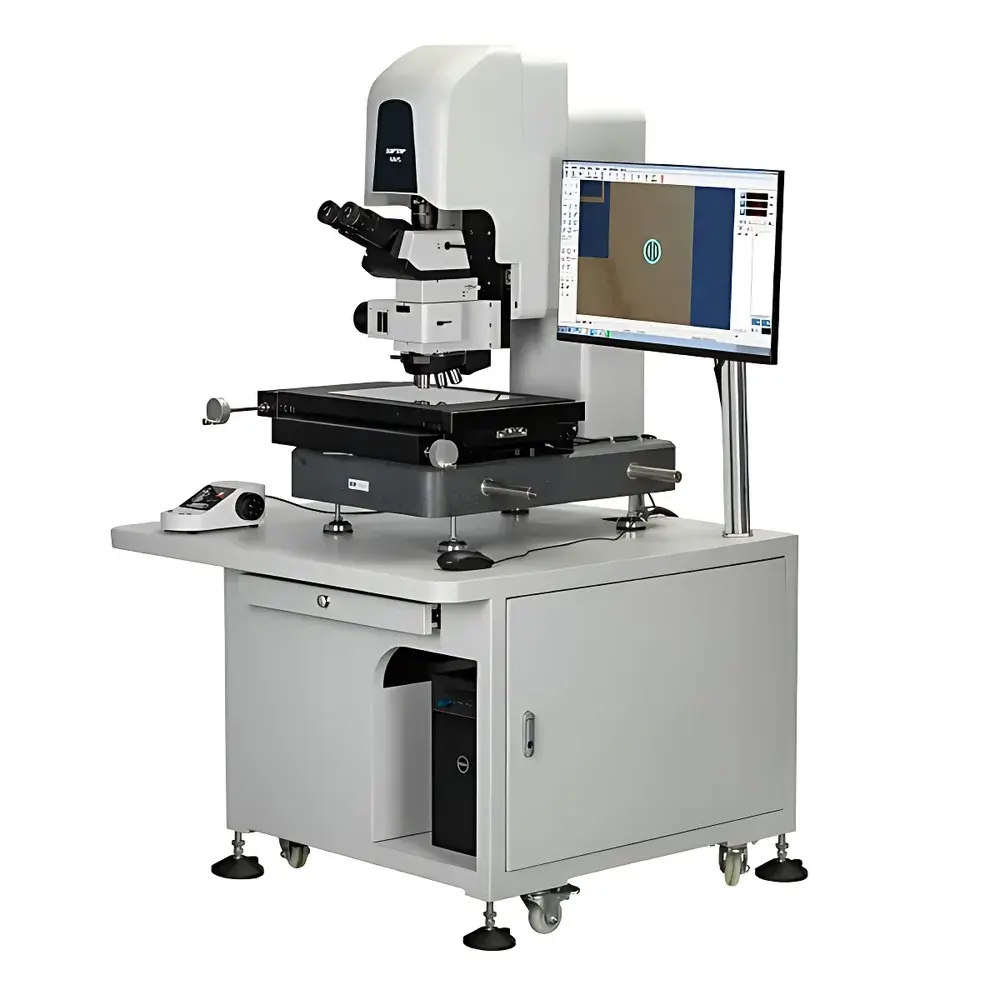
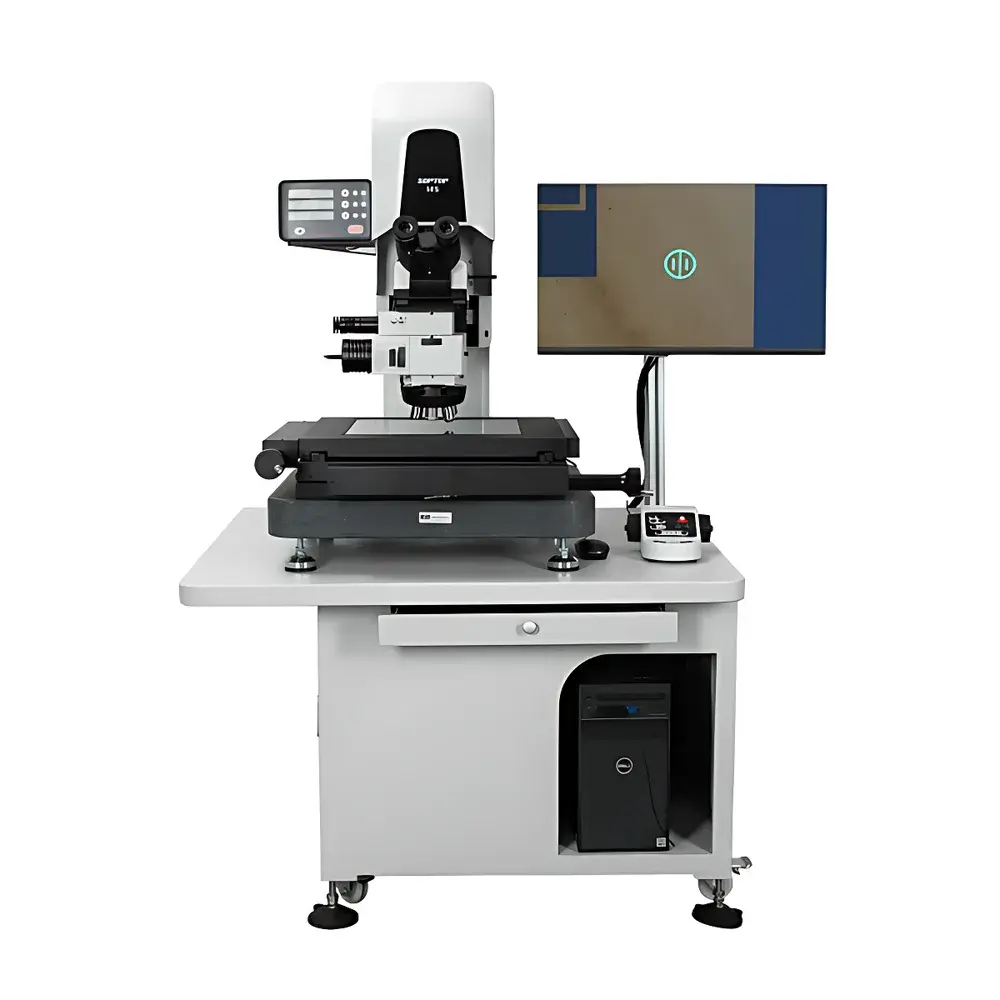
Soptop MS Series Tool Measuring Microscope
| Brand | Soptop |
|---|---|
| Origin | Zhejiang, China |
| Manufacturer Type | Direct Manufacturer |
| Region Category | Domestic (China) |
| Model | MS Series |
| Pricing | Upon Request |
Overview
The Soptop MS Series Tool Measuring Microscope is an advanced metrological optical instrument engineered for high-precision dimensional inspection and surface characterization in industrial quality control and R&D environments. It integrates the high-resolution imaging capability of metallurgical microscopy with the coordinate-based measurement functionality of vision metrology systems—operating on a robust infinite-conjugate optical architecture. The system employs strain-free, long-working-distance metallurgical objectives optimized for reflective and semi-reflective specimens, enabling simultaneous high-magnification observation and non-contact X–Y–Z coordinate measurement. Its core measurement principle relies on calibrated stage translation coupled with sub-pixel edge detection algorithms in the proprietary software, delivering traceable dimensional data compliant with ISO 10360 and VDI/VDE 2617 standards for coordinate measuring machines.
Key Features
- Infinite-conjugate optical path with apochromatic correction, supporting brightfield, darkfield, differential interference contrast (DIC), and polarized light observation modes
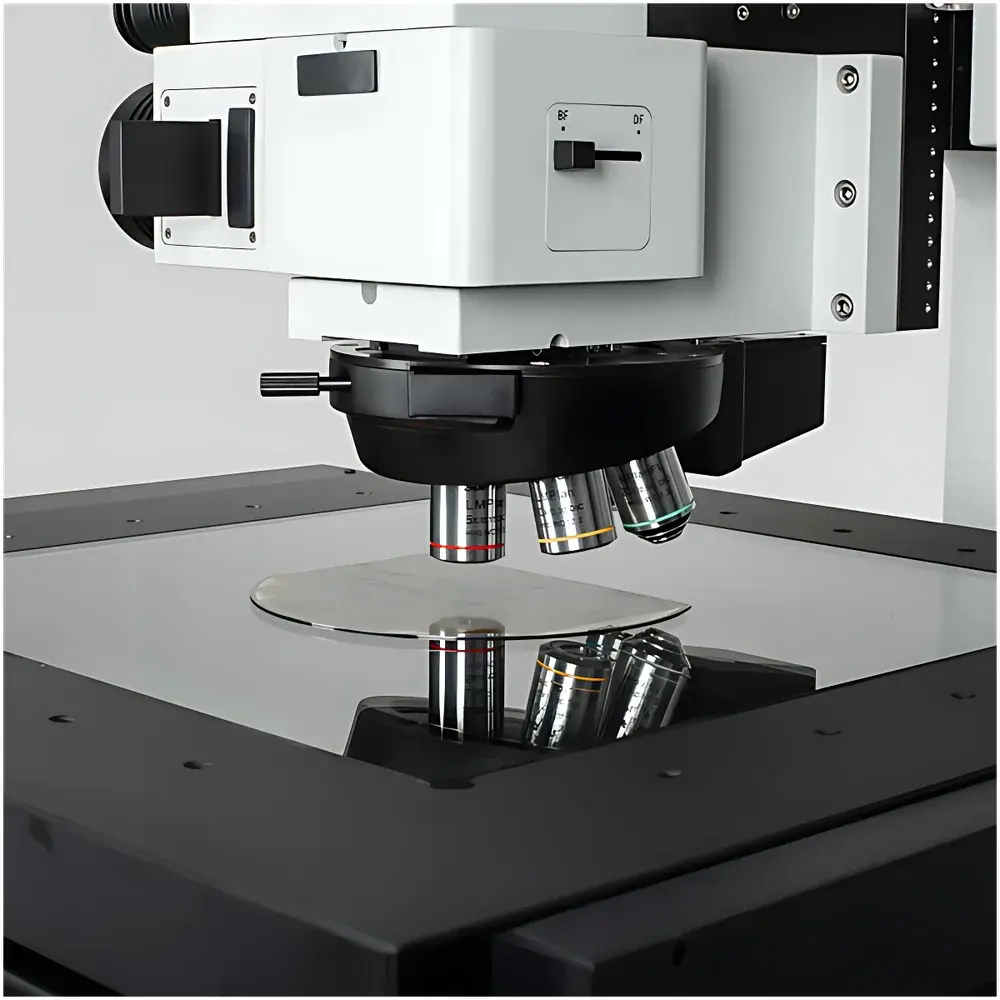
- Motorized six-position objective turret with automatic magnification recognition—eliminating manual scale entry errors during measurement workflows
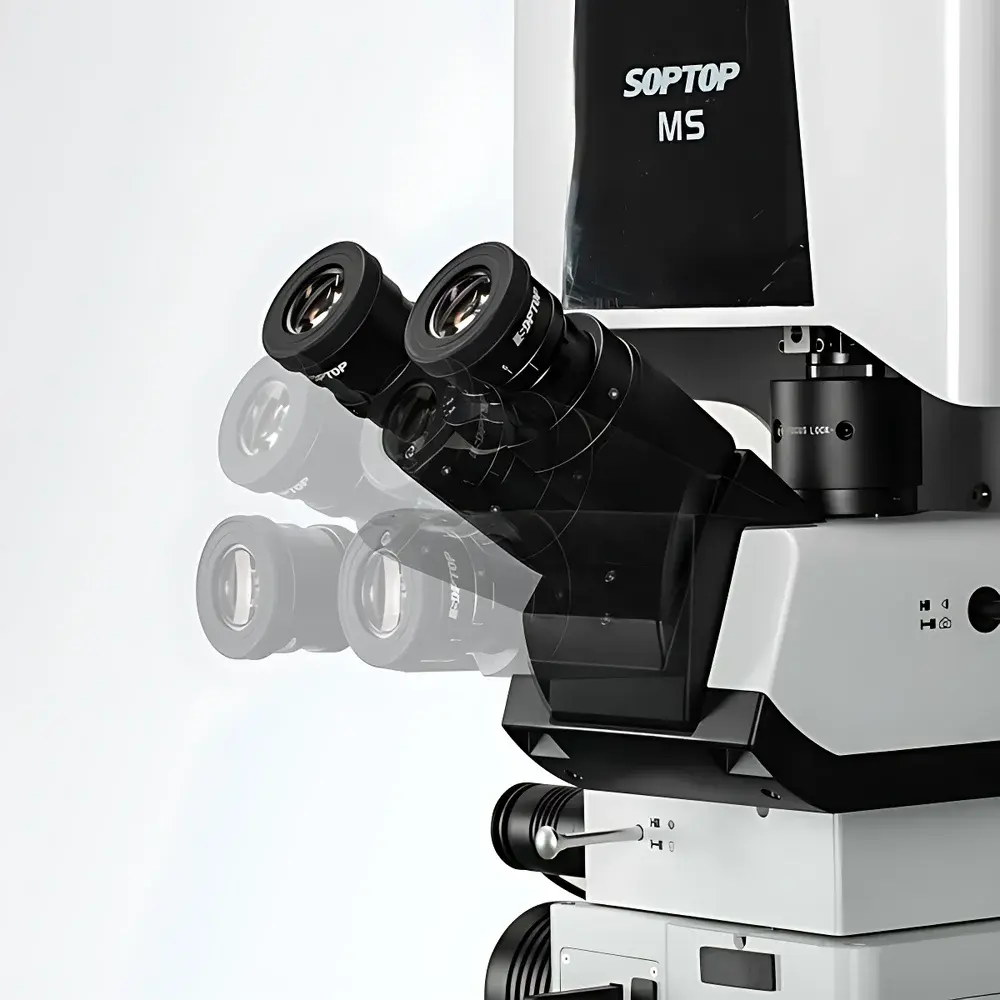
- Ergonomic tilting observation tube adjustable from 5° to 35°, accommodating seated or standing operators without compromising posture or visual comfort
- Modular large-travel mechanical stage options: 200 × 100 mm, 300 × 200 mm, 300 × 300 mm, and 400 × 300 mm—with optional custom configurations for specialized fixtures or extended travel
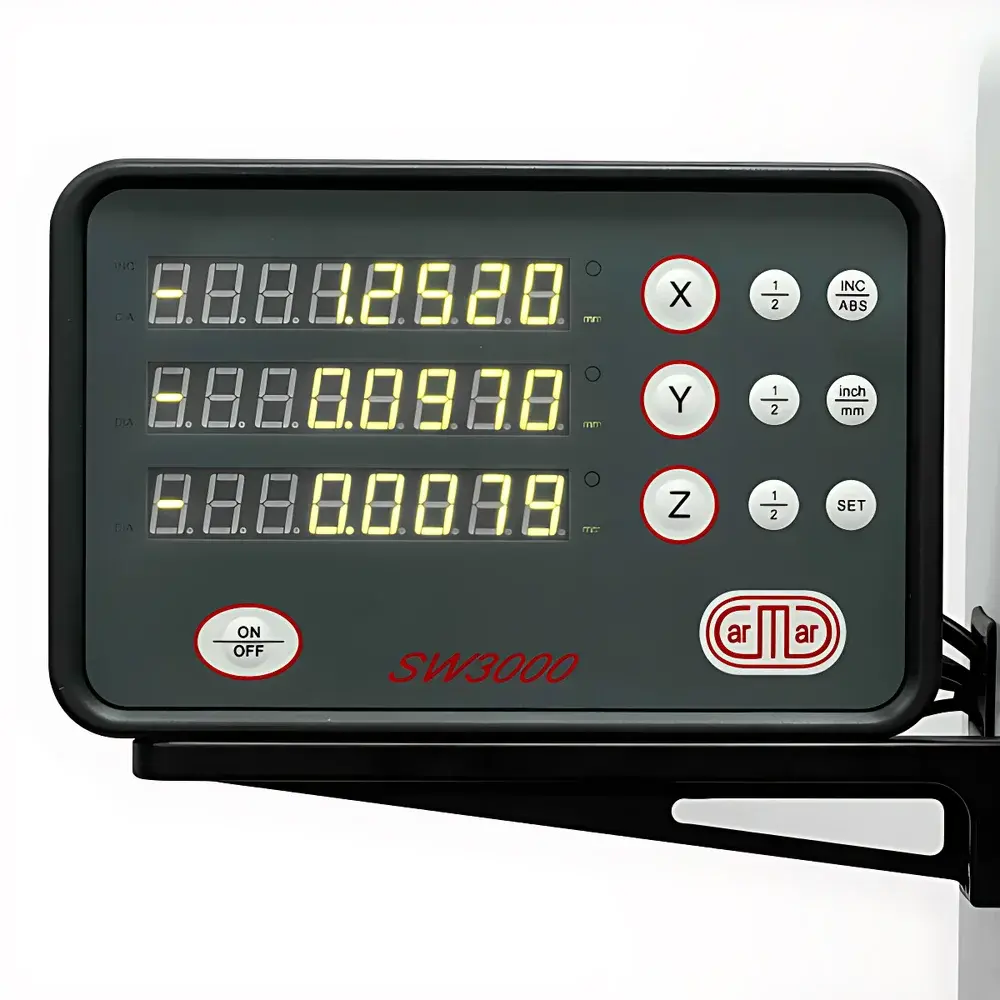
- Three-axis precision measurement system with 0.1 µm resolution on X, Y, and Z axes; Z-axis travel up to 150 mm via integrated high-torque motorized focus drive
- Dual-speed and three-step focus velocity selection (low/medium/high), reducing operator fatigue during repetitive focusing tasks
- Dedicated split-image focusing illuminator with independent brightness control and dual reticle patterns (crosshair + concentric circle) for rapid, unambiguous focal plane identification on low-contrast or topographically complex surfaces
- Integrated retractable ergonomic keyboard and front-access control panel—designed for seated operation and minimal workspace footprint
Sample Compatibility & Compliance
The MS Series accommodates a broad spectrum of industrial samples—including polished wafers, etched PCB traces, machined mold inserts, medical device components, automotive sheet metal stampings, and optoelectronic subassemblies. Its long working distance objectives (≥10.6 mm at 50×) permit measurement of specimens with substantial surface height variation (e.g., solder bumps, micro-lens arrays, or textured coatings) without collision risk. All optical components comply with ISO 8578 (microscope labeling), ISO 10110 (optical element specification), and RoHS Directive 2011/65/EU. The system supports GLP/GMP-aligned documentation protocols when used with validated software configurations, and its measurement traceability chain is compatible with ISO/IEC 17025-accredited calibration laboratories.
Software & Data Management
The MS Series ships with Soptop’s proprietary MetroVision™ measurement software—a Windows-based application designed for metrologists and QC engineers. It features customizable measurement templates, GD&T evaluation (including true position, flatness, circularity, and profile), batch report generation (PDF/Excel/CSV), and audit trail logging per FDA 21 CFR Part 11 requirements when deployed in regulated environments. Software supports automated image stitching for wide-field metrology, dynamic ROI (region-of-interest) scaling, and real-time pixel-to-unit calibration verification. Data export conforms to ISO 10303-21 (STEP AP214) for interoperability with PLM and MES platforms. Firmware and software updates are delivered via secure HTTPS channels with SHA-256 signature validation.
Applications
- Semiconductor packaging: Die bond alignment verification, lead frame coplanarity, wire bond loop height analysis
- PCB manufacturing: Solder mask registration accuracy, via diameter consistency, copper trace width/spacing compliance per IPC-A-600
- Optoelectronics: Lens centering error quantification, fiber array pitch uniformity, collimator beam axis deviation
- Medical device machining: Catheter hub concentricity, stent strut thickness distribution, surgical blade edge radius assessment
- Automotive powertrain: Gear tooth profile deviation, bearing raceway waviness, valve seat angle verification
- Tool & die metrology: EDM electrode wear profiling, injection mold cavity depth mapping, gage block calibration support
FAQ
Does the MS Series support automated edge detection on low-contrast metallic surfaces?
Yes—the MetroVision™ software incorporates adaptive thresholding and gradient-based sub-pixel interpolation optimized for metallurgical specimens, including brushed aluminum, anodized coatings, and electroplated finishes.
Can Z-axis measurements be referenced to a user-defined datum plane?
Yes—operators may define a best-fit reference plane from multiple user-selected points or use a physical reference standard (e.g., gauge block stack) for absolute height calibration.
Is third-party calibration certificate included with delivery?
A factory calibration report (traceable to CNAS-accredited standards) is provided; full ISO/IEC 17025 calibration with uncertainty budget requires optional on-site service or submission to an accredited lab.
What is the maximum specimen height clearance under the objective lens?
Clearance ranges from 35 mm (with 5× objective) to 10.6 mm (with 50× objective); taller specimens require optional tall-column stand or inverted configuration.
Are DIC and polarized light modules field-upgradable?
Yes—both modules are mechanically and optically pre-aligned for plug-and-play installation without realignment of the optical train.





