
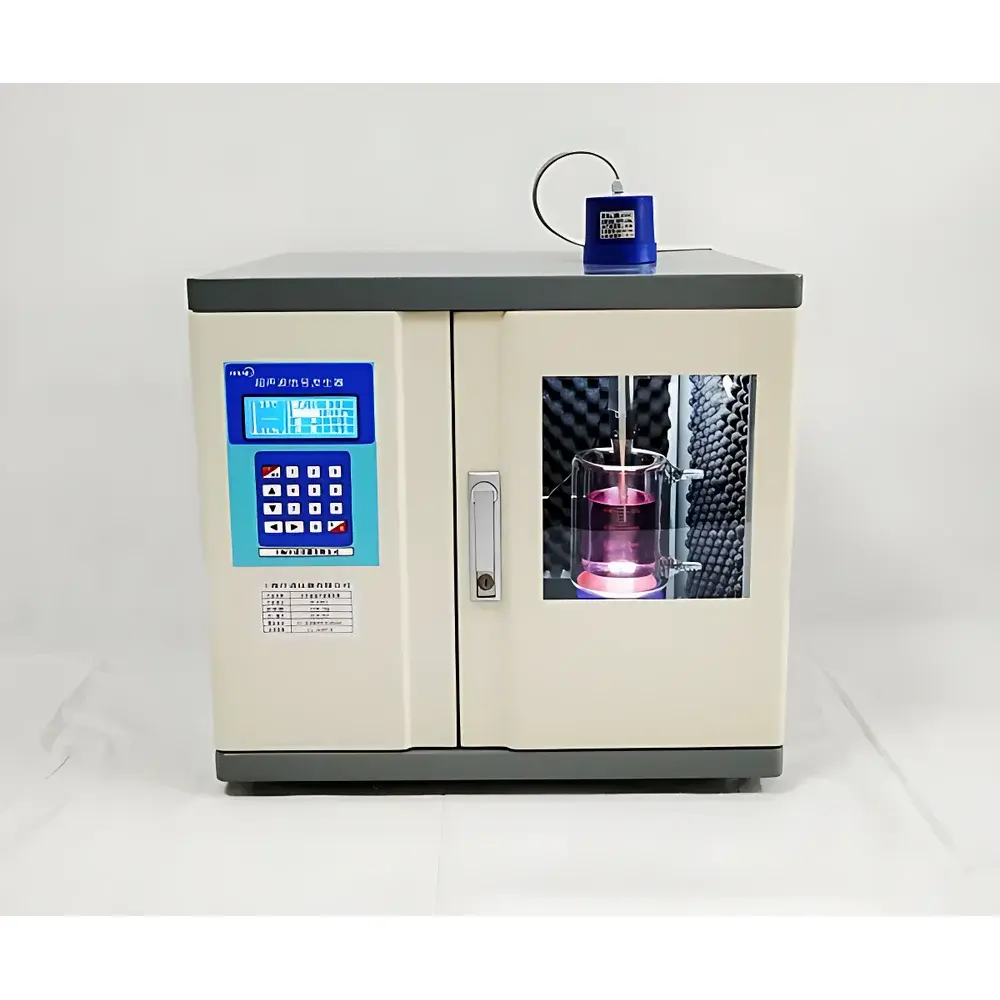
Hanuo HN-650CT Benchtop Constant-Temperature Ultrasonic Extractor
| Brand | Hanuo |
|---|---|
| Origin | Shanghai, China |
| Manufacturer Type | Direct Manufacturer |
| Product Category | Domestic |
| Model | HN-650CT |
| Ultrasonic Power | 650 W |
| Ultrasonic Frequency | 20 kHz |
| Heating Power | Standard |
| Temperature Range | −5 to 100 °C |
| Chamber Capacity | 600 mL |
Overview
The Hanuo HN-650CT Benchtop Constant-Temperature Ultrasonic Extractor is an engineered solution for controlled, small-batch extraction in analytical, phytochemical, and natural product laboratories. It operates on the principle of high-intensity ultrasonic cavitation—where rapid pressure fluctuations generate transient microbubbles in liquid media, collapsing violently to produce localized shear forces, microstreaming, and thermal effects. This physical disruption enhances mass transfer across cell membranes and solid–liquid interfaces, significantly improving extraction efficiency without chemical modification. Unlike immersion-type probes or bath systems, the HN-650CT employs a fixed-focus, horn-type transducer (standard 10 mm titanium alloy probe) delivering directional energy directly into the sample vessel—ensuring reproducible energy density and minimizing acoustic attenuation. Its integrated Peltier-assisted temperature control system maintains setpoint stability within ±0.5 °C across the full operating range (−5 to 100 °C), critical for thermolabile compounds such as flavonoids, alkaloids, polysaccharides, and essential oils.
Key Features
- Fixed-position ultrasonic horn design with adjustable amplitude (50–650 W output) and automatic frequency tracking (20 kHz nominal, ±1 kHz stability)
- Precise digital temperature regulation via dual-mode heating/cooling (Peltier + resistive), enabling sub-zero extraction for cold-sensitive analytes
- 7-inch capacitive touch interface with real-time dynamic ultrasonic power curve visualization and timestamped parameter logging
- Onboard memory stores up to 99 user-defined protocols, each configurable with ramp profiles, dwell times, and password protection (4-digit PIN)
- High-borosilicate glass extraction chamber (600 mL nominal volume, calibrated 50–600 mL working range) compatible with organic solvents, aqueous buffers, and supercritical CO₂ co-solvent systems
- Integrated safety architecture including overtemperature cutoff, probe dry-run detection, acoustic impedance monitoring, and LED-lit viewing window with UV-blocking shield
Sample Compatibility & Compliance
The HN-650CT accommodates heterogeneous matrices—including dried plant powders, fresh botanical tissues, microbial biomass, and polymer-encapsulated actives—without requiring pre-grinding or solvent polarity matching. Its non-selective mechanical action circumvents limitations of conventional Soxhlet or maceration methods, particularly for high-molecular-weight or polar constituents (e.g., saponins, tannins, glycosides). The system complies with general laboratory safety standards (IEC 61010-1) and supports GLP-aligned workflows through audit-trail-capable protocol storage. While not certified for GMP manufacturing environments, its repeatable energy delivery and temperature traceability align with method validation requirements per USP <851>, ISO 21567-1 (natural product analysis), and ASTM D7213 (ultrasonic-assisted extraction of bioactive compounds).
Software & Data Management
Data acquisition occurs natively via embedded microcontroller (ARM Cortex-M4) with 16-bit ADC resolution for power and temperature feedback loops. All operational parameters—including real-time RMS power, instantaneous temperature, elapsed time, and cycle count—are logged to internal flash memory (128 MB) with CSV export capability via USB-A port. No proprietary software is required; exported logs are compatible with MATLAB, Python (pandas), and commercial LIMS platforms. Password-protected access ensures data integrity during multi-user operation, satisfying basic 21 CFR Part 11 intent for electronic records (though formal electronic signature functionality is not implemented).
Applications
- Quantitative extraction of marker compounds for HPLC/UHPLC calibration (e.g., ginsenosides from Panax ginseng, curcumin from Curcuma longa)
- Preparative isolation of exopolysaccharides from fungal mycelia under cryo-ultrasonic conditions (−5 to 10 °C)
- Rapid screening of solvent–matrix interactions in green extraction process development (ethanol–water, limonene, deep eutectic solvents)
- Cell lysis optimization for intracellular metabolite profiling in untargeted metabolomics
- Accelerated leaching studies of heavy metals or pesticides from contaminated soil samples (EPA Method 3050B-adapted protocols)
FAQ
Is the HN-650CT suitable for volatile solvent extraction?
Yes—the sealed glass chamber design and optional condenser port support reflux-compatible operation with low-boiling solvents (e.g., dichloromethane, diethyl ether, hexane) when used in ventilated fume hoods.
Can the ultrasonic probe be sterilized for microbiological applications?
The titanium alloy probe is autoclavable at 121 °C / 15 psi for 20 minutes; however, the transducer housing and electronics are not steam-resistant and must remain external to sterilization cycles.
What maintenance is required for long-term reliability?
Annual recalibration of temperature sensor and power output verification using calorimetric standards (ASTM E2234) is recommended; probe tip erosion should be inspected visually after every 500 hours of cumulative operation.
Does the system support external trigger input or analog output signals?
No—this model lacks industrial I/O interfaces (e.g., 4–20 mA, TTL, RS-485); it is designed exclusively for standalone benchtop use with manual initiation.
How does fixed-horn geometry compare to ultrasonic bath systems in reproducibility?
Fixed-horn configuration delivers consistent spatial energy distribution (±3% intensity variation across 600 mL volume), whereas bath systems exhibit standing-wave node/antinode artifacts causing up to ±35% extraction yield variance—making the HN-650CT preferable for quantitative method development.



