
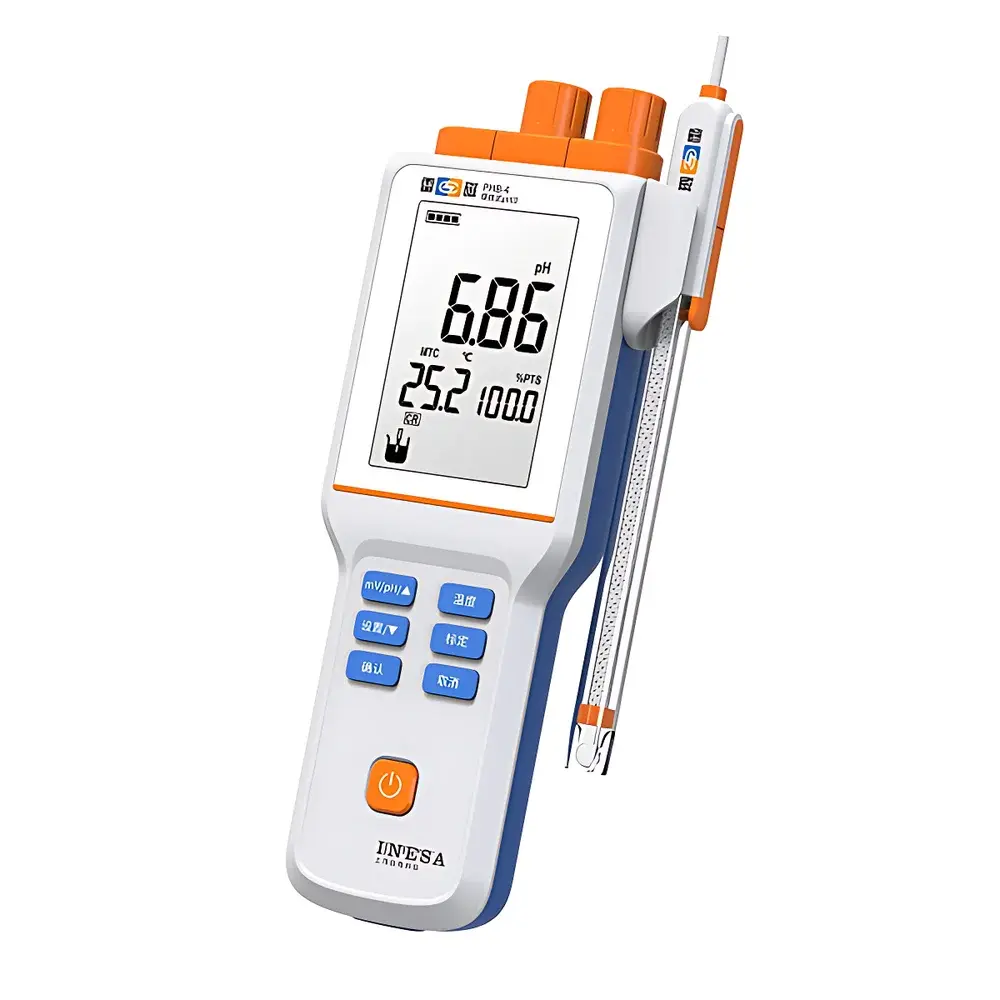
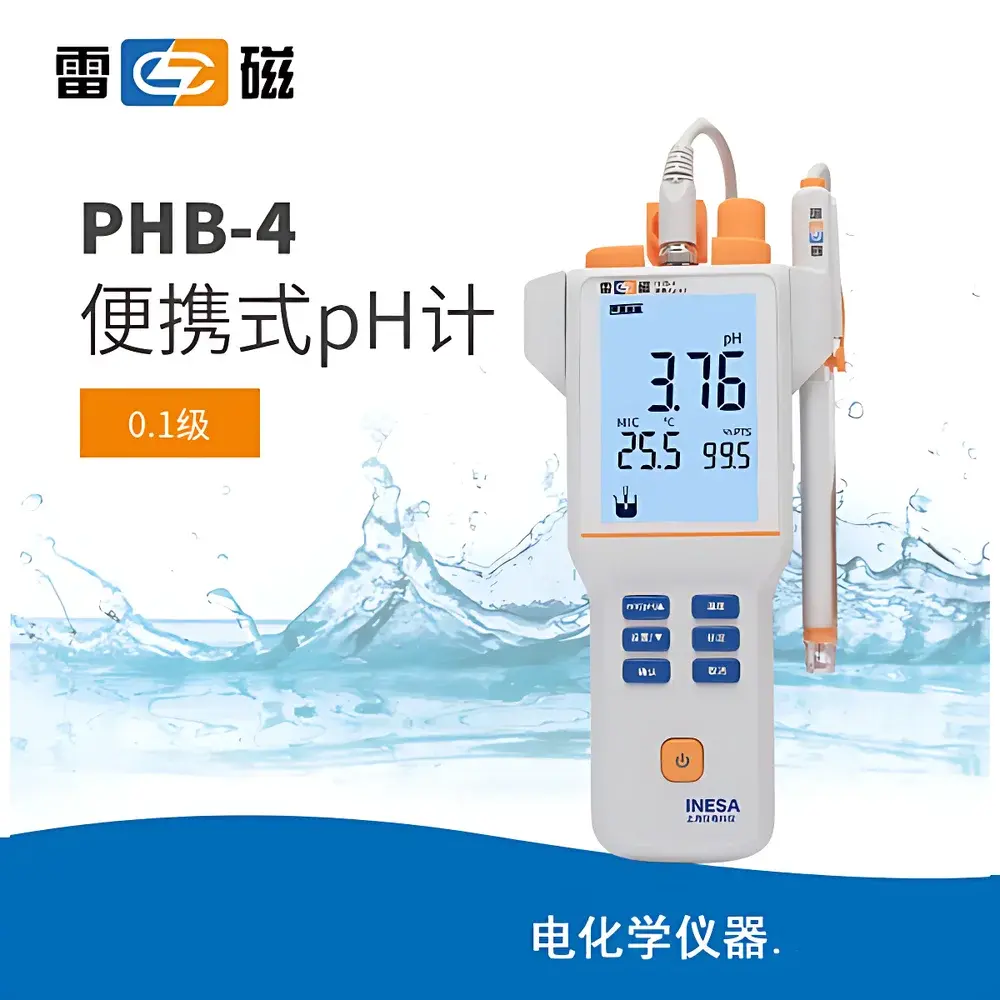
Leici PHB-4 Portable pH Meter
| Brand | Leici |
|---|---|
| Origin | Shanghai, China |
| Manufacturer Type | Direct Manufacturer |
| Region of Origin | Domestic (China) |
| Model | PHB-4 |
| Instrument Type | Portable |
| Parameter Types | Dual-parameter (pH/mV) |
| pH Accuracy | ±0.03 pH |
| pH Range | (0.00–14.00) pH |
| Resolution | 0.01 pH |
| mV Range | (−1400–+1400) mV |
| mV Resolution | 1 mV |
| mV Accuracy | ±0.2% FS |
| Temperature Compensation | Manual |
| Calibration Solutions | GB Standard Buffers at pH 4.00, 6.86, and 9.18 |
| Calibration Points | 1–2 point |
| IP Rating | IP65 |
| Power Supply | Rechargeable Li-ion battery |
| Dimensions | 80 × 225 × 35 mm |
| Weight | 0.4 kg |
Overview
The Leici PHB-4 Portable pH Meter is a field-deployable, dual-parameter electrochemical instrument engineered for reliable, high-fidelity pH and millivolt (mV) measurements in diverse environmental, educational, industrial, and quality control settings. Based on potentiometric measurement principles, the device determines hydrogen ion activity via a glass-membrane pH electrode and reports results relative to a stable reference electrode—typically integrated into a combined pH electrode. Its 0.01 pH resolution and ±0.03 pH accuracy meet the performance criteria of a Class 0.1 pH meter per Chinese national standards (JJG 119–2018), ensuring traceable and reproducible data across routine field use. Designed for operational robustness, the PHB-4 features an IP65-rated enclosure—providing dust-tight integrity and protection against low-pressure water jets—making it suitable for outdoor sampling, wastewater monitoring, aquaculture, soil leachate testing, and classroom laboratories where portability and environmental resilience are essential.
Key Features
- High-contrast LCD display with adjustable backlight for readability under variable lighting conditions
- Intelligent calibration system: automatic recognition of GB-standard buffer solutions (pH 4.00, 6.86, and 9.18) and support for user-defined buffers
- 1–2 point pH calibration with real-time slope and offset diagnostics to verify electrode health and calibration validity
- Integrated mV mode for direct redox potential measurement and electrode characterization (range: −1400 to +1400 mV, resolution: 1 mV)
- Manual temperature compensation (MTC) with dedicated temperature input for accurate pH correction when ambient or sample temperature deviates from 25 °C
- Power management architecture: built-in rechargeable lithium-ion battery (up to 100 hours typical operation), USB-compatible charging, low-battery warning, and charging status indicator
- Onboard firmware upgradability via PC connection, enabling future functional enhancements and compliance-aligned feature deployment
- Comprehensive data integrity safeguards: auto-power-off, power-loss recovery, factory reset, and self-diagnostic startup sequence
Sample Compatibility & Compliance
The PHB-4 is compatible with standard combination pH electrodes equipped with BNC connectors and integrated temperature sensors (e.g., Leici E-201-C or equivalent). It supports aqueous samples across the full pH range (0.00–14.00), including mildly turbid or low-conductivity solutions common in environmental surface water, drinking water, hydroponic nutrient solutions, and food extract analysis. While not certified for GMP or GLP-regulated production environments, its calibration traceability to GB-standard buffers and documented accuracy specifications align with general-purpose QA/QC requirements under ISO/IEC 17025–compliant laboratories for non-critical testing. The device complies with GB/T 18268.1–2010 (EMC requirements for laboratory equipment) and GB 4793.1–2007 (safety requirements for electrical equipment).
Software & Data Management
Data output is facilitated via micro-USB interface for connection to Windows-based PCs. The meter supports time-stamped single-point or batch data export in CSV format using Leici’s proprietary configuration utility—enabling integration into LIMS or Excel-based reporting workflows. Although the PHB-4 does not incorporate internal data logging memory or audit trail functionality, its calibration history (date, buffer IDs, slope, offset) is retained across power cycles and can be reviewed on-screen. For regulated environments requiring 21 CFR Part 11 compliance, external validation protocols—including documented calibration logs, operator access controls, and electronic record retention—are recommended as supplementary procedural controls.
Applications
- Field-based water quality assessment (rivers, lakes, effluent discharge points)
- Educational laboratory instruction for electrochemistry and analytical method validation
- Aquaculture and hydroponics system monitoring (nutrient solution pH stability)
- Soil slurry and leachate pH screening in environmental site assessments
- Pre-process verification in food & beverage facilities (e.g., rinse water, brine tanks)
- Calibration verification of fixed-installation pH transmitters in pilot-scale operations
FAQ
Does the PHB-4 support automatic temperature compensation (ATC)?
No—the PHB-4 implements manual temperature compensation only. Users must enter the measured sample temperature to apply the Nernstian correction factor.
Can I use non-GB buffer solutions for calibration?
Yes. The meter allows custom buffer entry with user-defined pH values, though GB-certified buffers are pre-programmed for one-touch recognition.
Is the included electrode suitable for measuring high-ionic-strength or protein-rich samples?
The standard E-201-C–type electrode is optimized for general-purpose aqueous use. For viscous, high-salinity, or fouling-prone matrices, a specialized electrode (e.g., double-junction or gel-filled) is recommended separately.
What is the expected service life of the rechargeable battery?
Under normal usage (2–3 hours daily), the Li-ion battery maintains ≥80% capacity for approximately 500 charge cycles (typically 18–24 months).
Does the PHB-4 comply with ASTM D1293 or ISO 10523 for pH measurement of water?
While the instrument meets the metrological requirements outlined in these standards (e.g., resolution, accuracy, electrode response time), formal conformance requires adherence to the full procedural framework—including electrode conditioning, stirring protocol, and temperature equilibration—per the respective standard text.
Related Products





