
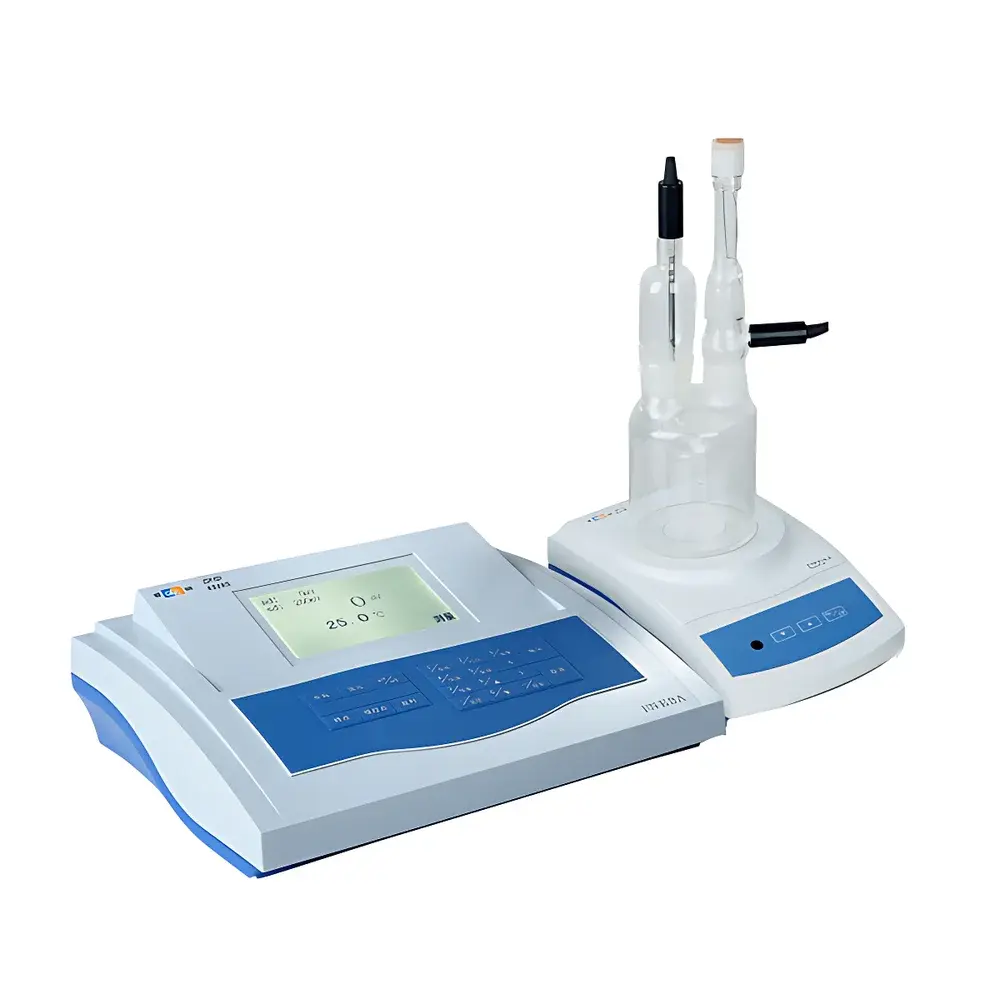
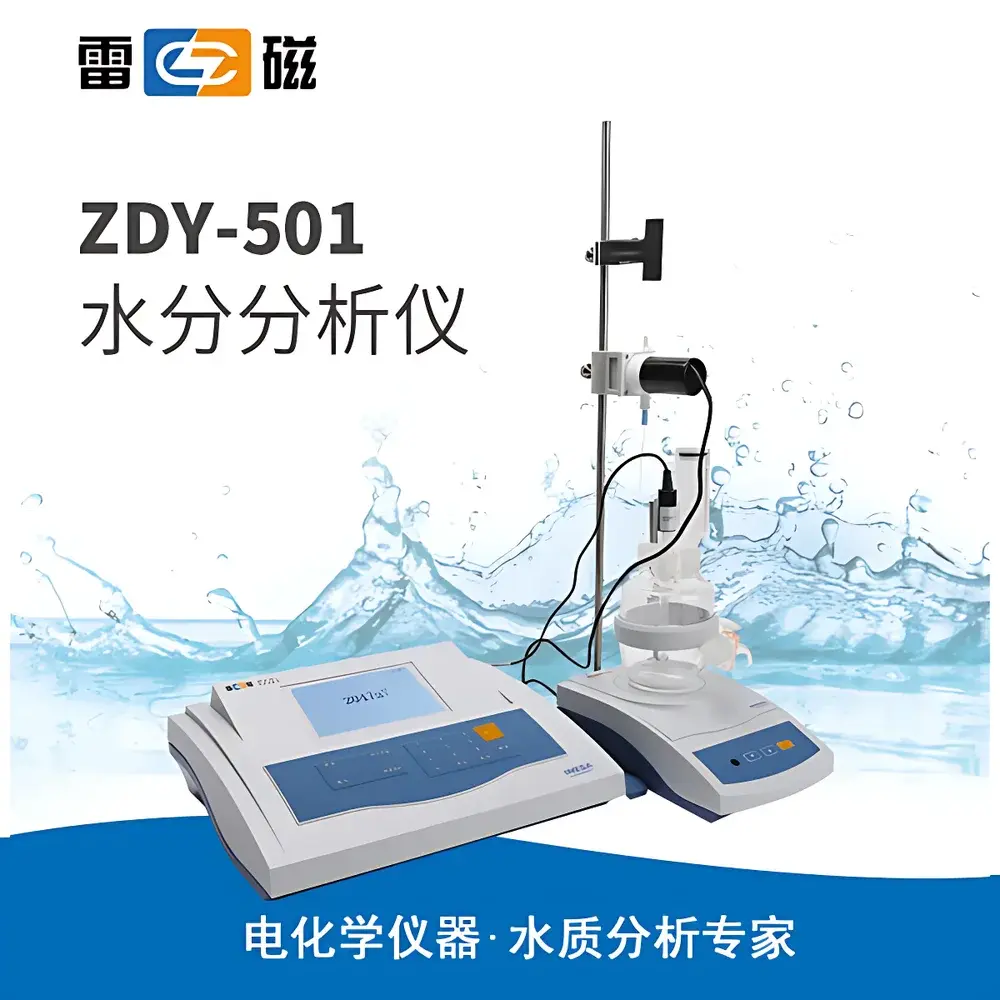
Leici ZDY-501 Karl Fischer Moisture Analyzer
| Brand | Leici |
|---|---|
| Origin | Shanghai, China |
| Manufacturer Type | Direct Manufacturer |
| Region of Origin | Domestic (China) |
| Model | ZDY-501 |
| Pricing Range | USD 570 – 2,850 |
| Titration Mode | Fully Automatic |
| Method Type | Volumetric and Coulometric Karl Fischer |
| Moisture Measurement Range | 0.1 mg – 250 mg |
| Measurement Accuracy | ±3% |
| Polarization Current | 1 µA |
| Endpoint Detection Range | 40–120 mV |
| Sample Temperature Range | 5–30 °C |
| Dimensions (L×W×H) | 280 × 210 × 120 mm |
| Weight | 5 kg |
Overview
The Leici ZDY-501 Karl Fischer Moisture Analyzer is a dual-mode benchtop instrument engineered for precise quantitative determination of trace water content in solid, liquid, and gaseous samples using both volumetric and coulometric Karl Fischer titration principles. It operates on the electrochemical stoichiometric reaction between iodine and water in a controlled anhydrous environment—where iodine is either delivered from a standardized titrant (volumetric mode) or generated in situ via controlled electrolysis of iodide ions (coulometric mode). This dual-capability design enables flexible method selection based on expected moisture concentration: volumetric mode is optimized for samples containing ≥100 µg water, while coulometric mode delivers superior sensitivity and resolution for ultra-trace analysis down to 0.1 mg absolute water mass. The analyzer complies with core requirements of ISO 8533:2014 (Determination of water content—Karl Fischer titration method), ASTM E203–22 (Standard Test Method for Water Using Volumetric Karl Fischer Titration), and supports GLP-aligned workflow documentation when integrated with compliant data management protocols.
Key Features
- Automated endpoint detection with adaptive titration control: real-time monitoring of polarization current (1 µA threshold) triggers dynamic transition from fast to slow titration upon approaching endpoint, minimizing overshoot and improving repeatability.
- Dual-method flexibility: switch seamlessly between volumetric and coulometric operation without hardware modification—enabling one instrument to serve R&D, QC, and stability testing across pharmaceuticals, polymers, petrochemicals, and battery electrolyte manufacturing.
- Optimized reagent compatibility: designed exclusively for Leici’s low-toxicity, low-volatility, odorless KF reagents—formulated to reduce occupational exposure risk and extend reagent shelf life under ambient storage conditions.
- High-resolution endpoint tuning: adjustable endpoint potential range (40–120 mV) allows fine calibration against matrix-specific interference, particularly beneficial for samples with redox-active components or high conductivity.
- Integrated environmental control: operational temperature window (5–30 °C) aligns with standard laboratory HVAC environments; no external chiller or heater required for routine use.
Sample Compatibility & Compliance
The ZDY-501 accommodates a broad spectrum of sample types—including hygroscopic powders (e.g., APIs, excipients), viscous liquids (e.g., silicone oils, resins), solvents (e.g., acetonitrile, methanol), and gas-phase samples via optional headspace adapter. Its sealed titration cell design minimizes atmospheric moisture ingress, ensuring measurement integrity per USP and Ph. Eur. 2.5.12 guidelines. While the instrument itself does not include built-in 21 CFR Part 11 audit trail functionality, its analog/digital output interface supports integration into validated LIMS or ELN systems where electronic records and user access controls are externally managed. All electrical components conform to IEC 61010-1 safety standards for laboratory equipment.
Software & Data Management
The ZDY-501 features an embedded microcontroller-based interface with a backlit LCD display (128 × 64 pixels), enabling local parameter configuration, real-time titration curve visualization, and manual result review. Data export is supported via RS-232 serial interface for connection to external PCs running third-party lab software (e.g., LabSolutions, Empower-compatible middleware). Raw titration logs—including time-stamped current response, volume consumed (volumetric), or charge integral (coulometric), endpoint voltage, and calculated water mass—are stored in non-volatile memory with timestamp and operator ID fields. For regulated environments, users may configure periodic CSV dumps synchronized with network time protocol (NTP) servers to support ALCOA+ data integrity principles.
Applications
- Pharmaceutical quality control: verification of residual moisture in lyophilized products, active pharmaceutical ingredients (APIs), and tablet granulations per ICH Q5C stability guidance.
- Electrolyte purity assurance in lithium-ion battery production: quantification of water contamination in carbonate-based solvents below 10 ppm threshold limits.
- Polymer processing: moisture content validation prior to extrusion or injection molding to prevent hydrolytic degradation of polyesters and polyamides.
- Fuel and lubricant specification testing: compliance screening for ASTM D6304 (water in petroleum products) and ISO 12937 (water in crude oil).
- Food ingredient certification: verification of declared moisture levels in powdered dairy, starches, and functional food additives per AOAC 992.18.
FAQ
Does the ZDY-501 support both volumetric and coulometric titration in a single instrument?
Yes—the ZDY-501 is a hybrid-mode analyzer capable of executing either method via software-selectable configuration; no mechanical reconfiguration or separate cell installation is required.
What is the minimum detectable water mass in coulometric mode?
The instrument achieves a lower detection limit of 0.1 mg absolute water mass, corresponding to sub-ppm sensitivity in typical 10 mL solvent volumes.
Is the endpoint detection based on bipotentiometric or amperometric principle?
It employs constant-current amperometric endpoint detection, using a dual-platinum electrode system with fixed 1 µA polarization current to monitor electrochemical reduction current decay at the equivalence point.
Can the ZDY-501 be validated for GMP environments?
While the base unit lacks native 21 CFR Part 11 features, it is routinely qualified under IQ/OQ protocols in pharmaceutical settings when paired with documented procedures, calibrated reference standards (e.g., sodium tartrate dihydrate), and external electronic record systems.
What maintenance intervals are recommended for long-term reliability?
Daily electrode cleaning with dry acetone, weekly drying of the titration cell, and quarterly verification of reagent titer stability using certified water standards are advised per manufacturer’s technical bulletin TB-ZDY-501-Rev.3.
Related Products




