
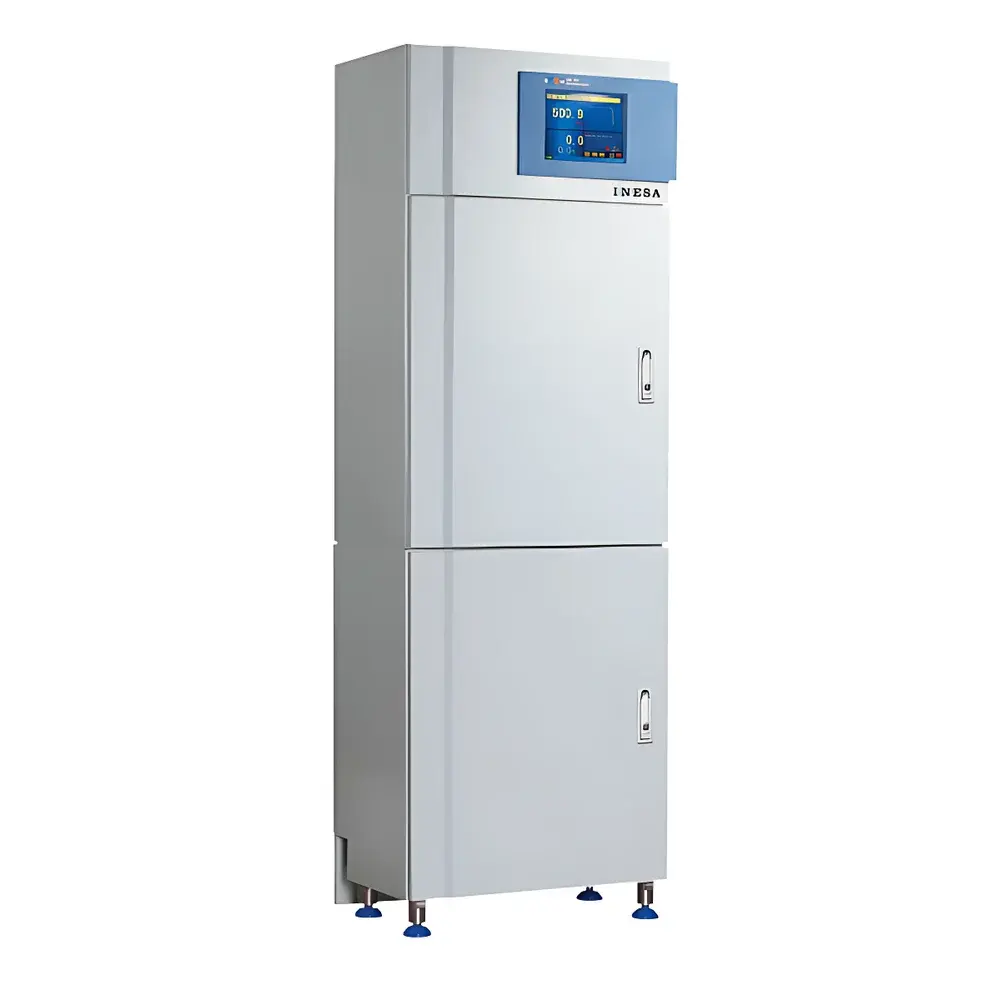
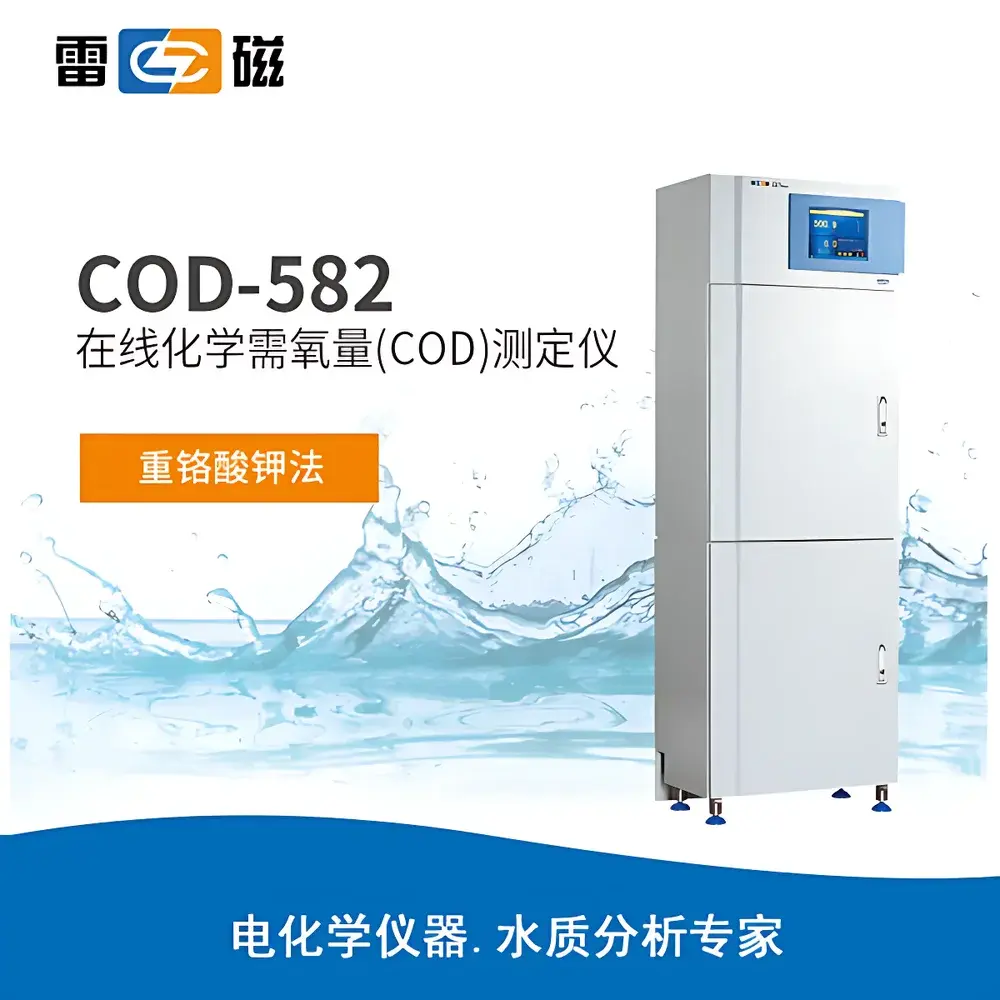
Leichi COD-582 Online Chemical Oxygen Demand (COD) Analyzer
| Brand | Leichi |
|---|---|
| Origin | Shanghai, China |
| Manufacturer Type | Direct Manufacturer |
| Country of Origin | China |
| Model | COD-582 |
| Instrument Type | Online Analyzer |
| Measurement Principle | Potassium Dichromate Digestion Method (Online) |
| Measurement Range | 10.0–5000 mg/L |
| Accuracy | ±10% or ±5 mg/L (for values ≤50 mg/L) |
| Repeatability | 5% or 5 mg/L (for values ≤100 mg/L) |
| Resolution | 0.1 mg/L (≤100 mg/L), 1 mg/L (>100 mg/L) |
| Zero Drift | ±5 mg/L/24 h |
| Span Drift | ±10%/24 h |
| Power Supply | AC 220 V ±10%, 50 Hz |
| Dimensions (W×D×H) | 550 × 400 × 1680 mm |
| Weight | 50 kg |
| MTBF | ≥360 hours |
| Output | Isolated 4–20 mA DC (configurable upper/lower limits) |
| Communication | RS-232 or RS-485 (selectable) |
| Interface | 7-inch color LCD touchscreen |
| Maintenance Interval | Up to 30 days without service |
Overview
The Leichi COD-582 Online Chemical Oxygen Demand (COD) Analyzer is an industrial-grade, fully automated water quality monitoring system engineered for continuous, unattended measurement of chemical oxygen demand in real time. It implements the standardized potassium dichromate digestion method—aligned with ISO 6060 and equivalent to ASTM D1252 (Method B) and China’s GB 11914–1989—wherein sample oxidation under acidic, high-temperature conditions is quantified photometrically via Cr3+ absorbance at 600 nm. Unlike laboratory-based batch analyzers, the COD-582 integrates digestion, cooling, dilution, colorimetric detection, and waste handling into a single compact cabinet, enabling robust operation in municipal wastewater plants, industrial effluent channels, and process water loops. Its architecture prioritizes long-term stability, minimal reagent consumption, and compliance-ready data integrity—making it suitable for regulatory reporting under national discharge standards and ISO 14001 environmental management frameworks.
Key Features
- Automated digestion cycle with precise temperature control (165 °C ± 2 °C) and timed reflux, ensuring consistent oxidation efficiency across variable matrix compositions.
- Optical liquid-level sensing for sub-milliliter reagent dispensing accuracy, reducing chemical usage by >40% versus conventional peristaltic metering.
- 7-inch capacitive touchscreen interface with intuitive navigation, real-time status dashboard, and multilingual UI support (English, Spanish, Chinese).
- Three operational modes: manual step-by-step diagnostics, scheduled measurement (user-defined intervals from 30 min to 24 h), and event-triggered analysis (e.g., flow-activated sampling).
- Comprehensive self-diagnostics including heater overtemperature lockout, leak detection via dual conductivity sensors, and reagent depletion alerts with predictive low-volume warnings.
- Configurable alarm hierarchy with relay outputs for external SCADA integration; emergency stop function halts all fluidic and thermal operations within <2 s.
- Password-protected configuration access with role-based permissions (Operator, Technician, Administrator) compliant with IEC 62443-3-3 security guidelines.
Sample Compatibility & Compliance
The COD-582 accommodates raw influent, secondary effluent, and treated discharge streams with suspended solids up to 100 mg/L and chloride concentrations ≤2000 mg/L (with optional chloride compensation module). It meets EN 12902:2012 requirements for automated water analyzers and supports GLP/GMP-aligned audit trails through timestamped system logs covering calibration events, fault codes, maintenance actions, and user logins. All measurement records include metadata (sample ID, operator ID, instrument serial number, digest time, temperature profile), satisfying traceability mandates under ISO/IEC 17025 and U.S. EPA Method 410.1 documentation standards.
Software & Data Management
Embedded firmware enables local storage of ≥100,000 measurement records with automatic rollover and CSV export via USB or serial interface. The analyzer supports Modbus RTU protocol over RS-485 for seamless integration into plant-wide DCS or PLC networks. Optional Leichi DataLink software provides remote configuration, trend visualization, statistical process control (SPC) charts, and automated report generation (PDF/Excel) compliant with FDA 21 CFR Part 11 requirements—including electronic signatures, audit trail review, and data immutability controls.
Applications
- Municipal wastewater treatment plants: Real-time monitoring of influent COD load for biological process optimization and discharge compliance verification.
- Industrial pretreatment systems: Continuous tracking of COD spikes in petrochemical, pharmaceutical, food & beverage, and semiconductor manufacturing effluents.
- Environmental surveillance networks: Fixed-station deployment in rivers, reservoirs, and estuaries for early warning of organic pollution events.
- Power generation facilities: Cooling water and boiler feedwater quality assurance where organic fouling risk must be quantified.
- Research & education laboratories: Platform for method validation studies and comparative analysis against TOC or UV254 surrogate parameters.
FAQ
What digestion standard does the COD-582 implement?
It follows the closed-reflux potassium dichromate method per GB 11914–1989, ISO 6060, and ASTM D1252 Method B—with programmable digestion time (2–120 min) and temperature (150–170 °C).
Can the analyzer handle high-chloride wastewater?
Yes—standard configuration tolerates ≤2000 mg/L Cl−; for higher concentrations, the optional AgNO3 precipitation module suppresses interference.
How is calibration verified during unattended operation?
The system performs automatic zero and span checks using certified reference standards at user-defined intervals; all calibrations are logged with uncertainty estimates.
Is remote firmware update supported?
Firmware upgrades require secure USB media import with SHA-256 signature verification—no over-the-air updates are permitted for cybersecurity compliance.
What maintenance tasks are required monthly?
Only reagent replacement, waste container emptying, and optical window cleaning; no pump tube or valve servicing is needed within the first 30 days of operation.







