
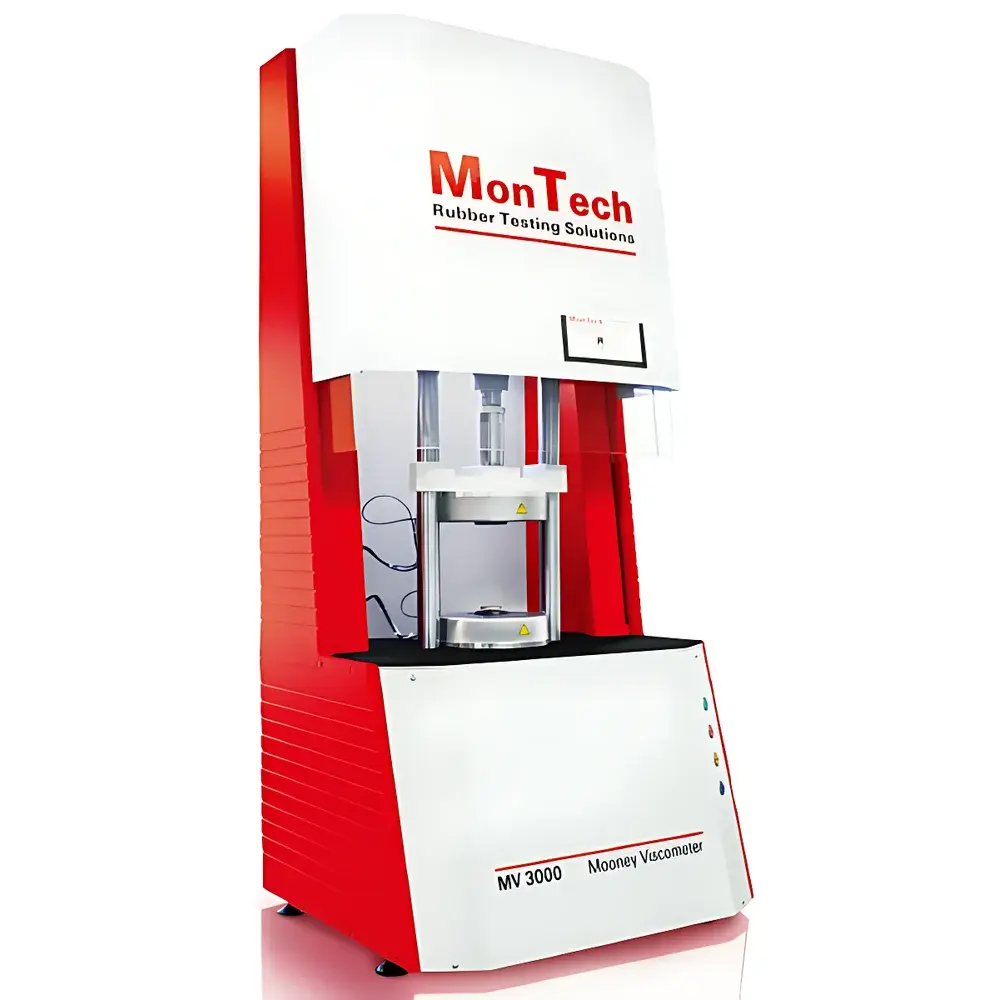
MonTech MV 3000 Mooney Viscometer
| Brand | MonTech |
|---|---|
| Origin | Germany |
| Model | MV 3000 |
| Standards Compliance | ISO 289:2005, ASTM D1646, DIN 53523, BS 903 Part A58, JIS K6300, GOST 10722–76 |
| Rotor Options | Large rotor (38.10 mm), Small rotor (30.48 mm) |
| Rotational Speed | 2 rpm ± 0.02 rpm |
| Temperature Range | Ambient to 232 °C |
| Temperature Accuracy | ±0.03 °C |
| Measurement Units | Mooney Units (MU), °C / °F, min:min or min:sec |
| Test Modes | Mooney Viscosity, Mooney Scorch, Stress Relaxation, Mold Release Performance, Delta Mooney |
| Sealing | Long-life elastomeric seal assembly |
| Control System | Digital microprocessor-based PID temperature and torque control |
Overview
The MonTech MV 3000 Mooney Viscometer is a precision-engineered, industrial-grade instrument designed for standardized rheological characterization of raw and compounded elastomers. Operating on the principle of rotational shear under controlled thermal conditions, it measures the resistance of uncured rubber compounds to deformation when subjected to a defined shear stress—quantified as Mooney viscosity (MU)—in accordance with internationally recognized test methods. The instrument employs a calibrated, heated cavity and a standardized rotor (either 38.10 mm large or 30.48 mm small) rotating at a fixed speed of 2 rpm. Torque response is continuously monitored and converted into Mooney units using a traceable calibration curve. Its primary function extends beyond basic viscosity determination to include scorch time (t5, t35), stress relaxation behavior, and mold release performance evaluation—critical parameters for process validation, compound development, and incoming material qualification in tire, automotive, and industrial rubber manufacturing.
Key Features
- Microprocessor-controlled temperature regulation with ±0.03 °C accuracy across a full range from ambient to 232 °C, ensuring strict adherence to ISO 289:2005 and ASTM D1646 thermal protocols.
- Dual-rotor compatibility (large and small) enables method flexibility and cross-laboratory correlation per DIN 53523 and JIS K6300 specifications.
- Robust mechanical architecture featuring long-life elastomeric sealing system minimizes maintenance frequency and ensures consistent cavity integrity over extended operational cycles.
- Integrated digital PID control loop for simultaneous stabilization of temperature and rotational velocity—critical for reproducible MU values across shifts and laboratories.
- Modular configuration options: MV 3000 Basic (standard QC mode), MV 3000 Enhanced (expanded test sequencing and data logging), and V-MV 3000 (variable-speed capability for non-standard shear rate investigations).
Real-time torque acquisition at ≥10 Hz sampling rate, supporting high-fidelity time–torque curve generation for scorch onset detection and relaxation kinetics analysis.
Sample Compatibility & Compliance
The MV 3000 accommodates a broad spectrum of elastomeric materials—including natural rubber (NR), styrene–butadiene rubber (SBR), ethylene–propylene diene monomer (EPDM), nitrile rubber (NBR), silicone (VMQ), and thermoplastic elastomers (TPEs)—as well as filled and reinforced compounds. Its design satisfies the dimensional, thermal, and dynamic requirements of ISO 289:2005 (Parts 1–4), ASTM D1646–22, DIN 53523 (Parts 1–4), BS 903-A58, AFNOR T43-00/005, GOST 10722–76, and JIS K6300. All test sequences are fully traceable and support GLP/GMP-aligned documentation workflows. Optional audit trail and electronic signature modules comply with FDA 21 CFR Part 11 requirements for regulated environments.
Software & Data Management
MonTech’s proprietary ViscoWin software provides full instrument control, real-time visualization of torque–time and temperature–time profiles, automated parameter extraction (e.g., ML, MH, t5, t35, relaxation half-life), and customizable report generation in PDF, CSV, or XML formats. Data export supports LIMS integration via ODBC and OPC UA protocols. Version-controlled method templates ensure inter-operator consistency, while encrypted database storage maintains data integrity and revision history. All raw and processed datasets are timestamped, user-annotated, and retain full metadata—including calibration certificate IDs, environmental logs, and hardware configuration snapshots.
Applications
- Quality control of incoming raw rubber and masterbatch batches in production facilities.
- R&D screening of vulcanization systems, accelerator packages, and filler dispersion efficiency.
- Process window definition for extrusion, calendering, and molding operations based on scorch safety margins.
- Stress relaxation profiling to assess green strength and handling characteristics of uncured stock.
- Delta Mooney analysis for detecting batch-to-batch variability in polymer molecular weight distribution.
- Regulatory submission support for ISO/TS 16949, IATF 16949, and FDA-regulated medical elastomer formulations.
FAQ
What standards does the MV 3000 comply with?
ISO 289:2005, ASTM D1646–22, DIN 53523 (Parts 1–4), BS 903-A58, JIS K6300, GOST 10722–76, and AFNOR T43-00/005.
Can the MV 3000 perform stress relaxation testing?
Yes—it executes ISO 289 Part 4–compliant stress relaxation tests, reporting relaxation time constants and residual torque decay profiles.
Is temperature calibration traceable to national standards?
Yes—each unit ships with a NIST-traceable temperature calibration certificate, and field recalibration is supported via MonTech-certified service engineers.
What is the minimum sample mass required for valid measurement?
Standard test procedure requires 4.5–5.5 g of compound; precise mass entry is mandatory for torque normalization and MU calculation.
Does the system support multi-language user interfaces?
ViscoWin supports English, German, French, Spanish, Chinese, Japanese, and Korean—configurable per user profile without software reinstallation.






