
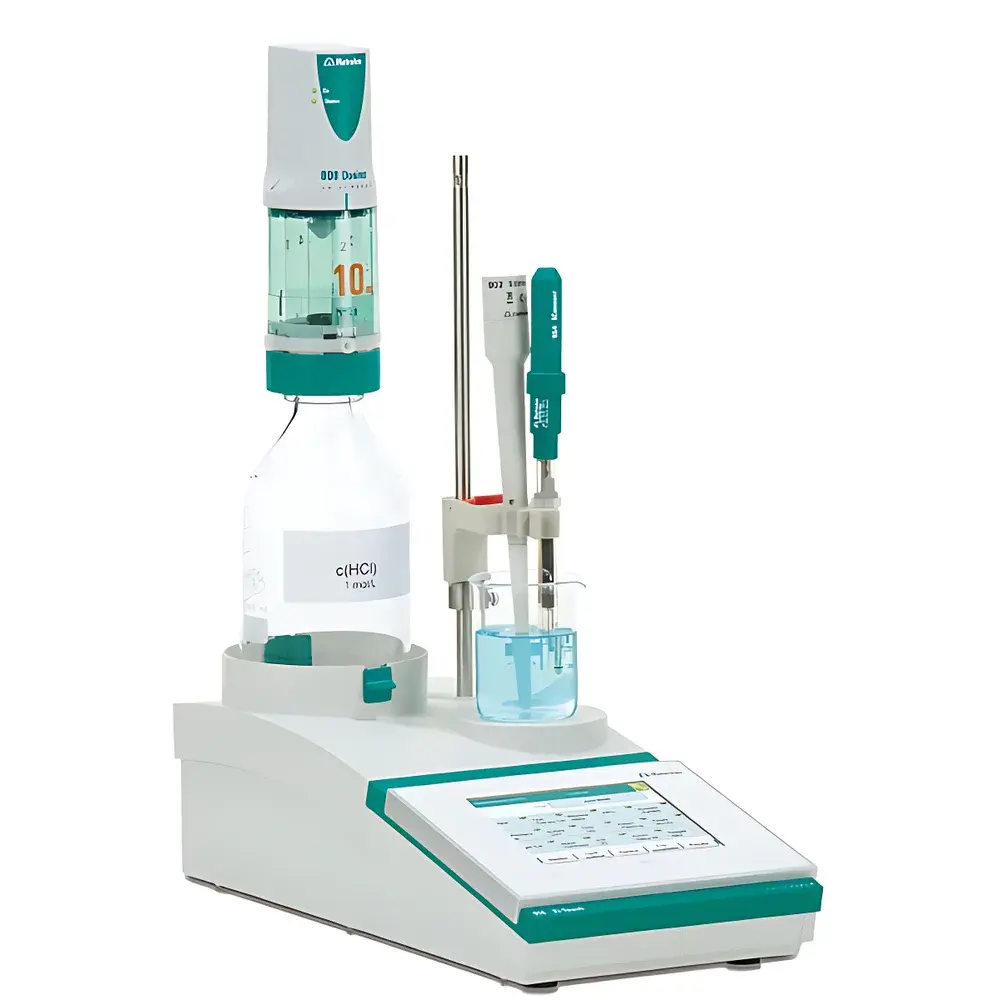
Metrohm 916 Ti-Touch Advanced Potentiometric Titrator
| Brand | Metrohm |
|---|---|
| Origin | Switzerland |
| Model | 916 Ti-Touch |
| Electrode Interfaces | 2 working electrode ports |
| Dosing Channels | 2 independent dosing units |
| Connectivity | Built-in Ethernet & LIMS interface (no PC required) |
| Report Output | Auto-generated PDF reports saved to USB drive |
| Sample Handling | Optional automated sample processor with interchangeable rotor trays (e.g., 12-, 24-, or 48-position) |
| Stirring Control | Adaptive speed adjustment based on sample viscosity |
| Dosing Technology | Dosino TMDosino™ multi-dose module — reagent cartridge replacement without disassembly or operator contact |
| Regulatory Compliance | Full GLP/GMP traceability |
Overview
The Metrohm 916 Ti-Touch is a fully integrated, standalone potentiometric titrator engineered for precision, reproducibility, and regulatory compliance in modern quality control and R&D laboratories. Operating on the fundamental principle of potentiometric endpoint detection—measuring the potential difference between a reference and indicator electrode as a function of titrant addition—the instrument delivers high-accuracy quantification of acid-base, redox, precipitation, and complexometric reactions. Its embedded Linux-based operating system and 7-inch capacitive touchscreen enable intuitive, glove-compatible operation without dependency on external computers. Designed for routine and method-critical applications, the 916 Ti-Touch meets the operational rigor demanded by pharmaceutical, chemical, food & beverage, and environmental testing laboratories under ISO/IEC 17025, USP <541>, and ASTM E2028 frameworks.
Key Features
- Touchscreen-driven workflow: 14 customizable shortcut icons on the home screen allow direct method launch—eliminating navigation delays and minimizing operator error.
- Dual-channel titration architecture: Two independent dosing units and two working electrode inputs support simultaneous or sequential multi-parameter titrations (e.g., pH and mV monitoring in Karl Fischer coulometric–volumetric hybrid workflows).
- Integrated connectivity: Native Ethernet port enables direct connection to laboratory networks and LIMS systems using standard TCP/IP protocols; supports HL7 and ASTM E1384 message formats for seamless data exchange.
- Dosino TMDosino™ technology: Pre-calibrated, sealed reagent cartridges are inserted without tools or exposure to reagents—ensuring operator safety, eliminating cross-contamination, and maintaining volumetric accuracy across >10,000 dosing cycles per cartridge.
- Adaptive magnetic stirring: Real-time torque sensing dynamically modulates stir bar rotation speed (range: 50–1200 rpm) to maintain homogeneous mixing across viscosities from water-like to >5000 mPa·s (e.g., polymer solutions or crude oil extracts).
- Onboard report generation: PDF analytical reports—including titration curves, equivalence point calculations, raw sensor data, metadata (user ID, timestamp, method version), and digital signatures—are generated in real time and stored directly onto connected USB mass storage devices.
Sample Compatibility & Compliance
The 916 Ti-Touch accommodates liquid, semi-solid, and heterogeneous samples via optional accessories including gas-tight cells, thermometric probes, and solid-sampling adapters. When paired with Metrohm’s 867 Autosampler or 877 Titrino Plus robotic platform, it supports unattended analysis of up to 48 samples per run under defined temperature and inert-atmosphere conditions. All data handling adheres to Good Laboratory Practice (GLP) and Good Manufacturing Practice (GMP) requirements: full audit trail logging (with immutable timestamps), role-based user authentication (admin/operator/auditor profiles), electronic signature capture per FDA 21 CFR Part 11 Subpart B, and encrypted database backups. System validation documentation—including IQ/OQ/PQ templates and risk assessments aligned with Annex 11—ships with the instrument.
Software & Data Management
No external software installation is required: all method development, calibration, sequence programming, and result evaluation occur natively within the Ti-Touch OS. Methods are stored as encrypted .MET files with version control and change history. Data export options include CSV (for statistical packages), XML (for LIMS ingestion), and PDF/A-1b (long-term archival format). Audit trails record every action—from electrode calibration to report finalization—with hash-verified integrity. Remote diagnostics and firmware updates are supported via secure HTTPS channels with certificate-based authentication.
Applications
- Pharmaceutical QC: Quantification of active pharmaceutical ingredients (APIs) per USP monographs; residual chloride in parenteral formulations; assay of excipients such as citric acid or sodium bicarbonate.
- Food & Agriculture: Total acidity in wines and juices (AOAC 942.05); salt content in dairy products (ISO 5725); peroxide value in edible oils (AOCS Cd 8-53).
- Chemical Industry: Alkalinity and acidity in catalyst slurries; free fatty acid determination in biodiesel (ASTM D664); sulfide concentration in wastewater effluents.
- Environmental Testing: Cyanide speciation in soil leachates (EPA Method 9010B); fluoride in drinking water (ISO 10359-1); hardness titration in surface water per APHA Standard Methods 2340 C.
FAQ
Does the 916 Ti-Touch require a PC for method development or data export?
No. All method creation, optimization, and report generation occur onboard. Data can be exported directly to USB drives or transmitted over Ethernet to network shares or LIMS.
Can the instrument validate electrode performance automatically?
Yes. It supports automatic electrode diagnostics—including impedance measurement, asymmetry potential checks, and response time verification—before and after each titration sequence.
Is the Dosino reagent module compatible with non-Metrohm titrants?
Only Metrohm-certified Dosino cartridges are supported to ensure volumetric accuracy, material compatibility, and regulatory traceability.
How is user access managed under 21 CFR Part 11?
Three-tiered roles (Admin, Operator, Auditor) enforce permission-based access; all electronic signatures are PKI-enabled and linked to validated identity credentials.
What sample volume ranges does the optional autosampler support?
The 867 Autosampler accepts vials from 10 mL to 100 mL capacity; custom trays accommodate micro-volume cells (1–5 mL) with integrated temperature control (±0.1 °C).






