
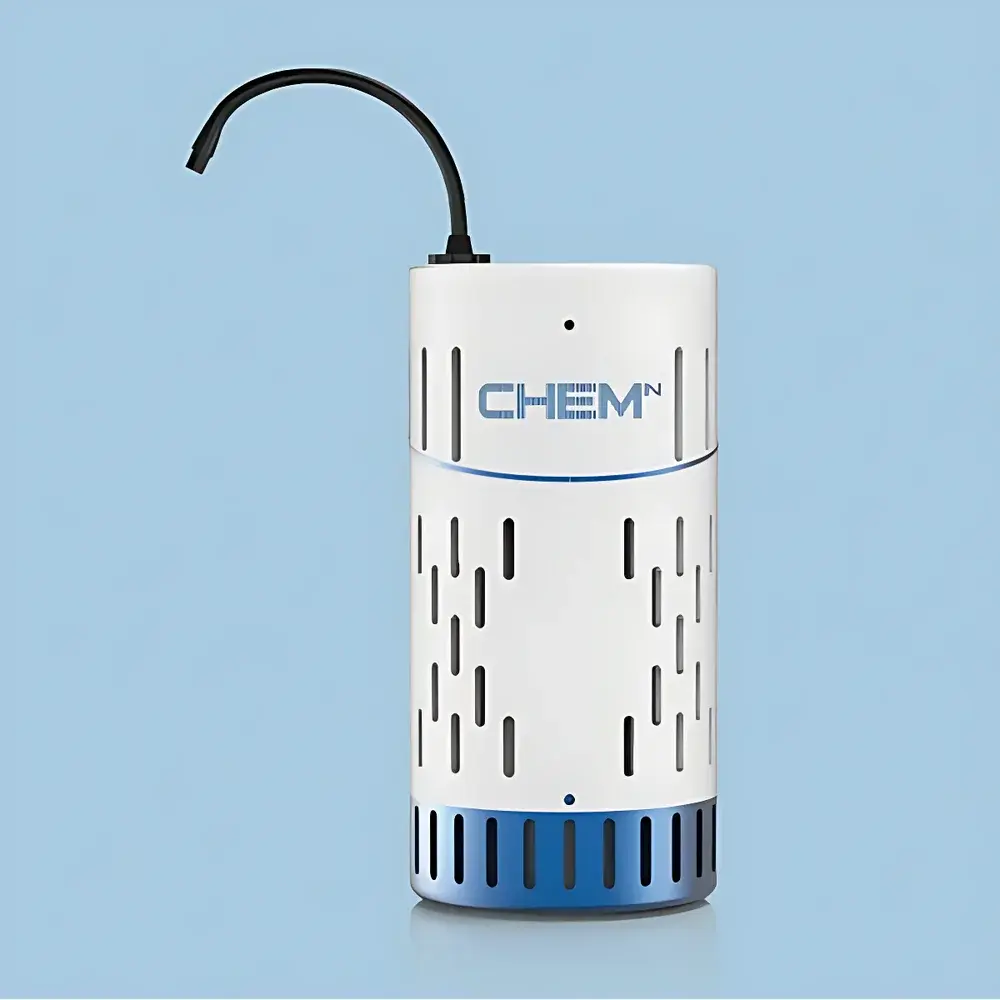
Chemn KL100 High-Intensity Tunable LED Light Source
| Brand | Chemn |
|---|---|
| Origin | Anhui, China |
| Manufacturer Type | Authorized Distributor |
| Country of Origin | China |
| Model | KL100 |
| Light Source Type | Monochromatic High-Power LED |
| Illumination Mode | External Irradiation |
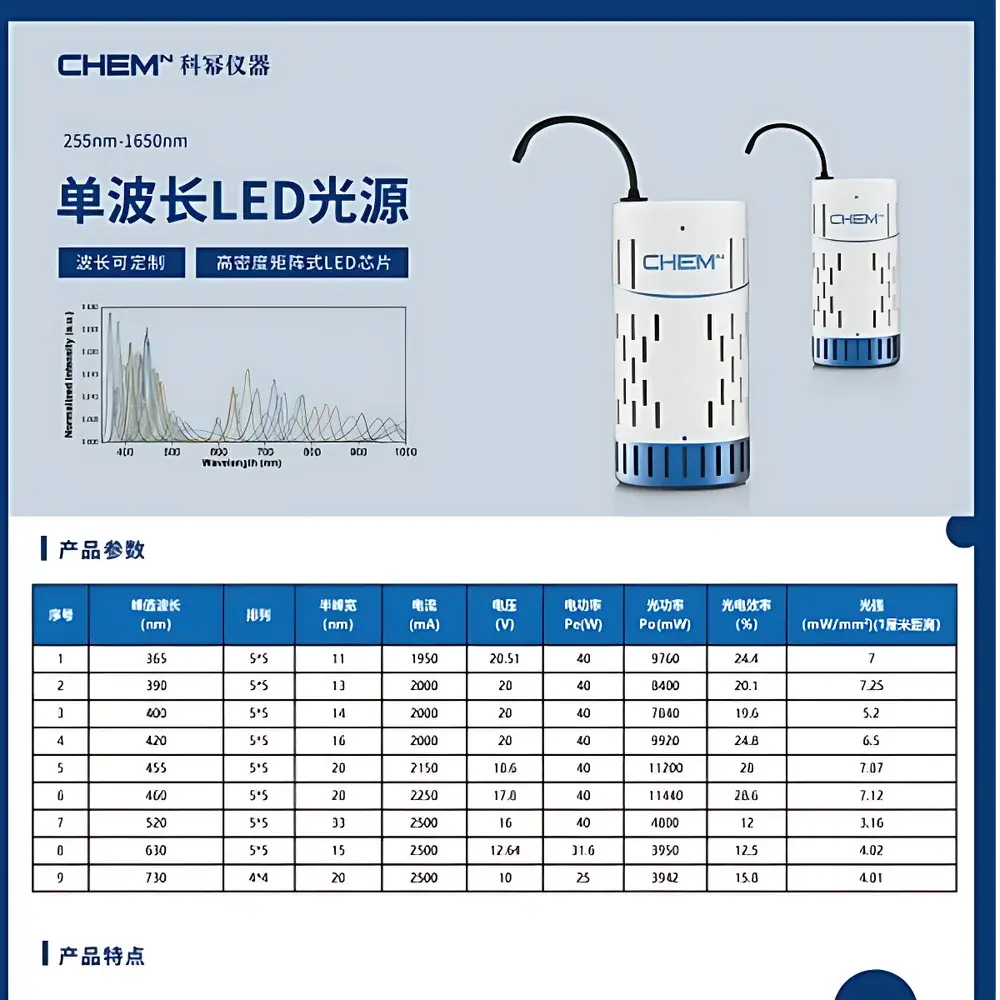
| Spectral Range | 255–1650 nm (customizable in 5 nm increments, excluding select wavelengths) |
| Wavelength Options (Standard) | 365, 390, 400, 420, 455, 460, 520, 630, 730 nm |
| Frequency Modulation Range | 0–100 kHz |
| Input Voltage | 220 V AC |
| Electrical Power Consumption | 40 W |
| Spectral Bandwidth (FWHM) | 16 nm @ 418 nm |
| Maximum Optical Output Power | 9920 mW |
| Irradiance | 675 mW/cm² @ 418 nm (measured at 1 cm distance) |
| Wall-Plug Efficiency | 24.8% @ 418 nm |
| Operating Temperature | 0–45 °C |
| Dimensions | Ø63 × 135 mm |
| Intensity Control | 9-step discrete adjustment |
| Display | Integrated LED screen |
| Optical Design | Custom reflector cavity and collimating optics optimized per spectral band |
Overview
The Chemn KL100 High-Intensity Tunable LED Light Source is an engineered optical irradiation system designed for quantitative photochemical experimentation in research laboratories. Unlike broadband arc lamps or filtered halogen sources, the KL100 employs monochromatic, high-power LED emitters with narrow spectral bandwidths (FWHM ≤ 16 nm), enabling precise wavelength selection without mechanical filters or monochromators. Its core architecture leverages high-density matrix-mounted LED chips coupled with application-specific reflector cavities and precision collimating optics—minimizing photon loss and maximizing directional irradiance uniformity across sample planes. The system operates on a stable 220 V AC input and delivers calibrated irradiance up to 675 mW/cm² at 418 nm (measured at 1 cm), with wall-plug efficiencies exceeding 24% in the visible range. This performance profile makes it particularly suitable for kinetic studies in heterogeneous photocatalysis, where reproducible photon flux control is essential for quantifying quantum yields, reaction order dependencies, and wavelength-resolved action spectra.
Key Features
- Monochromatic output with FWHM ≤ 16 nm at key emission peaks—ensuring minimal spectral crosstalk during wavelength-dependent experiments.
- Nine factory-calibrated standard wavelengths (365, 390, 400, 420, 455, 460, 520, 630, 730 nm) for immediate deployment in common photoredox and photocatalytic protocols.
- Custom spectral configuration available from 255 nm (UVC) to 1650 nm (NIR), in 5 nm increments—subject to LED availability and thermal management constraints.
- 9-step discrete intensity control enables systematic variation of photon flux while maintaining constant spectral composition—critical for establishing light-intensity–reaction-rate correlations.
- High-frequency pulse modulation (0–100 kHz) supports time-resolved photochemical studies, including transient absorption initiation and gated detection synchronization.
- Integrated LED display provides real-time feedback on selected wavelength, intensity level, and operational status—eliminating reliance on external controllers for basic operation.
- Compact cylindrical form factor (Ø63 × 135 mm) facilitates integration into gloveboxes, reactor manifolds, and custom optical benches without spatial compromise.
Sample Compatibility & Compliance
The KL100 is compatible with standard quartz and fused-silica cuvettes, immersion well reactors, and flat-bottomed photoreactor plates. Its external irradiation geometry permits flexible positioning relative to reaction vessels, enabling top-, side-, or oblique-angle illumination configurations. All optical components meet RoHS Directive 2011/65/EU requirements for hazardous substance restriction. While not certified to IEC 61000-4 electromagnetic compatibility standards as a standalone unit, the KL100 exhibits stable operation under typical laboratory electrical conditions when used with properly grounded outlets. For GLP-compliant workflows, users may log wavelength, intensity step, and duration manually or via optional RS232/USB interface (available upon request) to support audit-trail documentation per FDA 21 CFR Part 11 principles.
Software & Data Management
The base KL100 operates independently without proprietary software—relying on front-panel controls for full functionality. However, optional communication modules (RS232 or USB-C) enable remote command execution via ASCII protocol, supporting integration into LabVIEW, Python, or MATLAB-based automation frameworks. Supported commands include wavelength selection, intensity step adjustment, pulse frequency setting, and status interrogation. No cloud connectivity or vendor-hosted platforms are involved; all data acquisition and experiment logging remain under user control. Firmware updates are delivered as signed binary files with checksum verification—ensuring traceability and integrity in regulated environments.
Applications
- Quantitative photocatalytic degradation kinetics (e.g., methylene blue, phenol, or Cr(VI) reduction under controlled λ and Ephoton).
- Photoinduced C–C bond formation and asymmetric transformations in homogeneous photoredox catalysis.
- Wavelength-resolved action spectrum determination for semiconductor photocatalysts (e.g., TiO₂, g-C₃N₄, MOFs).
- Photobiological assays requiring defined UV-B or blue-light exposure (e.g., microbial inactivation, plant photomorphogenesis).
- Calibration reference source for spectroradiometers and photodiode-based irradiance meters within NIST-traceable lab settings.
FAQ
Is the KL100 suitable for UVC applications below 280 nm?
Yes—standard 255 nm and 275 nm options are available using AlGaN-based LEDs; however, output power and lifetime are reduced compared to visible/NIR variants. Quartz transmission windows and ozone-free operation must be verified for long-term use.
Can irradiance values be traced to national standards?
The KL100 is supplied with factory-measured irradiance data at 1 cm distance for each configured wavelength. Users may validate absolute irradiance using a NIST-calibrated spectroradiometer (e.g., Ocean Insight HDX or Bentham DMc series) prior to critical experiments.
What thermal management provisions exist for continuous operation?
The KL100 incorporates passive aluminum heat sinking and internal temperature monitoring. Sustained operation above 40 °C ambient requires forced-air cooling or duty-cycle limitation to maintain LED junction temperature below 85 °C—ensuring rated output stability over >10,000 hours.
Are optical alignment accessories included?
No alignment fixtures are bundled by default, but Chemn offers optional collimation tubes, adjustable mounting brackets, and fiber-coupling adapters (SMA 905) for specialized beam delivery configurations.
Does the KL100 comply with laser safety classifications?
It is classified as IEC 60825-1:2014 Class 1 for all standard wavelengths—no laser safety interlocks or warning labels are required under normal operating conditions.




