
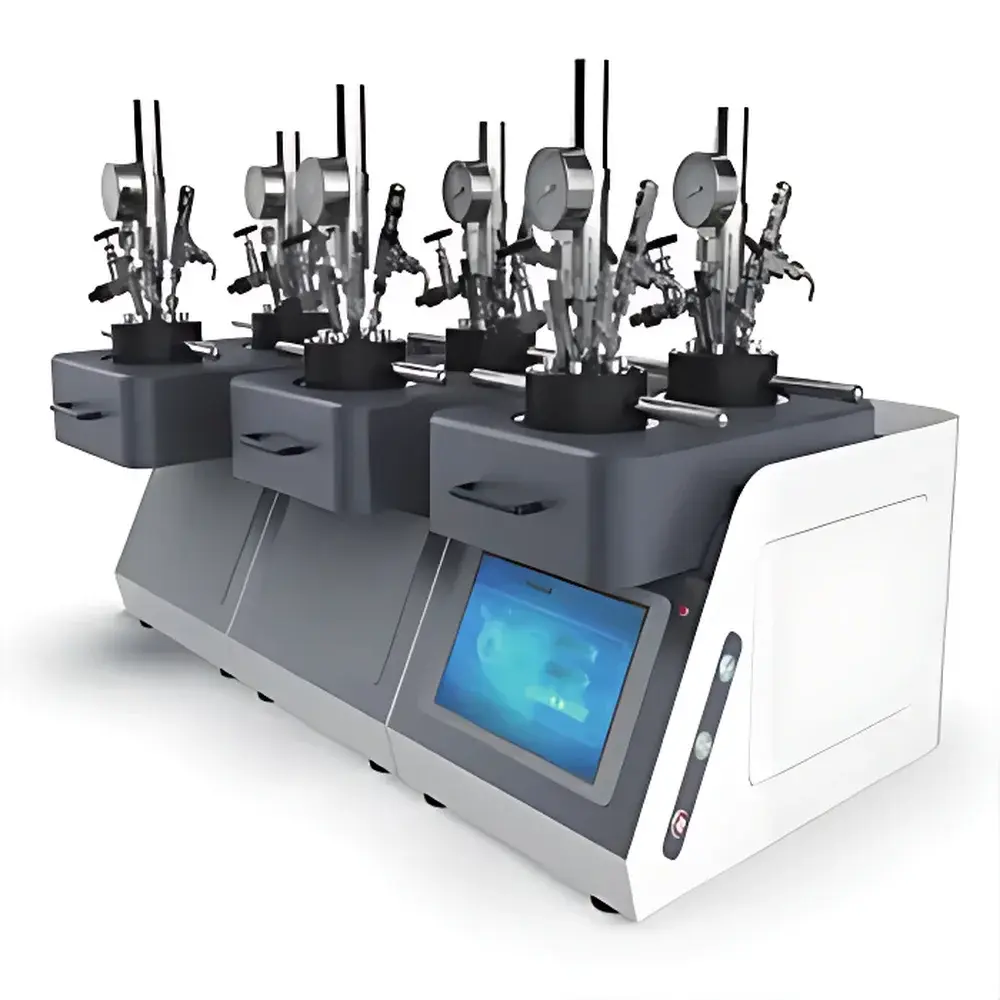
Ahkemi MSC100 Six-Station Parallel Intelligent Touchscreen Reactor System
| Brand | Ahkemi |
|---|---|
| Origin | Anhui, China |
| Model | MSC100 |
| Vessel Capacity Options | 25 mL, 50 mL, 100 mL |
| Construction Material | Stainless Steel (316L grade typical for high-pressure reactors) |
| Maximum Operating Pressure | 207 bar |
| Vacuum Capability | Up to 207 bar (gauge, indicating pressure-rated design, not vacuum level) |
| Control Interface | 10-inch capacitive touchscreen with real-time multi-parameter display |
| Independent Control | Six fully autonomous reaction stations |
| Data Export | USB port for CSV log export (temperature, stirring speed, internal pressure, time-stamped) |
| Safety Features | Overtemperature cutoff, overpressure audible alarm, integrated leak-tight sealing (tongue-and-groove flange with metal gasket) |
| Form Factor | Dual-row, three-column compact layout (fits standard fume hood footprint, ~600 × 450 × 400 mm H) |
| Compliance Context | Designed for GLP-compliant lab environments |
Overview
The Ahkemi MSC100 Six-Station Parallel Intelligent Touchscreen Reactor System is an engineered platform for high-throughput, parameter-controlled heterogeneous and homogeneous chemical synthesis under elevated pressure and temperature conditions. Based on the Couette-type stirred-tank reactor principle, each of the six independent vessels operates with precise control over thermal input (via integrated electric heating mantle), mechanical agitation (magnetic or mechanical drive, depending on configuration), and internal pressure monitoring—enabling rigorous kinetic studies, catalyst screening, and process intensification experiments. The system is designed for laboratory-scale reaction development where reproducibility across parallel runs is critical—particularly in pharmaceutical process R&D, fine chemical optimization, and academic catalysis research. Its rated pressure capacity of 207 bar (30,000 psi) positions it within the high-pressure reactor class, suitable for hydrogenation, hydroformylation, supercritical fluid reactions, and other gas-liquid-solid multiphase transformations.
Key Features
- Six fully isolated reaction stations with individual PID temperature control (range: ambient to 350 °C, depending on vessel specification), adjustable stirring speed (0–1200 rpm, calibrated feedback loop), and real-time pressure transduction (0–207 bar, ±0.5% FS accuracy)
- Monolithic stainless steel (316L) reactor body with CNC-machined tongue-and-groove sealing interface—eliminates weld seams and ensures consistent gasket compression and long-term leak integrity
- 10-inch industrial-grade capacitive touchscreen HMI with intuitive icon-driven navigation, multilingual UI support (English, German, Chinese), and contextual help overlays for operational guidance
- Integrated safety architecture: dual redundant temperature sensors, automatic power cutoff at user-defined thermal thresholds, and programmable pressure alarm with visual + audible alert (IEC 61000-4-2 compliant)
- Compact dual-row, three-column footprint (W600 × D450 × H400 mm) optimized for fume hood integration without compromising accessibility or thermal dissipation
- USB 2.0 host interface enabling direct export of timestamped .CSV files containing synchronized temperature, pressure, RPM, and elapsed time data—compatible with MATLAB, Python pandas, and LIMS ingestion protocols
Sample Compatibility & Compliance
The MSC100 accommodates a broad range of sample types—including slurries, viscous organometallic mixtures, solid-supported catalysts, and corrosive reagents—thanks to its electropolished 316L stainless steel wetted surfaces and optional Hastelloy C-276 liner kits. Each vessel is rated to ASME BPVC Section VIII Div. 1 standards for pressure containment, with full traceability documentation (material certs, hydrotest reports, NDE records) provided upon request. The system supports compliance workflows aligned with ISO/IEC 17025:2017 (for test labs), USP Analytical Instrument Qualification, and FDA 21 CFR Part 11 when operated with validated firmware (v3.2+) and controlled electronic records procedures. It is routinely deployed in GMP-adjacent environments for early-phase API route scouting and DOE-based reaction mapping.
Software & Data Management
The embedded controller runs a deterministic real-time OS (VxWorks-based) ensuring sub-second response latency for closed-loop control. Data acquisition occurs at 1 Hz default sampling (configurable up to 10 Hz), with onboard non-volatile memory retaining ≥72 hours of continuous logs. Exported CSV files include column headers compliant with ASTM E2500-17 metadata conventions (e.g., “Timestamp_UTC”, “Vessel_ID”, “T_Jacket_C”, “P_Internal_bar”, “RPM_Actual”). Optional PC software (Ahkemi ReactorLink v2.4) enables remote monitoring via Ethernet, batch comparison overlays, and automated report generation meeting GLP Annex 11 expectations—including electronic signatures, change audit trails, and role-based access control.
Applications
- Catalyst library screening under identical kinetic constraints (e.g., evaluating Pd/C vs. PtO₂ in asymmetric hydrogenation)
- Reaction condition space exploration via Design of Experiments (DoE)—simultaneous variation of T, P, [substrate], and residence time
- Thermal hazard assessment (e.g., ARC pre-screening) using adiabatic mode with dynamic power modulation
- High-pressure polymerization kinetics (e.g., ethylene copolymerization with metallocene catalysts)
- Supercritical CO₂-mediated extractions and impregnations requiring precise phase behavior control
- Electrocatalytic reaction studies when coupled with external potentiostat interfaces (via analog I/O expansion port)
FAQ
What pressure rating does “207 bar” refer to?
It indicates the maximum allowable working pressure (MAWP) of each reactor vessel at 20 °C, certified per ASME Section VIII Div. 1. Actual safe operating limits are derated at elevated temperatures per material stress-rupture curves.
Can the system operate in inert atmosphere mode?
Yes—each station features dedicated gas inlet/outlet ports with Swagelok SS-4 fittings, supporting purging sequences, controlled gas dosing (H₂, CO, NH₃), and blanketing with N₂ or Ar.
Is validation documentation available for GxP use?
Factory-installed IQ/OQ protocols (per ASTM E2500) and URS templates are supplied. PQ execution requires site-specific operational parameters and is supported by Ahkemi’s qualified field service engineers.
How is temperature uniformity ensured across all six vessels?
Each heating mantle incorporates dual-zone resistive elements with independent thermocouple feedback; inter-vessel thermal deviation is ≤±1.2 °C at 200 °C steady state (measured per ASTM E220).
Does the system support external automation integration?
Yes—Modbus TCP and RS-485 interfaces enable integration into centralized SCADA or LabVantage systems; digital I/O terminals allow triggering of external dosing pumps or quench valves.



