
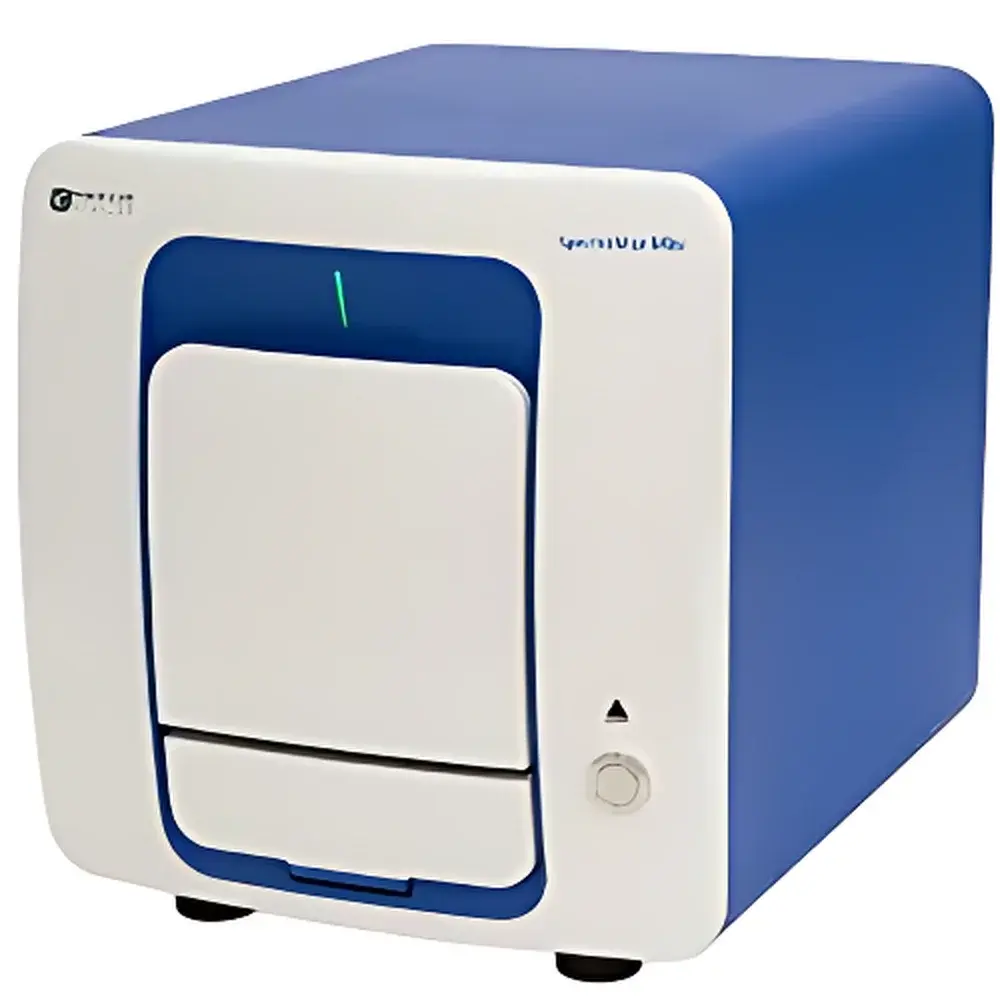
Molecular Devices SpectraMax Mini Multimode Microplate Reader
| Brand | Molecular Devices |
|---|---|
| Origin | Shanghai, China |
| Manufacturer Type | Authorized Distributor |
| Product Origin | Domestic (China) |
| Model | SpectraMax Mini |
| Detection Methods | Fluorescence Intensity, Absorbance, Luminescence |
| Functionality | Multimode |
| Automation Level | Fully Automated Microplate Reader |
| Assay Modes | Endpoint, Kinetic, Spectral Scan |
| Curve Fitting Options | Linear, 4-Parameter Logistic (4PL), 5-Parameter Logistic (5PL) |
| Detector | Thermoelectrically Cooled (–5°C) Photomultiplier Tube (PMT) and Photodiode |
| Wavelength Range | 200–1000 nm |
| Absorbance Range | 0–4 OD |
| Absorbance Linearity | ±2 nm |
| Wavelength Switching Speed | <1 second per wavelength |
| Absorbance Accuracy | <±0.003 OD ±1.0% (0–3 OD) |
Overview
The Molecular Devices SpectraMax Mini Multimode Microplate Reader is an engineered solution for laboratories requiring high-fidelity multimodal detection in a compact, cost-optimized platform. Based on dual-detector architecture—featuring a thermoelectrically cooled (–5°C) photomultiplier tube (PMT) for ultra-low-noise fluorescence and luminescence detection, and a precision photodiode for broad-spectrum absorbance measurements—the instrument delivers reproducible, quantitative data across three core modalities: absorbance (200–1000 nm), fluorescence intensity (FI), and luminescence (LUM). Its modular design supports field-upgradable functionality: users may begin with absorbance-only configuration and later activate fluorescence and/or luminescence modules via software license, preserving capital investment while aligning hardware capability with evolving experimental needs. The system is calibrated to meet ISO 17025 traceable standards for photometric accuracy and wavelength verification, ensuring compliance with GLP and internal quality control requirements.
Key Features
- Triple-detection modality support: absorbance (full spectral scan or fixed-wavelength), fluorescence intensity (filter-based excitation/emission), and luminescence—all accessible via intuitive touchscreen interface or PC control.
- High-precision optical path: monochromator-based wavelength selection with ±2 nm linearity tolerance and <1 s per-wavelength switching speed enables rapid spectral scanning and kinetic profiling.
- Thermoelectrically cooled (–5°C) PMT detector ensures low dark current and high signal-to-noise ratio, critical for low-abundance analyte quantification in cell-based assays and reporter gene studies.
- Integrated temperature control (ambient to 45°C, ±0.5°C stability) supports enzyme kinetics, cell viability, and real-time metabolic assays without external incubators.
- Compact footprint (28 × 42 × 24 cm) fits standard biosafety cabinets and benchtop workflows; CE-marked and compliant with IEC 61010-1 safety standards.
- Preconfigured assay templates in SoftMax Pro software—including ELISA, BCA/Bradford protein quantification, dsDNA/ssDNA analysis, MTT/XTT cell viability, and luciferase reporter assays—reduce method development time and operator dependency.
Sample Compatibility & Compliance
The SpectraMax Mini accommodates standard microplate formats from 6- to 384-well, including clear, white, black, and UV-transparent plates. Plate handling is fully automated via built-in plate positioning sensors and motorized stage alignment, minimizing positional variability across wells. All optical components are factory-aligned and verified against NIST-traceable reference standards. Data integrity is maintained through audit-trail-enabled SoftMax Pro software, supporting 21 CFR Part 11 compliance when deployed with appropriate IT infrastructure (e.g., user authentication, electronic signatures, and immutable log files). The instrument meets ISO 15197:2013 requirements for analytical performance of in vitro diagnostic devices and is validated per ASTM E2513-18 for microplate reader performance verification.
Software & Data Management
SoftMax Pro 7 software serves as the unified acquisition, analysis, and reporting engine. It provides real-time data visualization, automatic background subtraction, well-mapping tools, and batch processing for multi-plate experiments. Raw data export is supported in CSV, Excel (.xlsx), XML, and SDMX formats—compatible with LIMS integration and third-party statistical platforms (e.g., GraphPad Prism, R, Python pandas). The software includes embedded curve-fitting algorithms (linear, quadratic, 4PL, 5PL, sigmoidal dose-response) with residual plot diagnostics and goodness-of-fit metrics (R², AIC). For regulated environments, optional SoftMax Pro GxP Edition adds role-based access control, electronic signature workflows, and full audit trail generation meeting FDA and EMA expectations for analytical instrument qualification.
Applications
- Quantitative immunoassays (ELISA, CLIA) requiring high dynamic range and low inter-plate CV.
- Nucleic acid and protein quantification using UV-Vis absorbance at 260/280 nm or colorimetric methods (e.g., BCA, Lowry).
- Cell-based functional assays: ATP-dependent luminescence (CellTiter-Glo®), intracellular calcium flux (Fluo-4 AM), and oxidative stress markers (DCFDA).
- Enzyme kinetics under controlled temperature, including Michaelis-Menten parameter estimation and inhibitor screening.
- Reporter gene assays (luciferase, GFP) with dual-emission ratiometric normalization.
- High-content screening pre-validation where throughput and reproducibility outweigh ultra-high sensitivity requirements.
FAQ
Can the SpectraMax Mini be upgraded from 2-mode to 3-mode after purchase?
Yes—fluorescence and luminescence capabilities are enabled via software license activation, requiring no hardware modification.
Does it support kinetic measurements with temperature control?
Yes—temperature is stabilized to ±0.5°C across the entire plate surface during continuous read cycles up to 24 hours.
Is SoftMax Pro software included with the instrument?
Yes—SoftMax Pro 7 is bundled with full analysis and export features; GxP Edition requires separate validation package and licensing.
What wavelength calibration standards are used during factory verification?
Holmium oxide and didymium filters for wavelength accuracy; neutral density filters and NIST-traceable OD standards for photometric linearity and accuracy verification.
How is data security ensured during remote operation?
All network communication uses TLS 1.2 encryption; local data storage follows ISO/IEC 27001-aligned file permission policies and optional AES-256 disk encryption.




