
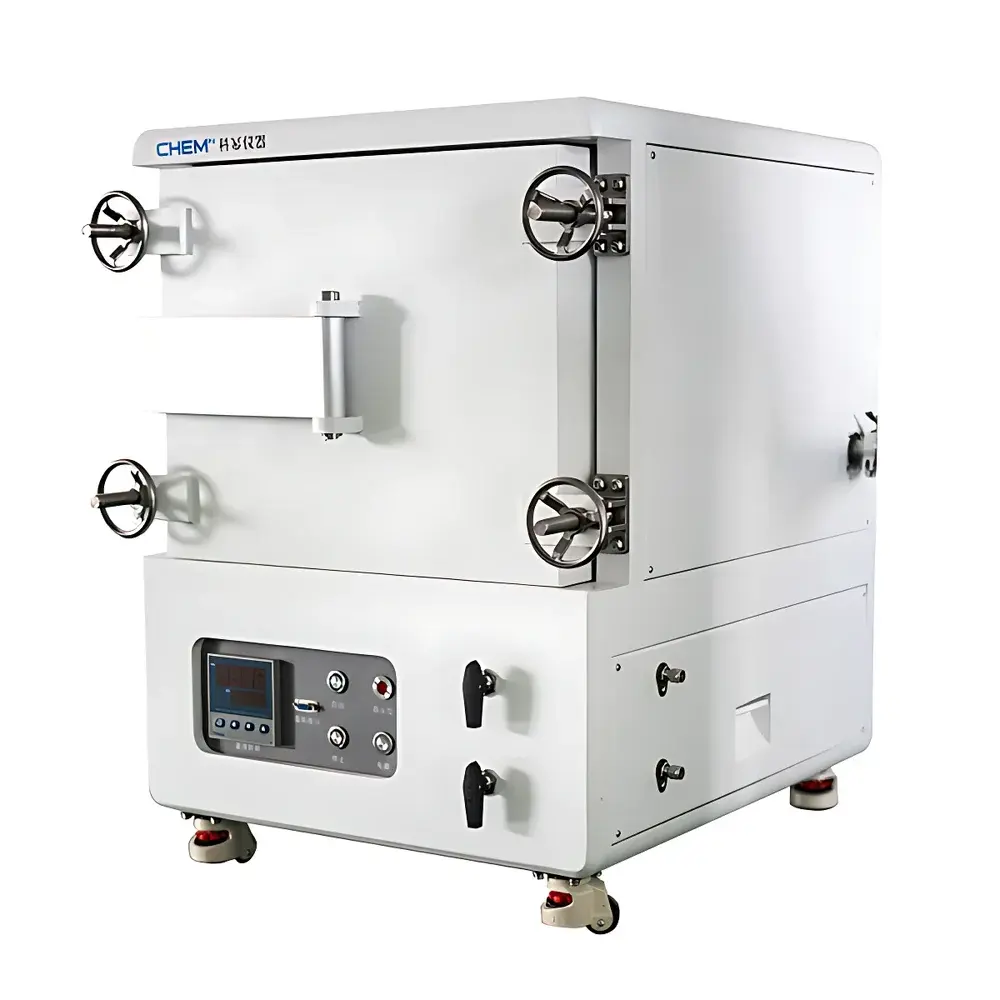
Ahkemi BFV-1200-7.2L Vacuum & Atmosphere-Compatible Box Furnace
| Brand | Ahkemi |
|---|---|
| Origin | Anhui, China |
| Model | BFV-1200-7.2L |
| Max Temperature | 1200 °C (short-term), 1150 °C (rated) |
| Control Accuracy | ±1 °C |
| Power Rating | 2.5 kW |
| Heating Rate | 20 °C/min (to max temp) |
| Chamber Dimensions | 200 × 300 × 120 mm (7.2 L nominal volume) |
| Vacuum Level | <1000 Pa |
| Heating Method | Resistive wire (3-sided: left, right, top) |
| Control System | Fuzzy PID with auto-tuning, 30-segment programmable ramp-soak profile |
| Safety Features | Over-temperature alarm, thermocouple break detection, emergency stop button |
| Input Power | AC 220 V, 50/60 Hz |
| External Dimensions | 450 × 500 × 610 mm |
| Net Weight | 80 kg |
Overview
The Ahkemi BFV-1200-7.2L is a compact, vacuum- and atmosphere-compatible box furnace engineered for precise thermal processing in research laboratories and quality control environments. Designed around a robust resistive heating architecture with three-sided (left, right, and top) heating element placement, it delivers exceptional temperature uniformity across its 7.2 L chamber—critical for reproducible sintering, annealing, calcination, and ashing protocols. Operating up to 1200 °C (short-term) and rated for continuous use at 1150 °C, the furnace integrates a high-stability K-type thermocouple feedback loop and digital fuzzy PID control with auto-tuning capability. Its sealed chamber supports both vacuum operation (≤1000 Pa) and controlled inert or reactive gas atmospheres via optional inlet/outlet ports—enabling oxidation-sensitive or reduction-based thermal treatments without cross-contamination.
Key Features
- Three-zone resistive heating configuration ensures radial and axial temperature homogeneity within ±3 °C across the full working volume at 1100 °C.
- Digital 30-segment programmable controller allows complex multi-step thermal profiles—including ramp, soak, and cooling sequences—with independent setpoint, rate, and dwell time parameters per segment.
- Real-time over-temperature protection with dual-level cutoff: primary limit at 1220 °C (hardware-based) and secondary software-triggered alarm at user-defined thresholds.
- Integrated thermocouple break detection halts heating and alerts operators immediately upon sensor failure, preventing uncontrolled thermal runaway.
- Ergonomic front-loading design with reinforced ceramic fiber insulation and double-layer stainless steel housing minimizes surface temperature rise (<60 °C at ambient) and improves energy efficiency.
- Emergency stop button compliant with IEC 60204-1 requirements is mounted on the front panel for immediate power disconnection under fault conditions.
Sample Compatibility & Compliance
The BFV-1200-7.2L accommodates crucibles and sample boats made of alumina, quartz, silicon carbide, or molybdenum—compatible with most non-volatile inorganic and ceramic precursors. Its chamber geometry (200 × 300 × 120 mm) permits standard ASTM E1111-compliant sample arrangements for thermal gravimetric intercomparison studies. The furnace meets CE marking requirements for electromagnetic compatibility (EN 61326-1) and low-voltage safety (EN 61000-6-3). While not certified for Class I Div 1 hazardous locations, it may be operated in ventilated fume hoods when processing volatile organics or reducing gases. Documentation includes factory calibration certificate traceable to NIM (National Institute of Metrology, China), supporting GLP-aligned recordkeeping.
Software & Data Management
The embedded controller logs temperature history at 1-second intervals during active runs and stores up to 10 complete thermal cycles internally. Data export is supported via RS485 interface (Modbus RTU protocol) for integration into LabVIEW, MATLAB, or custom SCADA systems. Optional PC software provides real-time graphing, CSV export, and password-protected user access levels—facilitating audit-ready data integrity per FDA 21 CFR Part 11 principles when paired with timestamped electronic signatures. All alarm events (e.g., over-temp, TC break, door open) are time-stamped and retained in non-volatile memory for post-run forensic review.
Applications
- Thermal treatment of battery cathode materials (e.g., LiCoO₂, NMC) under argon or nitrogen to prevent oxygen loss during lithiation.
- Controlled-atmosphere sintering of oxide ceramics (Al₂O₃, ZrO₂) where grain growth kinetics depend critically on partial pressure and dwell time.
- Pre-oxidation of metal foils prior to thin-film deposition, leveraging vacuum-outgas-and-purge cycles to minimize interfacial contamination.
- Residue analysis and LOI (Loss on Ignition) testing per ASTM C114 and ISO 6872 standards in cement and dental material labs.
- Heat treatment of catalyst supports (e.g., γ-Al₂O₃) under reducing H₂/N₂ mixtures to modulate surface acidity and metal dispersion.
FAQ
What vacuum level can the BFV-1200-7.2L achieve without auxiliary pumping?
The integrated vacuum valve and chamber seal support base pressures ≤1000 Pa using a standard two-stage rotary vane pump (not included). For pressures below 10 Pa, a diffusion or turbomolecular pump is required.
Is the furnace compatible with hydrogen atmosphere operation?
Yes—when equipped with appropriate gas fittings, leak-tested tubing, and an external hydrogen flow controller. Hydrogen service requires additional ventilation and explosion-proof area classification per local codes.
Can the 30-segment program be edited remotely?
Editing is performed locally via the front-panel keypad and encoder. Remote modification requires optional RS485-to-USB adapter and licensed configuration software.
Does the unit include a calibration certificate?
Yes—a factory-issued calibration report covering thermocouple linearity and controller accuracy at 300 °C, 600 °C, and 900 °C is supplied with each unit.
What maintenance is recommended for long-term reliability?
Biannual inspection of heating element continuity, door gasket compression force, and insulation integrity is advised. Ceramic fiber modules should be replaced after ~2000 cumulative hours above 1000 °C.



