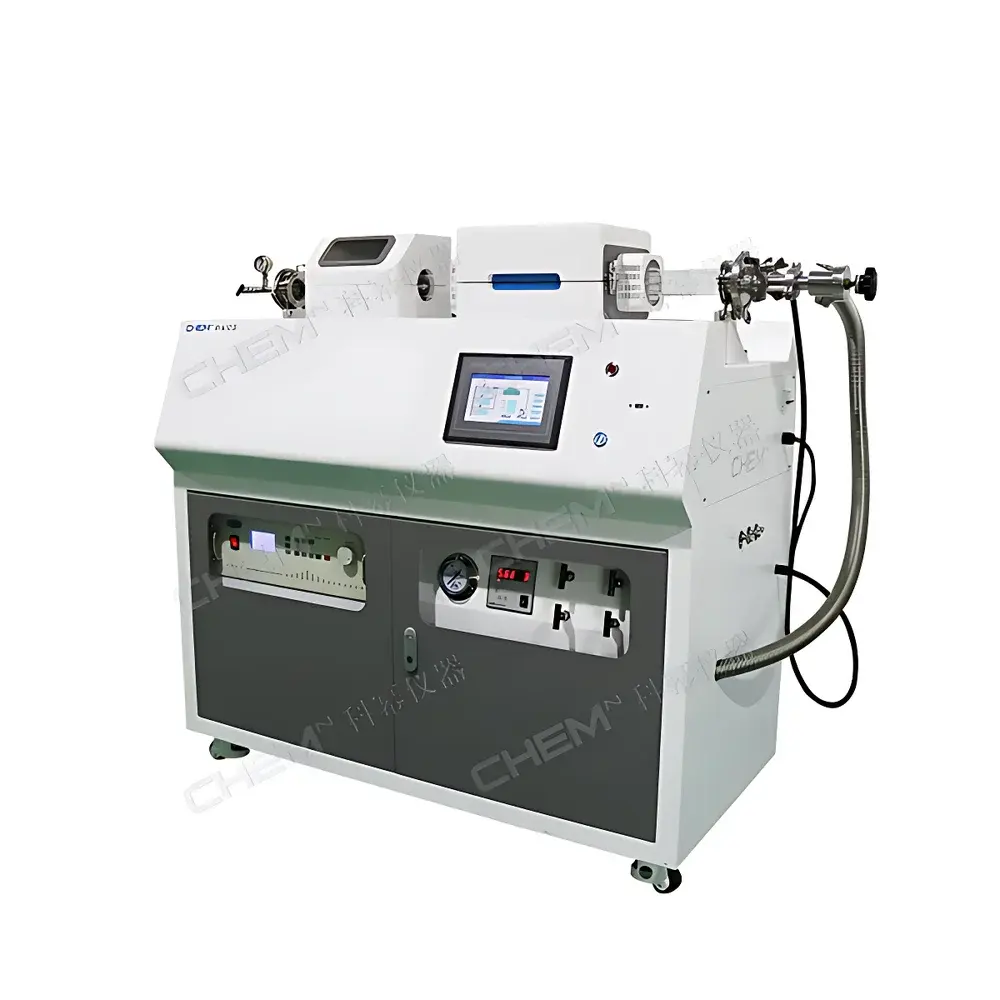
Ahkemi TFE-1200-50-I-220 Single-Zone Plasma-Enhanced Chemical Vapor Deposition System
| Brand | Ahkemi |
|---|---|
| Origin | Anhui, China |
| Model | TFE-1200-50-I-220 |
| Maximum Operating Temperature | 1150 °C (short-term), 1100 °C (rated) |
| Temperature Control Accuracy | ±1 °C |
| Heating Zone Length | 220 mm |
| Uniform Temperature Zone Length | 80 mm |
| Tube Dimensions | Φ30/50/60 × 1200 mm |
| Furnace Chamber Diameter × Height | Φ80 × 220 mm |
| RF Power Range | 5–500 W |
| RF Frequency | 13.56 MHz |
| Gas Delivery | 3-channel MFC-controlled (0–500 sccm per channel, customizable) |
| Vacuum System | Dual-stage rotary vane pump (optional diffusion or turbomolecular pump upgrade) |
| Rated Heating Power | 3 kW |
| Recommended Ramp Rate | ≤10 °C/min |
| External Dimensions | 1250 × 510 × 810 mm |
Overview
The Ahkemi TFE-1200-50-I-220 is a single-zone plasma-enhanced chemical vapor deposition (PE-CVD) system engineered for controlled, low-temperature thin-film synthesis in semiconductor and advanced display R&D environments. Unlike conventional thermal CVD systems, this instrument leverages 13.56 MHz radiofrequency (RF) plasma excitation to dissociate precursor gases at significantly reduced substrate temperatures—enabling high-quality film growth on temperature-sensitive substrates such as flexible polymer films or pre-patterned TFT backplanes. The system integrates a precisely regulated resistive heating furnace with a coaxial quartz tube configuration, where the plasma generation region overlaps fully with the heated zone via a sliding-rail mechanical design. This ensures uniform plasma exposure across the entire sample length during deposition, minimizing axial process gradients and enhancing reproducibility. Designed for laboratory-scale process development, the TFE-1200-50-I-220 supports rapid thermal cycling (≤10 °C/min ramp rate, with fast cool-down enabled by forced-air assist), facilitating iterative parameter screening for SiNx, SiOx, a-Si:H, and other functional dielectric or passivation layers used in OLED, microLED, and active-matrix display fabrication.
Key Features
- Stable, auto-matched 13.56 MHz RF plasma source (5–500 W adjustable output) with real-time impedance compensation for consistent plasma ignition and sustained glow discharge.
- Sliding-rail reaction chamber assembly ensuring full-length overlap between the plasma generation zone and the 220 mm heating zone—critical for uniform film thickness and stoichiometry across extended substrates.
- Precision temperature control architecture with ±1 °C stability over an 80 mm uniform zone; rated for continuous operation up to 1100 °C and short-term excursions to 1150 °C.
- Triple-gas mass flow control system (MFCs, 0–500 sccm each) with digital setpoint interface, supporting independent regulation of precursors, carrier, and reactive gases (e.g., NH3, SiH4, N2, Ar).
- Modular vacuum architecture: standard dual-stage rotary vane pump (base pressure ≤5×10⁻² Pa); optional upgrades to oil-free turbomolecular or diffusion pumping for sub-10−4 Pa base pressures required for ultra-low contamination processes.
- Robust mechanical construction with air-cooled RF feedthroughs, water-jacketed electrode mounting, and interlocked safety circuitry compliant with IEC 61000-6-2/6-4 electromagnetic compatibility standards.
Sample Compatibility & Compliance
The TFE-1200-50-I-220 accommodates standard quartz tubes with inner diameters of Φ30 mm, Φ50 mm, or Φ60 mm and a maximum usable length of 1200 mm—supporting wafer-level substrates (up to 6″), glass carriers (e.g., 370×470 mm Gen 2 display panels), or custom fixtures. Its low-thermal-budget operation aligns with industry requirements for stress-sensitive thin-film transistor (TFT) backplanes and encapsulation layers in next-generation displays. The system meets general-purpose laboratory safety standards (CE marking, UL-listed components) and supports integration into GLP-compliant workflows through configurable data logging and audit-trail-capable software (see Software & Data Management). While not certified to ISO 14644 cleanroom classes, its sealed gas delivery and vacuum pathways minimize particulate ingress—making it suitable for Class 1000–10,000 cleanroom installations when coupled with appropriate facility filtration.
Software & Data Management
The system operates via a dedicated industrial touchscreen HMI with embedded PLC-based motion and thermal control logic. All process parameters—including RF power, gas flow rates, chamber pressure, thermocouple readings, and stage position—are logged at user-defined intervals (1–60 s resolution) to internal non-volatile memory and exportable CSV files. Optional PC-based software (Ahkemi CVD-Studio v3.x) provides remote monitoring, recipe management, real-time plasma emission intensity tracking (via optional optical port), and automated compliance reporting aligned with FDA 21 CFR Part 11 requirements—including electronic signatures, change history, and user-access-level permissions. Raw data archives are timestamped and checksum-verified to ensure integrity for regulatory submissions or internal QA audits.
Applications
- Low-temperature deposition of silicon nitride (SiNx) and silicon oxynitride (SiOxNy) passivation layers for AMOLED TFT arrays.
- Growth of hydrogenated amorphous silicon (a-Si:H) for photovoltaic test structures and thin-film solar cell research.
- Plasma-assisted synthesis of carbon-based barrier films (e.g., SiCx, DLC) on flexible PET or PI substrates.
- Process development of ALD-compatible seed layers and nucleation promoters under sub-300 °C conditions.
- Investigation of plasma-surface interaction kinetics using in situ optical emission spectroscopy (OES) add-on modules.
FAQ
What vacuum level can the base configuration achieve?
With the standard dual-stage rotary vane pump, the system reaches a base pressure of ≤5×10⁻² Pa. Upgrades to turbomolecular or diffusion pumps enable base pressures down to 10−4–10−5 Pa, depending on bake-out protocol and leak integrity.
Is the RF matching network fully automatic?
Yes—the integrated matching network continuously monitors forward/reflected power and adjusts capacitive tuning in real time to maintain >95% power transfer efficiency across the full 5–500 W range.
Can the furnace accommodate multiple tube sizes without hardware modification?
The support frame accepts interchangeable quartz tubes (Φ30/50/60 mm ID) via standardized flange mounts; no recalibration or alignment tools are required when switching diameters.
Does the system support reactive gas chemistries such as O2 or Cl2?
Yes—provided compatible MFCs and stainless-steel gas lines are specified; fluorinated or highly corrosive precursors require optional Hastelloy wetted parts and specialized exhaust scrubbing.
What documentation is provided for IQ/OQ validation?
Factory acceptance test (FAT) reports, calibration certificates for all sensors (thermocouples, pressure gauges, MFCs), and a complete traceable component bill of materials are included. Custom IQ/OQ protocols can be developed in collaboration with Ahkemi’s applications engineering team.