
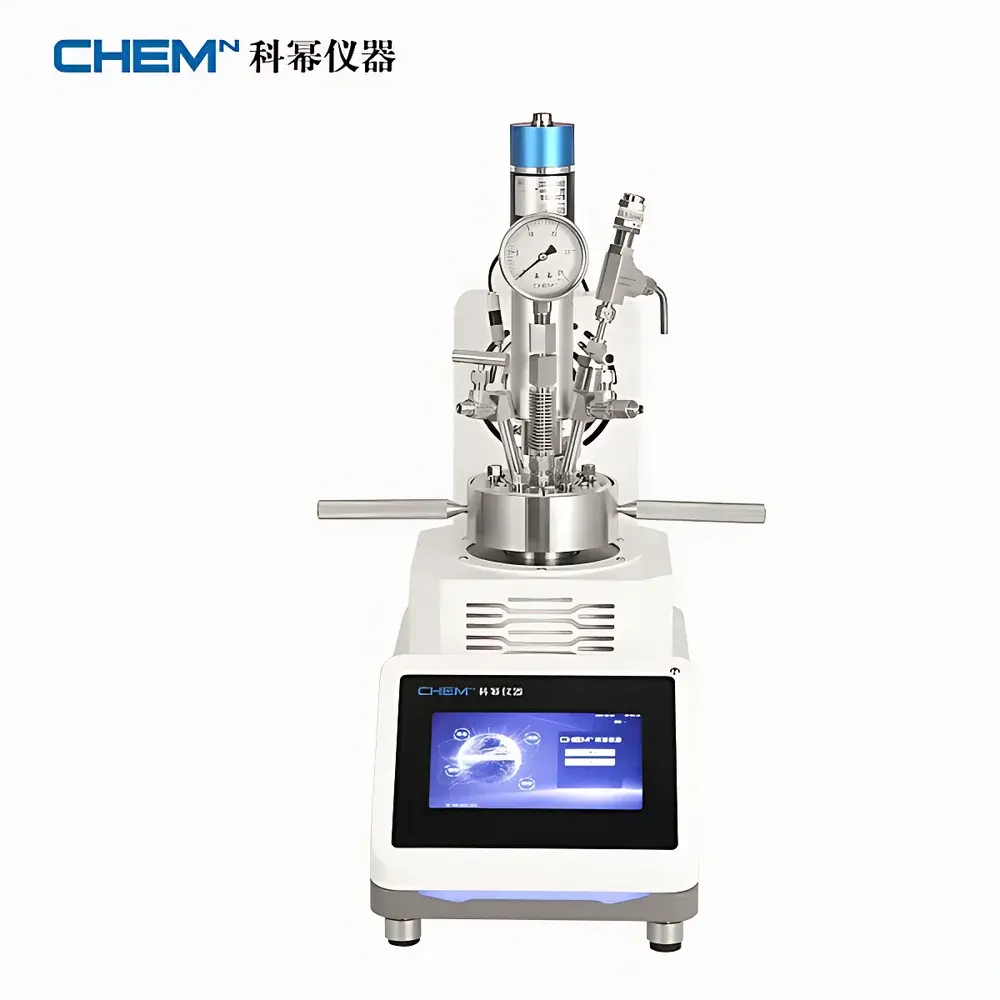
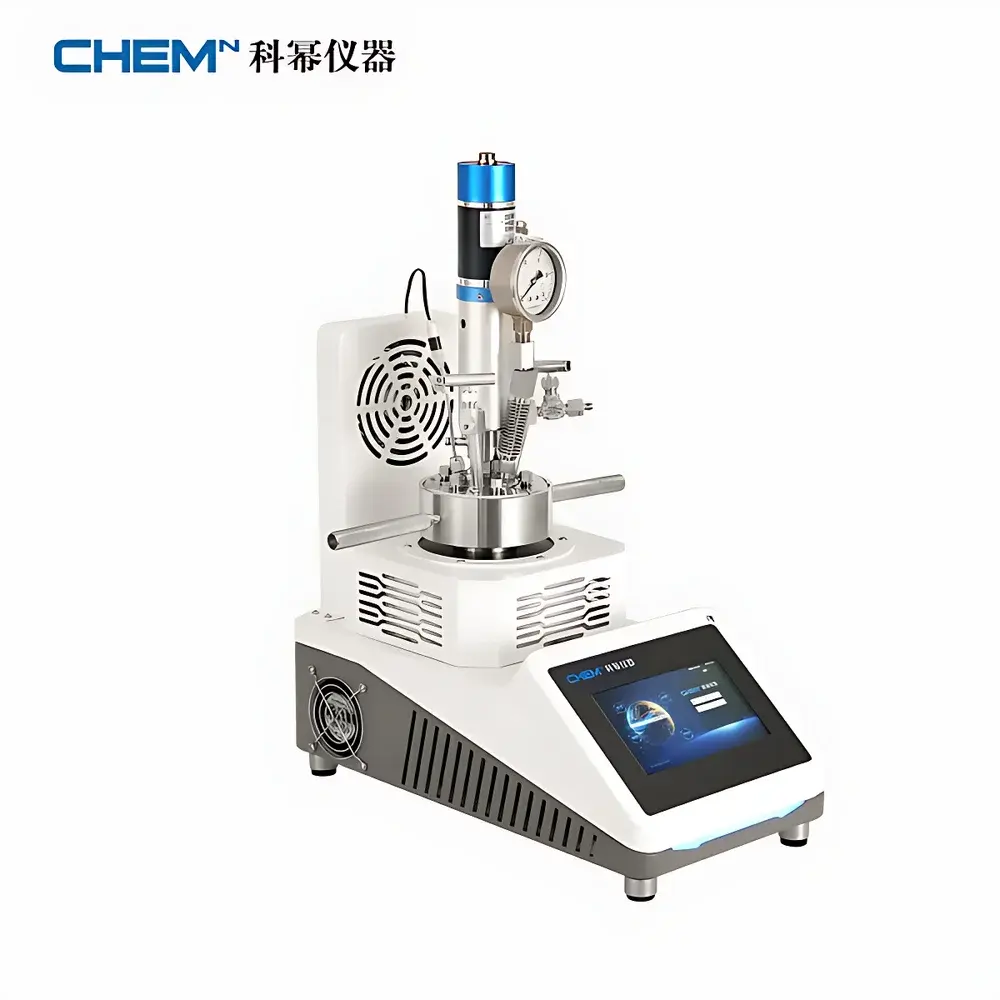
Ahkemi MSP Remote-Enabled Intelligent Miniature Mechanical Stirred Reactor
| Brand | Ahkemi |
|---|---|
| Origin | Anhui, China |
| Model | MSP |
| Reactor Volume Options | 25 mL, 50 mL, 100 mL, 300 mL, 500 mL, 1000 mL |
| Construction Material | Stainless Steel (316L standard) |
| Maximum Operating Pressure | 345 bar (5000 psi) |
| Sealing System | Dual-seal configuration — reinforced PTFE gaskets ≤300 °C |
| Vacuum Capability | Up to −0.098 MPa (equivalent to ~20 mbar abs) |
| Heating Method | Integrated steel-sheathed resistive furnace with overheat protection |
| Control Architecture | Siemens S7-1200 PLC + Schneider safety relays |
| Temperature Control Precision | ±1 °C (typical, full range) |
| Stirring Drive | Patented high-torque magnetic coupling, fully static seal |
| Compliance | Designed per ISO 4775, ASME BPVC Section VIII Div. 1 (for rated pressure variants), CE-marked for laboratory equipment |
Overview
The Ahkemi MSP Remote-Enabled Intelligent Miniature Mechanical Stirred Reactor is a fully integrated benchtop synthesis platform engineered for precision-controlled high-pressure, high-temperature chemical reactions under inert or reactive atmospheres. Based on Couette-type mechanical stirring within a statically sealed vessel and combined with resistive steel-sheath heating, the system delivers reproducible thermal profiles and homogeneous mixing across small-volume reaction matrices (25–1000 mL). Its core architecture eliminates dynamic shaft seals—relying instead on a proprietary high-torque magnetic drive that maintains hermetic integrity up to 345 bar—thereby eliminating leakage pathways common in conventional stirred autoclaves. The reactor is designed for unattended operation in regulated R&D environments, supporting GLP-compliant data traceability and remote supervision via secure IoT protocols.
Key Features
- Fully static magnetic drive system with torque-rated coupling, enabling continuous agitation at up to 1200 rpm under full pressure without seal wear or maintenance.
- Quick-release dual-clamp closure with machined tongue-and-groove flange interface; no welding in primary pressure boundary—ensures structural homogeneity and fatigue resistance.
- Multi-tier sealing strategy: enhanced virgin PTFE gaskets rated to 300 °C; flexible graphite gaskets for extended high-temperature service (>300 °C).
- Industrial-grade temperature control using adaptive PID algorithm with feedforward compensation—achieves ramp rates up to 15 °C/min while suppressing thermal overshoot (“fly-up”).
- Integrated furnace with steel-sheath heating element and redundant thermal cutoffs—prevents dry-firing and ensures fail-safe shutdown during coolant loss or sensor fault.
- Real-time dual-parameter monitoring: simultaneous acquisition of temperature (±0.5 °C accuracy, Pt100 Class A), pressure (±0.5% FS, piezoresistive transducer), and stir speed (Hall-effect feedback).
Sample Compatibility & Compliance
The MSP reactor accommodates heterogeneous catalytic systems, polymerization slurries, hydrogenation mixtures, and supercritical fluid media. Vessels are constructed from ASTM A240 Grade 316L stainless steel with passivated interior surfaces (per ASTM A967). All pressure-retaining components comply with ASME Boiler and Pressure Vessel Code Section VIII Division 1 design criteria for miniature reactors. Electrical architecture conforms to IEC 61000-6-2/6-4 EMC standards and carries CE marking for laboratory use. Data logging meets FDA 21 CFR Part 11 requirements when configured with audit-trail-enabled firmware (optional), including user authentication, electronic signatures, and immutable record export via USB mass storage.
Software & Data Management
The embedded control interface supports three operational modes: single-setpoint auto-start, multi-segment programmable ramping, and manual override. All process variables—including temperature, pressure, stir speed, and elapsed time—are timestamped at 1-second intervals and stored onboard (≥30 days of continuous logging). Historical datasets export in CSV format via USB port for post-processing in MATLAB, Python, or LIMS platforms. Optional cloud-connected firmware enables TLS-secured remote access through iOS/Android mobile applications or web-based dashboards. Remote functions include real-time parameter adjustment, alarm acknowledgment, emergency power cut-off, and synchronized multi-reactor fleet management.
Applications
- Catalyst screening under elevated H₂ or CO partial pressures (e.g., Fischer–Tropsch, hydrodeoxygenation).
- Kinetic studies of exothermic nitration or oxidation reactions requiring precise thermal management.
- Continuous-flow precursor synthesis for MOF and perovskite material development.
- High-pressure enzymatic transformations in non-aqueous media.
- Accelerated aging tests for battery electrolyte formulations under controlled thermal–mechanical stress.
FAQ
What pressure and temperature ranges are certified for routine operation?
Standard configuration supports continuous operation up to 345 bar and 350 °C; optional quartz-viewing windows limit max temperature to 250 °C.
Is the system compatible with corrosive reagents such as HF or fuming HNO₃?
Standard 316L construction is not recommended for halogenated acids; Hastelloy C-276 lining or custom alloy vessels are available upon request.
How is data integrity ensured during long-duration无人值守 runs?
Onboard non-volatile memory retains all sensor data even during power loss; checksum validation prevents file corruption during USB export.
Can multiple MSP reactors be synchronized in a single control network?
Yes—via Modbus TCP or OPC UA integration, enabling coordinated temperature/pressure ramps and cross-reactor event triggering.
Does the remote access feature support role-based permissions?
Yes—administrator, operator, and viewer roles can be assigned with configurable access scopes (e.g., parameter editing disabled for junior staff).



