
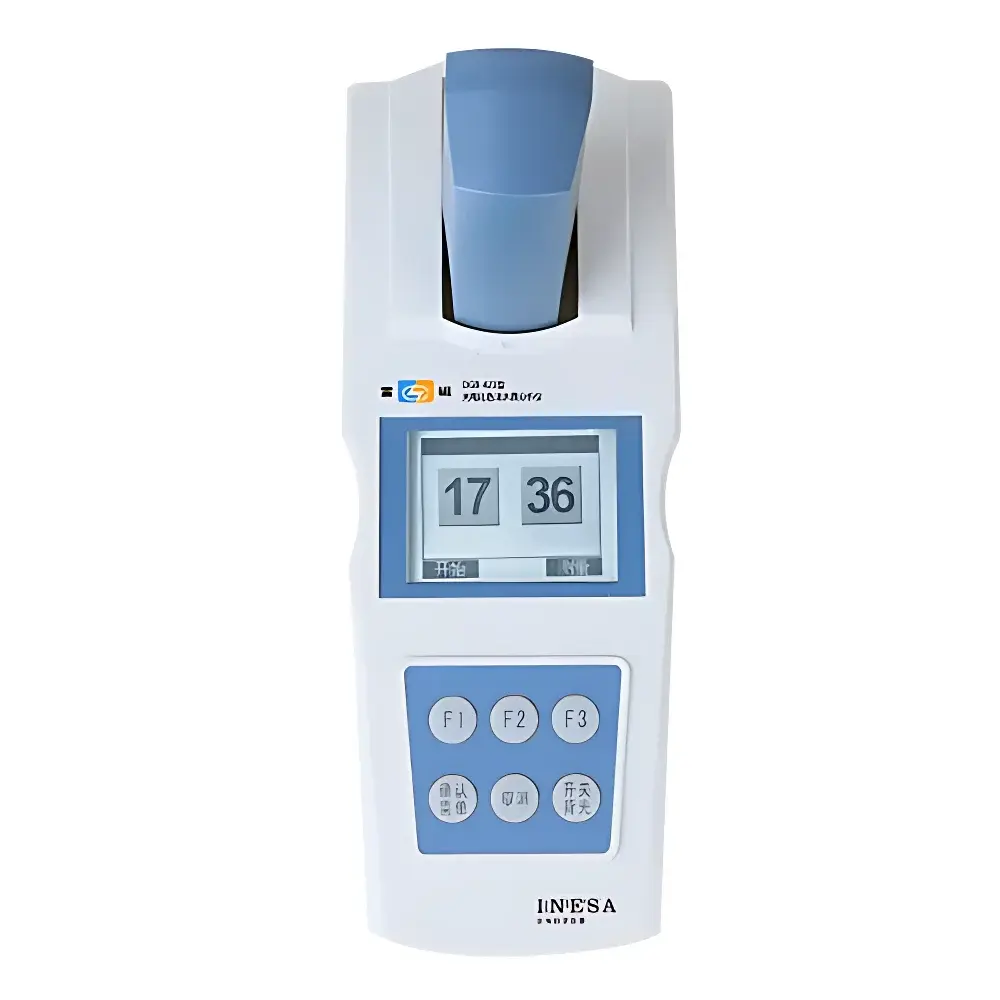
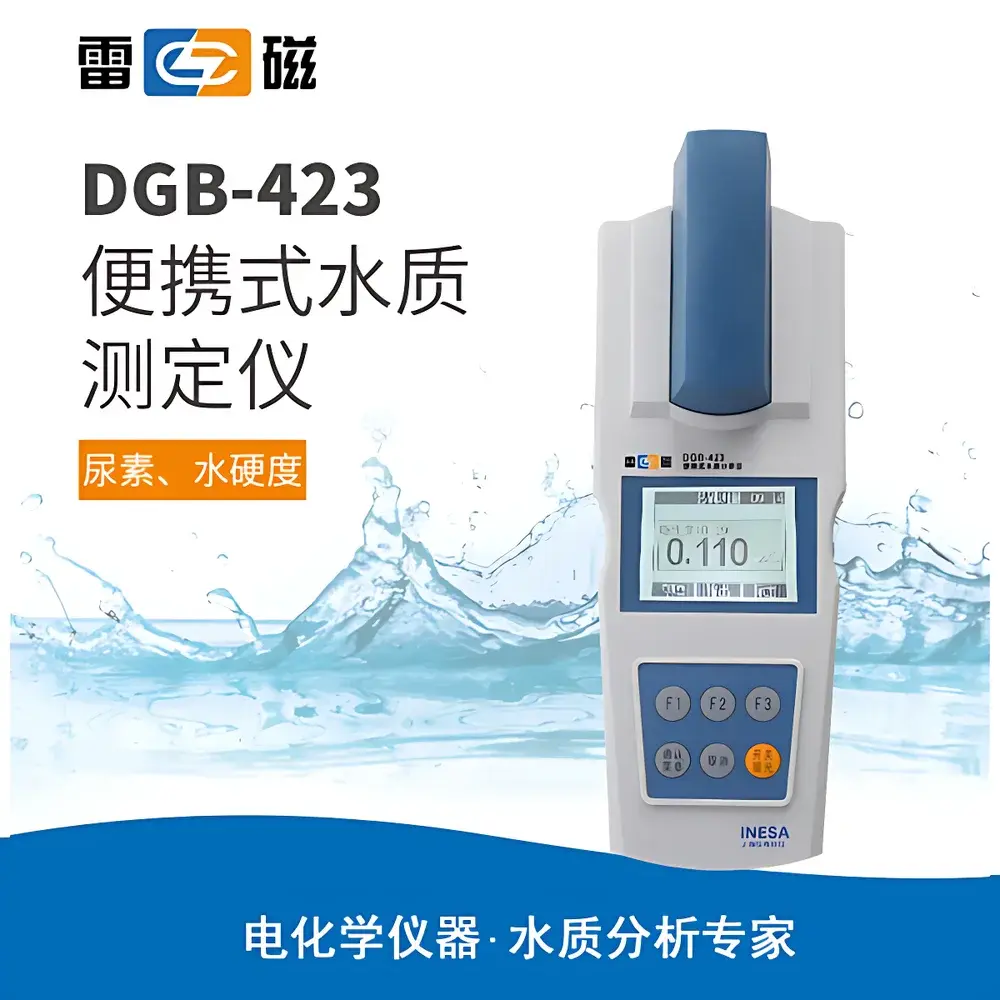
Leici DGB-423 Portable Water Quality Analyzer
| Brand | Leici |
|---|---|
| Origin | Shanghai, China |
| Manufacturer Type | Manufacturer |
| Country of Origin | China |
| Model | DGB-423 |
| Instrument Type | Portable / Handheld Water Quality Analyzer |
| Measured Parameter | Ammonia-Nitrogen (NH₃-N) |
| Measurement Method | Nesslerization |
| Light Source | 420 nm LED |
| Range | 0.000–4.000 mg/L NH₃-N |
| Accuracy | ±10% of reading |
| Repeatability | ≤3% RSD |
| Sample Vessel | 16 mm OD × 100 mm glass cuvette (10 mL capacity) |
| Dimensions | 220 × 85 × 50 mm |
| Weight | ~0.4 kg |
| Operating Environment | 5–35 °C, 0–85% RH |
| Power Supply | 4 × AA alkaline batteries or USB 5 V DC |
| Display | Backlit LCD with adjustable contrast and backlight timeout |
| Protection Rating | IP65 |
| Data Management | GLP-compliant storage, review, deletion, and print export via USB |
| Calibration | Up to 5-point user-defined calibration |
| Firmware Upgradeable | Yes |
Overview
The Leici DGB-423 Portable Water Quality Analyzer is a field-deployable photometric instrument engineered for rapid, on-site quantification of ammonia-nitrogen (NH₃-N) in diverse aqueous matrices. It operates on the principle of Nesslerization — a standardized colorimetric method in which ammonia reacts with Nessler’s reagent under controlled alkaline conditions to form a yellow-brown colloidal complex. Absorbance of this complex is measured at 420 nm using a high-stability, narrow-bandwidth LED light source, eliminating reliance on traditional tungsten-halogen lamps or external monochromators. The analyzer integrates factory-calibrated absorbance-to-concentration conversion curves directly into firmware, enabling immediate concentration readout without manual calculation. Designed for regulatory compliance and operational robustness, the DGB-423 meets fundamental requirements for field screening in environmental monitoring, wastewater treatment oversight, drinking water safety verification, and recreational water quality assurance per ISO 7150-1, EPA Method 350.1, and GB/T 5750.5–2023.
Key Features
- LED-based photometry at 420 nm ensures long-term optical stability, minimal drift, and reduced power consumption versus conventional lamp sources
- Integrated Nessler reagent-compatible workflow: direct measurement using standard 16 mm OD × 100 mm glass cuvettes (10 mL volume), eliminating transfer errors and contamination risk
- IP65-rated enclosure provides dust-tight and low-pressure water jet resistance — suitable for outdoor deployment in rain, humidity, or dusty environments
- Backlit LCD display with user-adjustable contrast and programmable backlight duration enhances readability across lighting conditions
- Automatic endpoint detection and value locking reduce operator variability and improve measurement consistency
- Up to five-point calibration support enables traceable accuracy adjustment across extended dynamic ranges or matrix-specific conditions
- Dual-power operation: 4 × AA alkaline batteries (typical >1000 measurements per set) or continuous USB 5 V DC supply for lab or vehicle use
- Firmware upgradability via USB allows future expansion to additional parameters (e.g., total phosphorus, residual chlorine, COD via MnO₄⁻ reduction) without hardware modification
Sample Compatibility & Compliance
The DGB-423 is validated for use with raw and treated waters including surface water, municipal and industrial wastewater, reclaimed water for landscape irrigation, potable water, swimming pool water, and hospital effluent. Its Nesslerization-based chemistry is compatible with samples containing low turbidity (<5 NTU) and moderate levels of interfering ions (e.g., Ca²⁺, Mg²⁺, Fe²⁺), provided pretreatment (e.g., filtration, masking agents) is applied per standard practice. The instrument supports Good Laboratory Practice (GLP) through timestamped data logging, operator ID entry (optional), audit-trail-capable memory, and exportable CSV files. While not inherently 21 CFR Part 11 compliant, its data management architecture aligns with foundational GMP/GLP documentation requirements for non-critical environmental monitoring applications.
Software & Data Management
All measurement results — including date/time stamp, sample ID, calibration status, measured absorbance, and final NH₃-N concentration — are stored internally (≥500 records). Data can be reviewed, filtered by date range, selectively deleted, or exported in plain-text CSV format via USB connection to Windows/Linux PCs or thermal printers. No proprietary software installation is required; the device appears as a mass-storage device upon USB enumeration. Firmware updates are delivered as signed binary packages, ensuring integrity during over-the-air or local upgrade procedures. All stored data retain immutable timestamps and cannot be edited post-acquisition.
Applications
- Routine ammonia surveillance at wastewater influent/effluent points for process control and discharge compliance
- Drinking water distribution system monitoring for early detection of nitrification breakthrough or disinfection byproduct precursors
- Swimming pool and spa facility maintenance to verify safe NH₃-N thresholds (<0.5 mg/L) per WHO and national health codes
- Field assessment of agricultural runoff and aquaculture pond water quality
- Educational laboratory use for teaching colorimetric analysis principles and environmental chemistry protocols
- Emergency response teams conducting rapid water safety triage following natural disasters or chemical spills
FAQ
What sample preparation is required prior to measurement?
Samples should be free of visible particulates (filtered through 0.45 µm membrane if necessary) and adjusted to room temperature (20–25 °C). High-color or highly turbid samples may require dilution or pretreatment with sodium thiosulfate to remove residual chlorine interference.
Can the DGB-423 measure parameters other than ammonia-nitrogen?
The base firmware supports only NH₃-N. However, the platform architecture permits firmware-level parameter expansion; custom configurations for total phosphorus, residual chlorine, or COD are available upon request and subject to validation protocol alignment.
Is the instrument suitable for use in humid or rainy field conditions?
Yes — its IP65 ingress protection rating certifies resistance to dust and water jets from any direction, making it appropriate for sustained outdoor use in temperate and subtropical climates.
How is calibration traceability maintained?
Users may perform multi-point calibration using certified NH₃-N reference standards traceable to NIST or CNAS-accredited providers. Calibration coefficients and dates are logged with each measurement batch.
What is the expected battery life under typical field usage?
With default backlight settings and average measurement frequency (≤50 tests/day), four AA alkaline batteries provide ≥12 months of service life or >1000 discrete measurements before replacement.







