
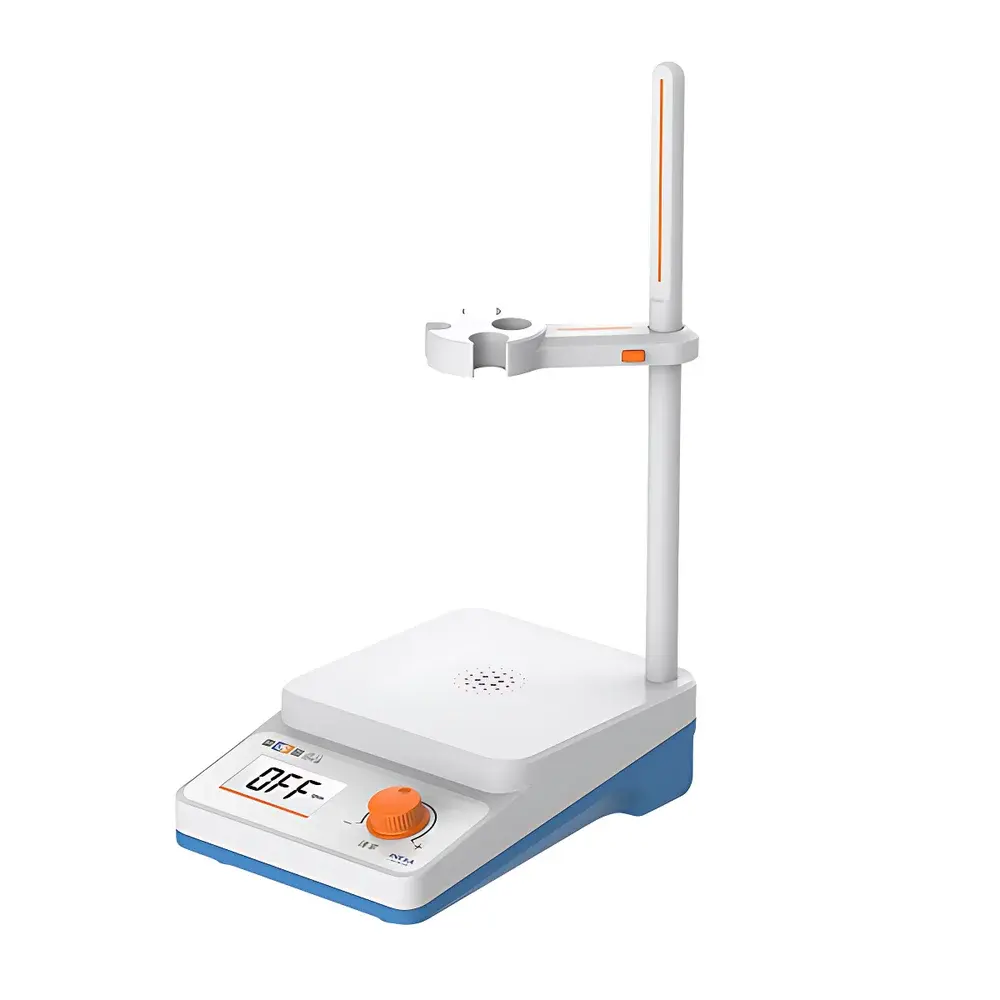
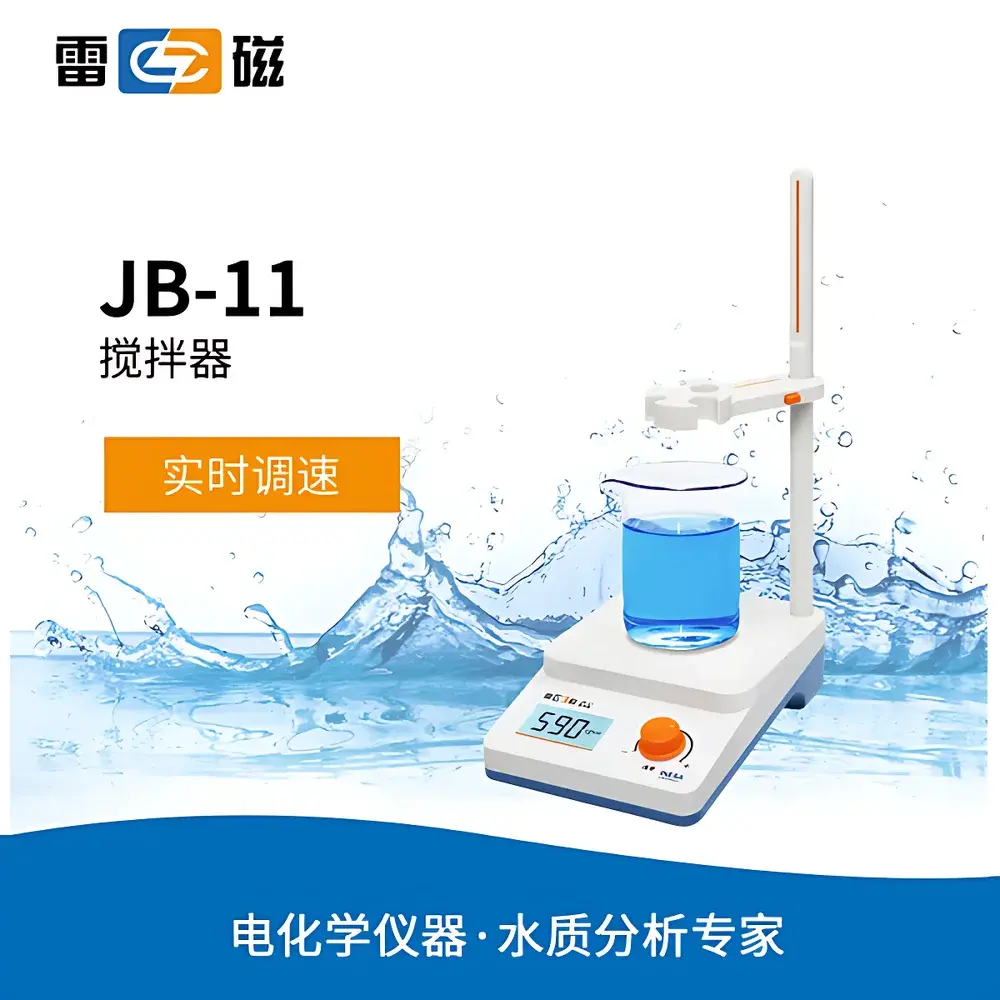
Leici JB-11 Magnetic Stirrer
| Brand | Leici |
|---|---|
| Origin | Shanghai, China |
| Manufacturer Type | Direct Manufacturer |
| Regional Category | Domestic (China) |
| Model | JB-11 |
| Instrument Type | Magnetic Stirrer |
| Maximum Stirring Volume | 1000 mL |
| Speed Range | 100–1800 rpm |
| Speed Display | Segment LCD |
| Speed Accuracy | ±5% or ±10 rpm |
| Stirring Plate Dimensions | 135 mm × 132 mm |
| Plate Material | PC + ABS |
| Stir Bar Included | φ6 × 20 mm |
| Operating Environment | 0–40 °C, ≤85% RH |
| Power Supply | AC 100–240 V input / DC 9 V output |
| Dimensions (L×W×H) | 135 × 195 × 55 mm |
| Weight | ~0.5 kg |
Overview
The Leici JB-11 Magnetic Stirrer is a compact, benchtop laboratory instrument engineered for reliable and repeatable liquid mixing in analytical, electrochemical, titration, and general chemistry applications. It operates on the principle of magnetic coupling: a rotating permanent magnet beneath the non-magnetic plate generates a time-varying magnetic field that induces synchronous rotation of a ferromagnetic stir bar immersed in the sample vessel. This contactless drive mechanism eliminates mechanical seals and shafts, ensuring low maintenance, minimal contamination risk, and consistent torque delivery across its operational speed range. Designed for routine use in academic teaching labs, QC environments, and small-scale R&D settings, the JB-11 delivers stable rotational control without thermal induction—its PC+ABS plate remains non-heated during operation, making it suitable for temperature-sensitive protocols where external heating is managed separately.
Key Features
- Adjustable speed control from 100 to 1800 rpm, enabling precise tuning for viscous solutions, low-volume micro-reactions, or high-shear dispersion tasks.
- Segment-type LCD display provides real-time, glare-resistant readout of set speed—no backlight required for standard lab lighting conditions.
- Memory function retains the last used speed setting; power-on defaults to that value, reducing setup time between sequential experiments.
- Engraved alignment markings on the stirring surface assist in centring glassware (e.g., beakers, Erlenmeyer flasks) to minimize orbital wobble and ensure coaxial stir bar rotation.
- Integrated electrode support bracket accommodates up to three standard 6-mm diameter electrodes—optimized for potentiometric titrations, pH monitoring, and redox measurements without requiring auxiliary clamps.
- Includes a standardized φ6 × 20 mm PTFE-coated magnetic stir bar with high corrosion resistance and uniform moment of inertia for consistent start-up behavior.
Sample Compatibility & Compliance
The JB-11 supports vessels up to 1000 mL in capacity, including borosilicate glass beakers, polypropylene centrifuge tubes, and quartz cuvettes—provided the bottom geometry allows efficient magnetic coupling. Its non-heated design complies with ISO/IEC 17025:2017 requirements for equipment used in accredited testing laboratories where thermal drift must be decoupled from mixing variables. While not certified to IEC 61000-6-3 (EMC) or UL 61010-1 as a standalone unit, its low-power DC operation (9 V, <1.5 W) ensures electromagnetic compatibility in shared instrumentation racks. The device meets GB/T 28813–2012 (Chinese national standard for laboratory stirrers) for mechanical stability, speed accuracy (±5% or ±10 rpm, whichever is greater), and electrical safety under normal operating conditions (0–40 °C, ≤85% RH).
Software & Data Management
The JB-11 is a manually operated, analog-control instrument with no embedded firmware, network interface, or data logging capability. As such, it does not require software installation, driver configuration, or cybersecurity validation. This architecture aligns with GLP and GMP environments where simplicity, auditability, and absence of uncontrolled digital interfaces are prioritized. All operational parameters—including speed setting, duration, and vessel type—are recorded manually in lab notebooks or LIMS-compatible electronic records. No FDA 21 CFR Part 11 compliance features (e.g., electronic signatures, audit trails) are implemented, consistent with its classification as a Class I general-purpose laboratory accessory.
Applications
- Homogenization of aqueous and organic-phase reagents prior to spectroscopic analysis (UV-Vis, FTIR).
- Continuous agitation during potentiometric or conductometric titrations using dual-reference and indicator electrodes mounted on the integrated bracket.
- Preparation of calibration standards and dilution series requiring uniform solute distribution without foaming or splashing.
- Supporting electrochemical cell setups, including three-electrode configurations for cyclic voltammetry and chronoamperometry in non-thermostatted cells.
- Low-energy mixing in microbiological media preparation where shear-sensitive components (e.g., enzymes, antibiotics) must remain intact.
FAQ
Does the JB-11 include a heating function?
No. The JB-11 is a non-heated magnetic stirrer. Temperature control must be achieved externally using a water bath, heating mantle, or hotplate-stirrer combination.
Can it accommodate larger stir bars or custom geometries?
Yes—while the included φ6 × 20 mm stir bar is optimized for 100–500 mL volumes, users may substitute longer or cross-shaped stir bars (up to 40 mm length) provided they remain within the magnetic coupling envelope of the drive magnet.
Is the power adapter compatible with international voltage standards?
Yes—the supplied AC/DC adapter accepts universal input (100–240 V AC, 50/60 Hz), making it suitable for use in North America, EU, APAC, and other regions without additional transformers.
What maintenance is required for long-term reliability?
Routine cleaning of the PC+ABS plate surface with isopropanol and periodic inspection of stir bar coating integrity are sufficient. No lubrication or internal servicing is specified by the manufacturer.
How is speed accuracy verified during calibration?
Speed verification is performed using a non-contact optical tachometer referenced against the LCD display value at three points: 300 rpm, 900 rpm, and 1500 rpm—per GB/T 28813–2012 Annex B procedures.



